
News
Zamfara AAC Governorship Candidate, Others Defect To APC


Zamfara AAC Governorship Candidate, Others Defect To APC
Zamfara AAC governorship candidate, others defect to APC The state APC chairman urged the defectors to remain committed to the party’s development by promoting unity, peace and stability.
Alawmaker, Aminu Jaji (APC-Zamfara) has received former Zamfara Governorship Candidate of the African Action Congress in the 2023 election, Muhammad Kabir-Sani, into the fold of the All Progressives Congress, Zamfara State chapter.
Mr Kabir-Sani, defected along with members of ex-Peoples Democratic Party state House of Assembly candidates’ Forum.
The defectors with their supporters joined the APC through the Jajiyya APC political movement under the leadership of Isiyaka Ajiya-Anka.
They announced their defection to the APC with thousands of AAC and PDP members after a meeting with the lawmaker in his Gusau residence.
The former AAC governorship candidate said they were happy to join the APC under the Jaji Political Movement.
He said, “We are convinced with the performance and good representation of Aminu Jaji considering various developmental achievements he had recorded in his constituency and Zamfara State in general.’’
Also speaking, the representative of the PDP state house of assembly candidates’ forum, Ibrahim Labbo-Anka, said that they decided to join the APC because it remained the strongest political party in the state.
Mr Labbo-Anka stated, “We had fruitful discussions with mutual understanding with Hon. Aminu Jaji; so, we decided to join the APC, we will remain in the party for the development of our dear state.’’
Receiving the defectors, Mr Jaji, who is the Chairman, House Committee on Ecological Fund, commended them for joining the APC.
The federal lawmaker described the defectors’ action as a welcome development for the APC in the state and Nigeria in general.
He assured the defectors of fair treatment and good working relationships to enhance the capacity of the party in the state.

APC
Mr Jaji expressed confidence that the political experience and calibre of the defectors, especially their leaders, would boost the strength of the Jajiyya movement and the entire APC family in the state.
“I urge you to remain with APC and feel free to contribute to the best of your capacity for the development of the APC,” the lawmaker said.
Earlier, the state Chairman, APC-Jajiyya movement, Isiyaka Ajiya-Anka, described the movement as the strongest political group having active structure across the 14 local government areas of the state.
Mr Ajiya-Anka promised that the defectors would be engaged in the party’s activities without any discrimination.
He urged them to remain committed to the development of the party by promoting unity, peace and stability in the APC.










News
TIB Movement Demands Justice Over Former APC Women Leader Jamima Dutse Murdered at Her Bauchi Residence

TIB Movement Demands Justice Over Former APC Women Leader Jamima Dutse Murdered at Her Bauchi Residence
The Take-It-Back (TIB) Movement, Bauchi State Chapter, has condemned the murder of Mrs. Jamima J. Dutse, a former Zonal Women Leader of the All Progressives Congress (APC) in Bauchi South, and called on security agencies to immediately investigate the killing.
Eereporter.com
Dutse was reportedly attacked and killed by unknown assailants at her residence in Bauchi. In a statement dated October 4, 2026, signed by its Bauchi State Coordinator, Nazif Bashi, the TIB Movement expressed shock and outrage over the killing and commiserated with Dutse’s family, friends and associates.
The group described the killing as a “senseless act of violence” and said it raised concerns about the safety of residents in the state. “A society where citizens regardless of their political affiliations, gender, or status, cannot feel safe in their own homes is one on the brink of breakdown,” the group said.
It said the attack was not only against Dutse and her family but also against the peace, security and democratic fabric of Bauchi State.
The TIB Movement called on the Bauchi State Police Command, the Department of State Services (DSS) and other relevant security agencies to intensify efforts to identify and arrest those responsible for the killing.
It demanded the immediate constitution of what it described as a “dedicated, high-powered investigative panel” to investigate the murder.
The group also urged the security agencies to maintain transparent communication with Dutse’s family and the public by providing timelines and periodic updates on the progress of the investigation.

Breaking News
“Justice must not only be done; it must be seen to be done,” the statement said. “Those responsible for this murder must be brought to book and face the full wrath of the law to serve as a stern deterrent to criminal elements across the state.”
The group further called on the Bauchi State Government and security authorities to strengthen local security measures, surveillance and intelligence gathering across Bauchi metropolis and neighbouring local government areas.
The TIB Movement said such measures were necessary to address what it described as a rising tide of violent attacks in the state.
It also appealed to civil society organisations, trade unions, human rights defenders and residents of Bauchi State to demand accountability until those responsible for Dutse’s death are arrested and prosecuted. “The Take-It-Back Movement reaffirms its commitment to advocating for the rights, safety, and justice of all citizens,” it said.
“Silence in the face of tyranny and insecurity is complicity.”
Eereporter.com
NNPC Ltd Offers N66 Fuel Discount Throughout the Nation
The Nigerian National Petroleum Company Limited (NNPC Ltd.) has unveiled a nationwide ₦66 fuel discount promotion for customers using the NNPC Fuel App.
Eereporter.com
In a post obtained from its X handle on Friday, the promotion, which runs from October 1 to 7, is being held across NNPC stations nationwide as part of activities marking the period.
“The ₦66 Discount Promo is ongoing & the excitement is already happening across our stations nationwide!
“All over Nigeria, our customers are getting in on the action & there’s still time for you to benefit!
The promo runs from 1–7 October on the NNPC Fuel App,” the post read.
NNPC said customers across the country have already begun participating in the promotion, with highlights from the first day showing activities at several stations.
“Keep fueling, keep transacting and keep your eyes on our pages,” the post read.
NNPC
NNPC also shared moments from the first day of the promotion and said more pictures and activities from stations across the country would be released.
The company urged customers not to miss the opportunity to participate before the promotion ends on October 7.
The ₦66 discount offer is available through the NNPC Fuel App during the stated promotional period.
Eereporter.com
Economy
NAF, Innoson Vehicle Manufacturing (IVM) Sets for Partnership to Advance Indigenous Defence Capacity
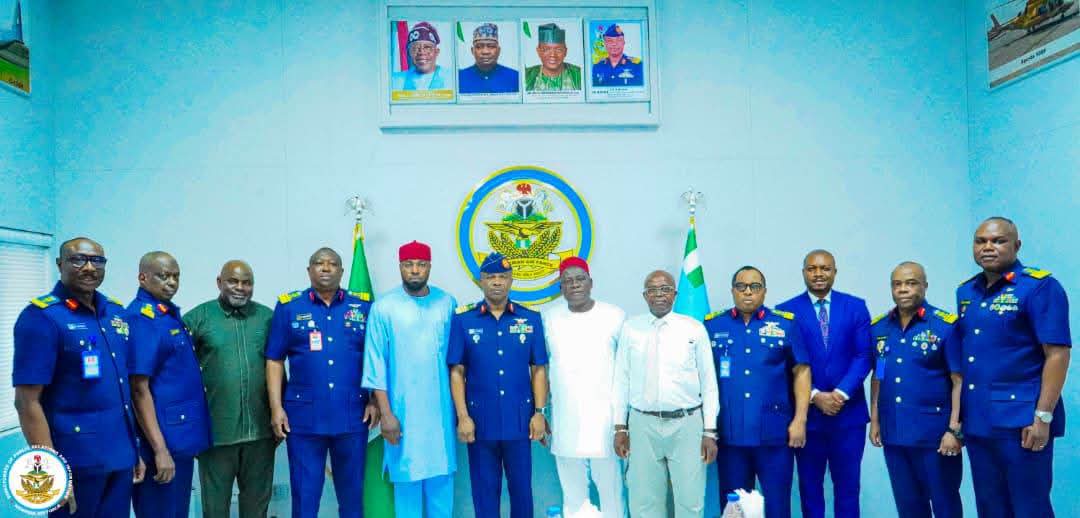
NAF, Innoson Vehicle Manufacturing (IVM) Sets for Partnership to Advance Indigenous Defence Capacity
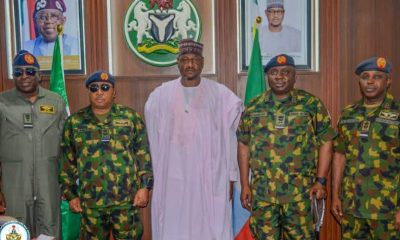
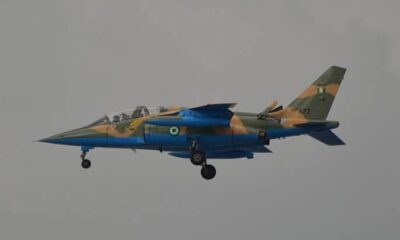
The Chief of the Air Staff (CAS), Air Marshal Sunday Kelvin Aneke, has expressed the readiness of the Nigerian Air Force (NAF) to explore a strategic partnership with Innoson Vehicle Manufacturing (IVM) to strengthen indigenous capacity in aircraft spares production, technology transfer and specialised technical training.
Eereporter.com
The CAS stated this on 29 September 2026 when the Chairman of IVM, Chief Dr Innocent Ifediaso Chukwuma, CON, paid a courtesy visit to him at Headquarters NAF, Abuja.
Discussions focused on leveraging IVM’s indigenous manufacturing capabilities to support NAF operational requirements and advance local content in the defence sector. Chief Chukwuma highlighted IVM’s interest and capability in the production of selected aircraft parts and spares, while also showcasing its CNG and electric vehicle manufacturing capabilities.
The CAS welcomed the initiative and reaffirmed NAF’s commitment to partnerships that promote local production, technology transfer and human-capacity development. He also expressed interest in exploring affordable vehicle acquisition options for NAF personnel through convenient payment arrangements, subject to further engagement and applicable procedures.

Innoson Vehicle Manufacturing (IVM)
The engagement underscores the CAS’s drive to harness indigenous innovation and local expertise to strengthen NAF capability and personnel welfare, while supporting Nigeria’s broader pursuit of technological self-reliance and industrial development.
Eereporter.com
-

 Crime1 year ago
Kogi Assembly Considers Law To Regulate Rent, Establish Control Board: Tenancy Law
-

 News2 years ago
Atiku Reveals Why He Failed To Pick Wike As Running Mate In 2023
-
 Akwa Ibom2 years ago
The Apostolic Church Gets New Territorial Chairman, Exco
-

 Crime2 years ago
Federal High Court Jails 2 For Vandalizing Transformer, Telecom Mast In Kogi
-

 News2 years ago
The Apostolic Church Gets New National President, Executive
-
 Akwa Ibom2 years ago
Umo Eno Commences Payment Of 80,000 Naira Minimum Wage With Arrears
-

 News2 years ago
Senator Natasha Returns To Senate With Husband Amid Seat Dispute
-

 Economy1 year ago
Kiyosaki: Is Tinubu’s Government Afraid Of Ibrahim Traore?