
Politics
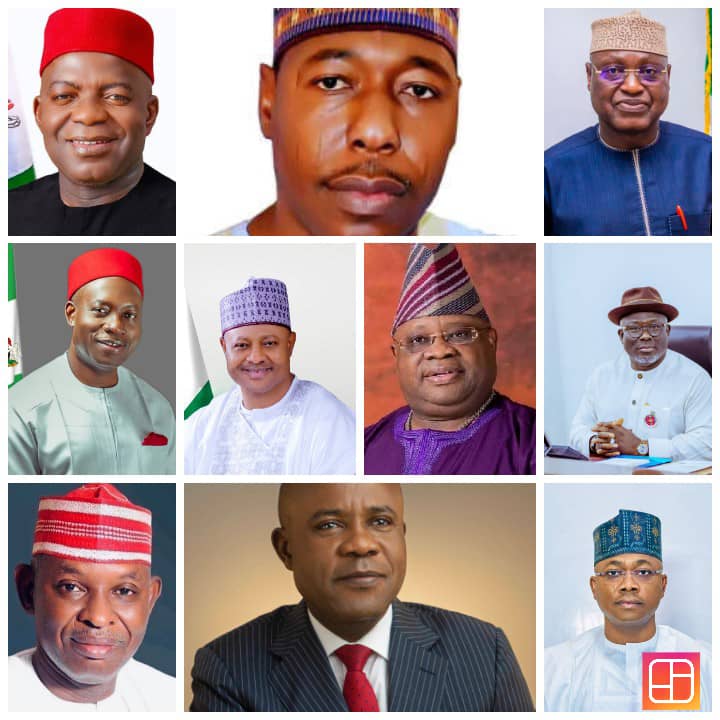
BREAKING: 2025 GATI Report: Abia, Borno, Ekiti, Anambra, Other Rank Performing States

BREAKING: 2025 GATI Report: Abia, Borno, Ekiti, Anambra, Rank Performing States
The Guild of Online Media Editors and Publishers (GOMEP) Nigeria has released the much anticipated 2025 Governance Accountability and Transparency Index (GATI) Report, with Abia, Borno, Ekiti, Anambra, Kaduna, Osun, Delta, Kano, Enugu and Kogi States emerging Top 10 performing states in the country.
The Report unveiled at a press conference in Abuja, the Nigeria capital territory marks the second edition of the annual Governance Accountability and Transparency Index developed by the GOMEP Nigeria, an umbrella body of more than 75 online media editors and publishers across Nigeria.
The annual report seeks to strengthen democratic governance by assessing how transparently and responsibly Nigeria’s 36 state governments conduct public affairs, while also reinforcing the media’s role as an impartial watchdog on governance, social justice and public interest.
Purpose of the Index
According to GOMEP Nigeria, the Governance Accountability and Transparency Index (GATI) was conceived to deepen good governance by placing greater scrutiny on the activities of state governments through measurable indicators that reflect transparency, accountability and responsiveness to citizens.
The 2025 index assessed all the 36 states using seven key measurable indices, namely:
1. Public Access to Information and Open Data Initiatives:
– Implementation of Freedom of Information (FOI) laws
– Government websites and online portals
-Government data portals
– Data formats and accessibility
2. Budget Transparency and Participatory Budgeting:
– Access to budget documents
– Clarity and accessibility of budget documents
– Details of budget expenditures
– Citizen engagement in budgeting processes
– Public hearings and consultations
3. Audit and Oversight:
– Independence of audit institutions
– Effectiveness of parliamentary oversight
4. Anti-Corruption Efforts:
– Effectiveness of Whistleblower protection laws
5. Government Responsiveness:
– Timeliness of government responses to citizen inquiries
– Citizen satisfaction surveys
6. Procurement Transparency:
– Publicly available procurement information
– Tender processes and contract awards.
7. Media Freedom:
– Press freedom
– Journalists’ safety and protection
Methodology Used
Presenting the report, the National President of the GOMEP Nigeria, Dr. Dozie Nwankodu, who is also the Publisher of GlobalReporters.Ng stated that the group adopted five internationally recognised methodologies in evaluating the states.
These include:
Surveys conducted among citizens, businesses and government officials;
Document Reviews of publicly available government policies, laws and records;
Expert Assessments involving academics and civil society organisations;
Data Analyses using statistical models from multiple sources; and
Index Aggregation using weighted averages to determine final scores.
Dr. Nwankodu explained that each of the seven indices was scored independently before the Average Index Point for each state was determined.
“Points were awarded to states based on merit across the seven indices. The final index mark for each state was obtained by adding the scores across the indices and dividing by seven,” he said.
He further explained the grading system:
85% – 100%: Category A – Exceptional Performance
65% – 84%: Category B – Strong Performance
45% – 64%: Category C – Average Performance
25% – 44%: Category D – Poor Performance
0% – 24%: Category E – None Performance.
Rigorous Data Collection Process
Speaking on the credibility of the report, the Chairman of the Appraisal Committee and Publisher of Naija NewsHouse, Comrade Dominic Edem, said the evaluation process was rigorous and adhered to global best practices. He disclosed that the committee consisted of 36 professionals drawn from the media, academia and civil society, painstakingly analysed data gathered from across the country.
“Our approach combined both quantitative and qualitative methods, including surveys, interviews and analyses of publicly available information across the states,” Edem said.
According to him, primary data were collated by field agents across the 36 states within a 90-day period, generating 350 data points per state, amounting to 12,600 data entries nationwide.
He added that the data were compiled by the Information and Data Desk of GOMEP before being reviewed by the Appraisal Committee, which carefully analysed them before submitting the final report to the general house – membership of the GOMEP Nigeria for adoption.
Comparative Performance of Category A States (Exceptional Performance) in the 2025 GATI Report To The Previous Year, 2024 Report
From the Report obtained by newsmen, during the unveiling of the GATI 2025 Report, a comparative analyses of the 2024 First Edition, and the 2025 Edition revealed notable improvements in governance performance across several Nigerian states, with four states (Abia, Kaduna, Kano and Kogi), which hitherto were not in (Category A – Exceptional Performance) bracket, advancing into the position, while six others consolidated their positions.
Abia State recorded a significant progression between the two editions. In the 2024 report, the state ranked under Category B (Strong Performance) with an Average Index Point of 82.2. But in the 2025 edition, Abia advanced to Category A (Exceptional Performance) with 90.0 points, representing an increase of 7.8 points, or a 9.49% improvement in its governance performance score.
Borno State, which already occupied the Exceptional Performance category in 2024 with an Average Index Point of 86.3, further strengthened its standing in 2025. The state achieved 89.7 points, reflecting a 3.4-point increase and a 3.94% improvement, thereby consolidating its position among the leading performers.
Ekiti State demonstrated steady advancement, improving from 86.3 points in 2024 to 89.6 points in 2025. This 3.3-point increase represents a 3.82% growth in its governance performance index.
Anambra State also recorded measurable progress, rising from 86.3 points in 2024 to 89.3 points in 2025, representing a 3.0-point increase and a 3.47% improvement.
Kaduna State recorded one of the most notable upward movements among the states that previously fell below Category A. In 2024, Kaduna ranked in Category B (Strong Performance) with an Average Index Point of 81.7. By 2025, it had risen to Category A (Exceptional Performance) with 89.3 points, reflecting a 7.6-point increase, equivalent to a 9.30% improvement.
Osun State posted notable gains as well, increasing from 86.3 points in 2024 to 89.3 points in 2025, a 3.0-point rise representing a 3.47% improvement.
Similarly, Delta State improved from 86.3 points in 2024 to 89.3 points in 2025, marking a 3.0-point increase and a 3.47% growth in its index score.
Kano State recorded one of the most remarkable improvements in the index. In the 2024 Report, the state was placed in Category C (Average Performance) with an Average Index Point of 58.6. In the 2025 Edition, however, Kano surged to Category A (Exceptional Performance) with an Average Index Point of 89.1. This represents an impressive 30.5-point increase, translating to a 52.05% improvement in governance performance.
Enugu State maintained its position within the high-performing tier, moving modestly from 86.3 points in 2024 to 86.4 points in 2025. This reflects a 0.1-point increase, equivalent to a 0.12% improvement, indicating stability in governance performance.
Perhaps the most dramatic improvement was recorded by Kogi State. In the 2024 report, the state ranked in Category D (Poor Performance) with an Average Index Point of 33.9. In the 2025 edition, however, Kogi surged to Category A (Exceptional Performance) with 85.5 points. This represents an extraordinary 51.6-point increase, translating to a 152.21% improvement—one of the most significant governance performance turnarounds captured in the index.
Focus On Governance Transparency
Also speaking at the event, the Deputy National President of GOMEP and Publisher of Satcomm Online, Luqman Oluwatoyin Bolakale, noted that the index specifically examined governance models adopted by state governments and how transparency and accountability were embedded in their programmes.
“For there to be meaningful development, transparency and accountability must remain the cornerstone of governance. All we did was examine how state governments performed within those parameters, knowing that good governance reflects clearly when those two indicators are present in public institutions,” Bolakale stated.
Overcoming Field Challenges
The Secretary of the Appraisal Committee and Publisher of Marshal Newslink, Comrade Ndiana Okon acknowledged that security challenges in some parts of the country posed difficulties during the data gathering process, causing the delay in the release of the 2025 Index Report. However, he commended the dedication of GOMEP’s field agents who were able to obtain credible data from all the states, ensuring the reliability of the final report.
He also disclosed that the top 10 state governors recognised in the 2025 Index Report would receive Certificates of Merit from GOMEP in recognition of their commitment to governance transparency and accountability.
Okon further noted that the index will remain an annual exercise designed to encourage healthy competition among states and promote better governance across Nigeria.
Call For Greater Transparency
In his closing remarks, the National President of the GOMEP, Dr. Dozie Nwankodu, called on government institutions at all levels to embrace transparency and accountability as the foundation of democratic governance.
He also revealed that the organisation plans to extend the assessment framework to Federal Ministries and the National Assembly in future editions.
Overall, GOMEP’s 2025 GATI Report highlighted a broad upward trajectory in governance standards, with several states not only improving their index scores, but also transitioning into higher performance categories.
These gains, according to the GOMEP, signal strengthening commitments to accountability, transparency, and institutional performance, key pillars for sustainable governance and public sector credibility.
The press briefing was attended by members of GOMEP, media practitioners, members of the academia, and representatives of civil society organisations.
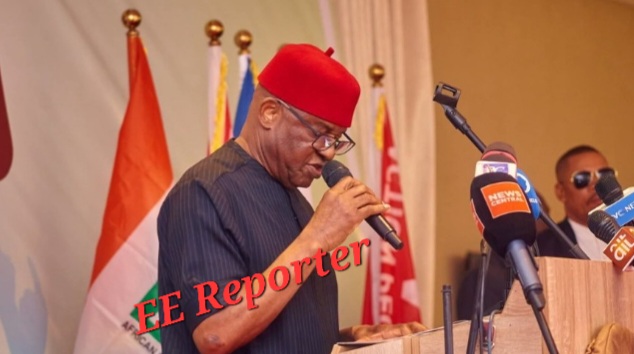
ADC National Chairman David Mark Address At The Opposition Summit In Ibadan
Entire communities are uprooted, families shattered, and livelihoods destroyed. Fear has taken the place of freedom, and uncertainty has replaced hope.
Distinguished leaders of the opposition,
Protocols:
1. Our gathering here today is an urgent response to our nation’s call to patriotic duty. My prayer is that history will remember us, that when the nation cried out to be rescued, we answered, that when we heard the agonies of mothers that just buried their children killed by bandits, we answered, that when we saw the silent agonies of fathers and husbands who watched their daughters and wives raped by terrorists, we answered, that when struggling workers could not afford to transport themselves to work, we answered, that when children went to bed hungry, we answered, that when proud, hardworking citizens were turned to beggars; we answered. History will ask, what did we do? What role did we play? All of us here and millions who are with us but for one reason or the other are not here physically will answer positively.
2. The call to rescue Nigeria is not a mere opposition slogan. The evidence is there for all of us to see. Across the length and breadth of our country, insecurity has become a defining feature of daily life. From the avoidable protracted insurgency and terrorism, to the relentless banditry and mass kidnappings, to the steady rise of violent crimes in our urban centres, Nigeria faces a historic challenge.
3. The statistics are frightening. In 2025 alone, Nigeria recorded more than 12,000 conflict-related deaths. This figure exceeds those of countries who are actively at war, like Syria, Iraq and Yemen, combined. Nigeria is now ranked 4th in global terrorism index. Despite all the claims and posturing by government, the situation continues to get worse. While global terrorism deaths fell by 28% in 2025, Nigeria’s increased by 46%. At least 15 Nigerians are killed daily, while about 19 people are abducted. In the first three months of this year alone, about 1,400 Nigerians have been killed or abducted in different parts of the country. Entire communities are uprooted, families shattered, and livelihoods destroyed. Fear has taken the place of freedom, and uncertainty has replaced hope.
4. Yet, the government, whose primary duty it is to protect the citizens, carry on with a shocking indifference as if nothing is wrong. We are a nation that is constantly in mourning, a nation burying its citizens with alarming regularity, a nation crying out for leadership and protection. While these killings and kidnappings continue relentlessly, the APC led government is behaving as if all is well. The government is preoccupied with election matters and politics of self-succession.
5. The essence of democracy is to provide the people with a choice. When one government fails, like this government has woefully done, the constitution of our land grants the people the power to vote that government out. However, with what we have witnessed in recent times, the ruling party has done everything to deny the people of Nigeria this very right to seek an alternative. In the last three years, this government has launched major attacks on the opposition parties, all in a bid to deny the people the right to choose. They want to foist a one-party state on Nigeria. Institutions that should safeguard our freedom and protect the will of the people are increasingly under assault. The right of citizens to freely choose their leaders is being undermined. The independence of democratic institutions is being compromised. In fact, it is becoming increasingly difficult to describe what we have today as a fully functioning democracy in both form and substance.
6. Our mission to recue Nigeria is a task that must be done. When we, as members of the opposition, say that our singular objective is to rescue Nigeria, we are neither exaggerating nor engaging in political theatrics. The task before us is nothing short of a national rescue mission. It is a mission born out of necessity, compelled by the suffering of our people, and driven by the urgency of the moment.
7. I must emphasise therefore, that this responsibility is far more important than partisan sentiment, personal interest or personal ambition. What is at stake; the very survival and restoration of our country, is greater than every single one of us. It involves sacrifice by every member in the opposition. I have no doubt in my mind, that no single opposition political party, no matter how strong, can confront a system so entrenched and so determined to retain power at all costs. What we are faced with is a regime that has shown, in both words and in deeds, a willingness to weaken democratic structures and suppress opposition voices. Let’s not make a mistake about this. The move towards a one-party state is real. It has never happened before in this country, and it will not happen in our generation.
8. The government has argued that it is not their duty to help build the opposition. They are right. And we seek no such favour from them. They call what they are doing to opposition political parties ‘strategy’. I call it tyranny. But is it their duty to destroy the opposition as they have brazenly attempted to do? Can one do what they have been doing and still claim to believe in democracy, or to be a democrat? The answer is certainly NO.
9. We must not be in doubts. The forces that have sought to destabilise our various political parties will not stop. Even as we gather here, they are already scheming how to further undermine us and divide our ranks and sow seeds of discord among us. But we on our path must remember where the rains began to beat us. We must remember how we got to where we are today. We must remember what has brought us here. We must remain clear that we cannot confront the future as fragmented entities. We must be united to salvage our nation. It is for these reasons that this gathering and our dealings must be anchored on honesty and integrity. We must put all our cards faced up on the table and speak truthfully to one another. There must be no hidden agendas, no last-minute surprises, and no room for distrust. Perhaps, more than anything else, the success of our collective effort depends on our ability to build and sustain trust.
10. We are racing against time, and operating within a limited window. The urgency of our situation does not permit repeated mistakes. We must be willing to rise above narrow sentiments and reject petty parochialism that has historically divided the oppositions in this country. This is the time to rewrite the story of coalition building in Nigeria.
11. The record of the APC government is one of failure. What remains in its wake is an aggressive reliance on propaganda and a sustained assault on opposition voices. However, we will not engage in a contest of propaganda. We will not substitute truth with noise. Their reliance on propaganda only exposes a deeper problem, an inability to accept responsibility and a lack of integrity. Nigerians are watching, and they have seen through the smokescreen and the lies. They recognize a government that has failed to meet their expectations and shown no empathy for their sufferings.
12. This is why, as we have repeatedly maintained, the struggle before us is no longer a conventional political contest. This contest is between the ruling party APC, and the Nigerian people. APC is contesting against the mother who has just buried her child, against the father who works tirelessly yet cannot feed his family, against the young graduate who sees no future, and against the pensioner who has been abandoned after decades of service. We are on the side of the people. Therefore, the Almighty God is on our side.
13. Recent changes within the economic management team are themselves a tacit admission of failure. When a system is functioning effectively, you do not replace leadership. Reshuffling cabinet at this late hour cannot save them from the verdict of the people.
ADC National Chairman David Mark
14. Distinguished Ladies and gentlemen, as I conclude, let me use this opportunity to emphasise once again, that the credibility of our democracy rests on the neutrality and integrity of its electoral institutions. When the referee clearly and proudly wears the jersey of one of the teams in a match he should be officiating, then the legitimacy of the entire process is undermined. In this instance, Nigerians have lost confidence in the electoral body, INEC. INEC is no longer an impartial umpire. And if nothing changes, Professor Joash Ojo Amupitan is about to preside over the most distrusted election in Nigerian history. The consequences are better left to imagination.
15. Leaders of our parties, let it be said loud and clear that at a defining moment in our history, when Nigeria stood at the edge of uncertainty, we did not falter. We did not allow personal ambition to override the desire of Nigerians for a better life. We did not collapse under the temptation of petty partisanship or self-satisfying ambitions. Instead, we chose unity over division, sacrifice over self, and country above all.
16. Let this summit go down in history as the moment when everything changed. Let this be the beginning of a decisive movement, a movement that will restore the dignity of our democracy, secure the lives of our people, and rebuild the foundations of our nation.
17. I am very confident that if we stand together with conviction, discipline, and sincerity, no force will be strong enough to stop the will of the Nigerian people. May history remember us for our courage, our sacrifice and our resolve to save our democracy and our country.
May it record that when Nigeria called, we answered with unwavering commitment, when our people needed us, we did not falter and we did not fail them.
18. And may God bless the Federal Republic of Nigeria.
APP inaugurates LG, ward excos in Imo
Action Peoples Party (APP)
The Action Peoples Party (APP) on Saturday inaugurated its executive committees for the Ideato North and Ideato South Local Government Areas of Imo, declaring itself the main opposition party in the state.
The party also inaugurated its executives in the 27 wards of the two LGAs, comprising 14 wards in Ideato North and 13 in Ideato South.
In a speech at the ceremony held in Akokwa, Ideato North LGA, the lawmaker representing Ideato North/Ideato South Federal Constituency, Ikenga Ugochinyere, vowed to “aggressively” challenge the ruling All Progressives Congress (APC) in the upcoming elections.
Mr Ugochinyere said, “Today in Imo, our party is the biggest opposition political party. APC has eight House of Representatives members, while our party has two.
“That makes APP the leading opposition party with a lot of prospects in terms of elected officials, registered membership and the way we have organised ourselves.
Eereporter.com
“It is a courageous achievement in just a few weeks of the party in the state.”
The lawmaker further said that APP was “strategically mobilising grassroots to aggressively confront the APC and seize electoral control across the state”.
He highlighted significant constituency progress despite funding gaps.
According to him, most of the projects undergoing execution in the constituency, including water boreholes, transformers, and the renovation of health centres in Osina, were nearing completion.
He said that he would soon inaugurate a month-long project to showcase the party’s “courageous achievement”.
Handing over the party flags to the new party executive members, Ugochinyere advised them to “mobilise and expand” their polling unit structures to ensure victory.
“The fate of this party is now in your hands,” he said, emphasising the need for their commitment to the goal.
He warned that his party was ready to resist any electoral process short of a free, fair and peaceful election.
APP inaugurates LG, ward excos in Imo
The National Leader of the party, Sylvester Duruaku, also addressed the new officials, tasking them with “absolute” discipline.
“Your job is to ensure that the party wins all the seats,” Duruaku charged the executive members.
He further charged the excos and party chieftains to guard against “unnecessary rancour and disunity”.
He encouraged them to confront their challenges as one united family.
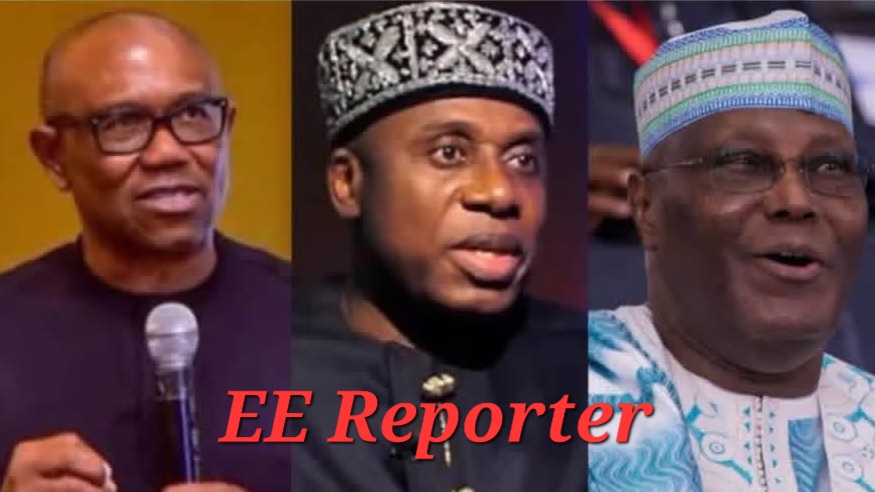
Nigerians React As Opposition Parties Plan Single Presidential Candidate For 2027
Peter Obi, Rotimi Ameachi and Atiku abubakar
Several Nigerians have taken to social media in reaction to plans by opposition parties, including the Peoples Democratic Party (PDP) and the African Democratic Congress (ADC), to present a single presidential candidate to challenge President Bola Tinubu in the 2027 election.
The parties reached the agreement at the end of a national summit of opposition party leaders held in Ibadan on Saturday.
An X user, @U_Rochas, said, “The agreement of the opposition parties to field one candidate in the 2027 presidential election is a brutal checkmate to Tinubu. I said earlier that there is a way someone plays the game and ends up playing himself. BAT has played himself.”
Another X user,@firstladyship, wrote, “Opposition parties have decided to field only one presidential candidate. Asiwaju has succeeded in uniting the opposition. Like the ‘Doctrine of Necessity’ that transferred powers to GEJ, Ibadan Declaration has entered the history books. Historians should take note of epoch event.”
A verified X user, @drkenon2, also noted that “Participating opposition parties in Nigeria, after deliberations on the existential threats & challenges we face under the oppressive APC, have resolved to field one presidential candidate in 2027.”
Nigerians React
@OurFavOnlineDoc, also shared that “The main opposition parties in Nigeria have agreed to field one presidential candidate! It’s time to unite to fight the devil,” the user wrote.
eereporter.com
Key opposition figures present at the Ibadan meeting included former Vice President Atiku Abubakar, former Anambra State Governor Peter Obi, former Senate President David Mark, former Kano State Governor Rabiu Kwankwaso, and former Osun State Governor Rauf Aregbesola, among others.
-
 Crime12 months ago
Kogi Assembly Considers Law To Regulate Rent, Establish Control Board: Tenancy Law
-

 News1 year ago
Atiku Reveals Why He Failed To Pick Wike As Running Mate In 2023
-
 Akwa Ibom1 year ago
The Apostolic Church Gets New Territorial Chairman, Exco
-

 Crime1 year ago
Federal High Court Jails 2 For Vandalizing Transformer, Telecom Mast In Kogi
-
 News1 year ago
The Apostolic Church Gets New National President, Executive
-
 Akwa Ibom1 year ago
Umo Eno Commences Payment Of 80,000 Naira Minimum Wage With Arrears
-

 News1 year ago
Senator Natasha Returns To Senate With Husband Amid Seat Dispute
-
 Economy12 months ago
Kiyosaki: Is Tinubu’s Government Afraid Of Ibrahim Traore?