
News
The Man Who Saw Tomorrow: Senator Akpabio And The Uncommon Politics Of Certainty

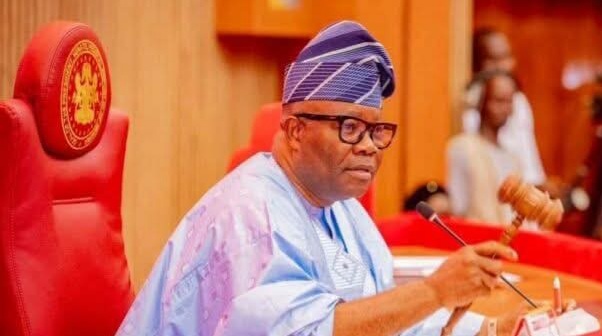
The Man Who Saw Tomorrow: Senator Akpabio And The Uncommon Politics Of Certainty
By
Hon Eseme Eyiboh
Eereporter.com
Let us begin with a confession. There is something unsettling about a politician who no longer appears to struggle.
In the turbulent theatre of Nigerian politics, where noise is often mistaken for relevance, where primaries resemble wrestling contests and delegate management demands the instincts of a hostage negotiator, a man who walks in unopposed does not merely win. He transforms the entire contest into a rehearsal.
On Monday, May 18, 2026, at Methodist Primary School, Ukana, in Essien Udim Local Government Area, Senator Godswill Akpabio did exactly that. No contest. No drama. No nervous counting of votes. He simply emerged as the candidate of the All Progressives Congress for the Akwa Ibom North West Senatorial District without a single challenger.
While many politicians remain trapped in the exhausting rituals of horse trading, factional bargaining, and survival politics, Akpabio’s good works delivered something far rarer in Nigeria’s political environment than gold itself. Absolute consensus.
To the casual observer, an unopposed return may suggest the absence of competition. That would be a dangerously shallow interpretation.
Those familiar with the political phenomenon long associated with the “Uncommon Transformer” understand the distinction clearly. An unopposed ticket does not mean nobody desired to contest. Politics naturally attracts ambition the way light attracts insects. Power always generates interest. Influence always provokes aspiration.
What an unopposed return truly means is far more significant: potential challengers surveyed the landscape, studied the numbers, weighed the networks, measured the emotional connection between the man and the political structure around him, and quietly concluded that the road to victory simply did not exist.
There is a profound difference between lack of opposition and the collapse of viable opposition
Why is there no road to victory for others? Because what Akpabio has built in Akwa Ibom State in general and Akwa Ibom North West in particular is no longer merely a political structure. It is a fortress. Its walls are not made of concrete. They are made of cultivated loyalty. Enduring networks. Strategic generosity. And the unspoken understanding that confronting him politically is not simply difficult. It is often futile and absurd.
The atmosphere at the ward centre resembled less a political exercise and more a carnival of affirmation. Supporters, community leaders, women groups, youths, and party faithful gathered not to determine an outcome but to endorse a grace carrier already settled in the public imagination. The votes were counted without end. The votes were celebrated.
Here is the remarkable part.
The whispers surrounding Akpabio’s dominance do not come only from admirers. They come from seeming opponents too.
Eereporter.com
They do not fear his voice. They fear his results. They do not tremble at confrontation. They confront something more sobering: the recognition that within his political territory, the arithmetic has been solved with almost clinical precision.
While others are still assembling coalitions, Akpabio consolidated his long ago. While rivals continue calculating delegate figures, he has already moved to the next question: what happens after victory? How does political power translate into enduring relevance and measurable impact?
That is the distinction between a career politician and a political architect. One chases office. The other shapes the terrain on which the chase itself occurs.
Since assuming office as President of the 10th Senate, Akpabio has projected a measure of stability within the Red Chamber. That should not be understated.
The Nigerian Senate has earned a reputation for turbulence over the years. Leadership rebellions. Internal fractures. Floor dramas that generate headlines while weakening governance and social democratic structures. Against that backdrop, a Senate President capable of maintaining institutional stability without recurring crises becomes more than merely effective. He becomes uncommon.
His admirers see in him a politician who has consistently combined institutional authority with emotional loyalty from his base through the National to International arena. From Governor to Minister to Senate President, his rise is framed as the journey of a man who understood tomorrow before others arrived there. A politician deeply conscious of timing, alignment, and the delicate craft of converting social capital into durable influence and uncommon power (political capital).
This point matters enormously. Political capital is easy to squander. This point matters enormously. Political goodwill is easy to destroy. Many politicians exhaust it through arrogance, exclusion, or the endless pursuit of personal advantage. But Akpabio appears to understand something deeper about leadership: goodwill grows when people genuinely feel seen, valued, included, and carried along.
Over the years, he has cultivated relationships not merely through politics, but through accessibility, generosity of spirit, loyalty to associates, and an unusual ability to make people feel remembered even in the midst of high office. That is why his support structure often appears less like a coalition held together by convenience and more like a community bound by shared experience and enduring personal connection.
What some interpret merely as political dominance may actually be the long-term harvest of sustained human investment.
And perhaps that explains the ease with which the field gradually cleared around him. Not because opposition was forcibly silenced, but because many within the political environment saw little wisdom in disrupting a consensus built around continuity, stability, experience, and an existing relationship of trust.
His commitment to continue working closely with President Bola Ahmed Tinubu and Governor Umo Eno reinforces a broader message of continuity and strategic alignment. At a time when fragmentation remains the temptation of many ambitious actors, Senator Akpabio has chosen coordination. That is not a weakness. It is political arithmetic.
And this is where the conversation shifts from the present to the near future. The same political capital that secured his senatorial return without resistance is not a one-use currency. It accumulates. It compounds. The goodwill he has cultivated, the equilibrium he has maintained, and the pragmatic preference for results over rhetoric are not merely tools for another Senate term. They form the foundation of something larger and forthcoming.
The crystal ball is not required to observe the trajectory. A Senate President who secures his own return effortlessly, stabilises a chamber historically associated with instability, aligns himself with the centre of national power grid while maintaining grassroots legitimacy, is a Senate President who has solved one of Nigerian politics’ most difficult equations.
He has demonstrated to his colleagues that he can deliver. He has shown the party hierarchy that he can be trusted. He has reassured constituents that proximity to power has not disconnected him from them.
This combination is rarer than any single attribute standing alone. So when the 11th Senate eventually convenes and the question of leadership emerges once again, the conversation may prove shorter than many anticipate. Not because there will be no interested contenders. There always are. But because the arithmetic of loyalty, institutional experience, strategic alignment, and demonstrated political capacity will already have completed its quiet work.
Akpabio has not formally declared interest in leading the 11th Senate. He does not need to. The declaration already exists in the pattern of his movements, the stability of his stewardship, and the political field he has cleared without visible strain. It is simply the discipline of reading political signs as they present themselves* .
In the end, Nigerian politics rewards those who understand the people more deeply than those who merely master performance and noise.That is not sentimentality. It is a political reality.
A politician capable of delivering his constituency without violence, panic, or emergency intervention is a politician who understands something fundamental: power is never truly declared. It is demonstrated. And it is demonstrated most convincingly when nobody steps forward to challenge it.
On that Monday in Ukana, the drums rolled. Praises echoed across the gathering. And the political message arrived without ambiguity. In Akwa Ibom North West, the conversation has moved beyond opposition. What remains is an audience waiting to see the next chapter unfold without ceasing.
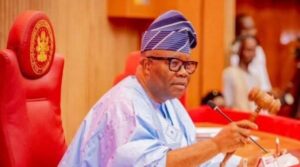
Akpabio
Senator Godswill Akpabio has once again reminded observers that in certain political spaces, dominance is not always loud.
Sometimes, it is simply complete. And in the intricate chessboard of Nigerian politics, where many players are still learning how the pieces move, that level of mastery remains rare, consequential, and deeply potent.
The man who saw tomorrow understood something else too. The loudest voice in the room is rarely the one that prevails.
The one that prevails is the one that no longer needs to shout because everybody already understands. And that is what Senator Godswill Akpabio has demonstrated that he is the man who saw tomorrow.
Rt Hon Eseme Eyiboh mnipr is a former member and Spokesperson of the House of Representatives and currently Special Adviser, Media/Publicity and official Spokesperson to the President of the Senate.
Eereporter.com






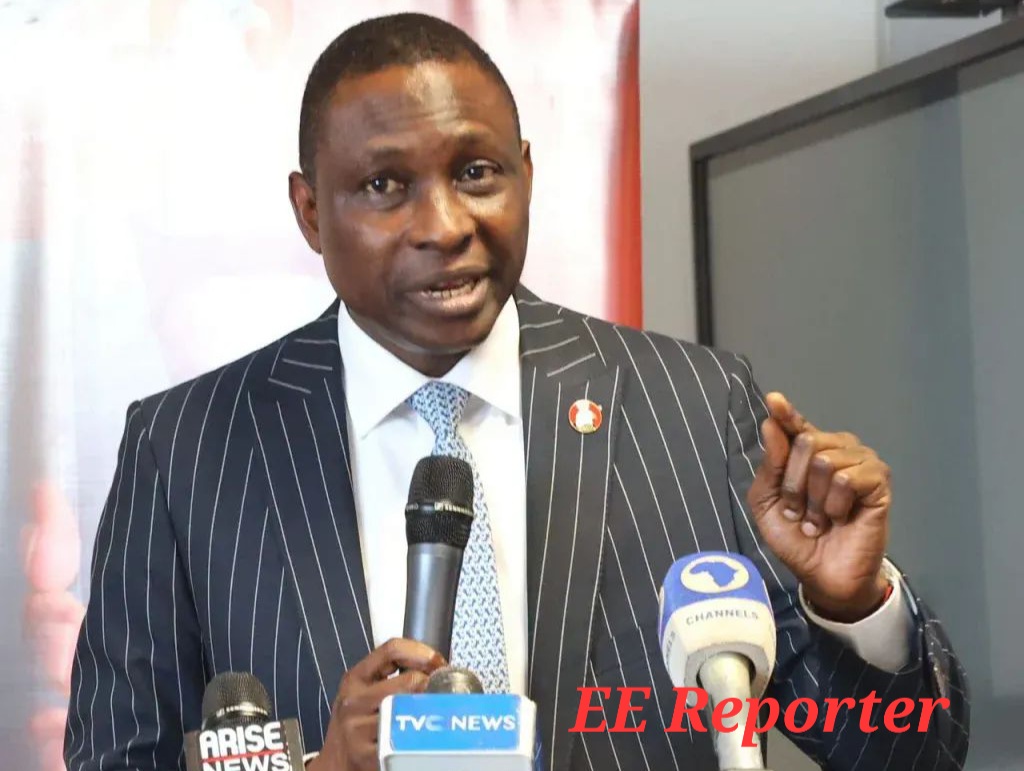
Ola Olukoyede Tasks Youths on Financial Literacy, Warns Against Negative Peer Pressure
The Executive Chairman of the Economic and Financial Crimes Commission (EFCC), Mr Ola Olukoyede, has urged Nigerians, particularly young people, to remain vigilant against financial scams, protect their personal financial information and embrace ethical financial practices.
Eereporter.com
Olukoyede gave the charge on Wednesday, November 25, 2026, at the grand finale of the Access Bank Regulatory Compliance Thought Leadership Initiative, themed “Spot the Scam,” and a debate competition involving 100 schools across Lagos State
The competition , held in Victoria Island, Lagos, focused on discussions about money laundering, cybercrime and the influence of social media.
Represented by Deputy Superintendent of the EFCC, DSE Titilola Tokan-Lawal, the EFCC Chairman described the theme as timely, given the rapid advancement of technology and its growing influence on communication, social interactions and business transactions.
He noted that while technology had created enormous opportunities, it had also provided platforms for cyber-enabled crimes and financial scams, threatening Nigeria’s economy and the livelihoods of victims.
“While technology had created enormous opportunities, it has also provided platforms for cyber-enabled crimes and financial scams, which threaten Nigeria’s economy and undermine the livelihoods of victims,” he said.
Olukoyede further warned that young people were particularly vulnerable to cyber-related crimes, stressing the need to introduce financial literacy at an early age to equip them with the knowledge required to make informed financial decisions.
On ethical financial behaviour, he cautioned young people against internet fraud, a.k.a yahoo-yahoo, examination malpractice for financial gain, and allowing their bank accounts to be used for money laundering or other illicit financial transactions.
He emphasised that integrity remained fundamental to genuine success, noting that ill-gotten wealth often come with consequences.
“Money gotten the wrong way will finish the wrong way. But money earned with honesty brings peace,” he said.
In a related development, Olukoyede also urged youths to resist negative influences, shun criminality and embrace integrity, discipline and responsible decision-making.
He gave the charge at the Positive Role Models Conference for Boys 2026, organised by the KNOSK Charity Education Initiative in Lagos State.
Speaking through the Head of Public Affairs, Lagos Directorate 1, Deputy Commander of the EFCC, DCE Ayo Oyewole, the EFCC Chairman identified peer pressure as a major factor influencing the decisions and behaviour of young people.
He warned that negative associations could expose young people to academic failure, drug abuse, cultism, violence, cybercrime, internet fraud and other criminal activities.
EFCC
According to him, many young people had jeopardised their education, freedom, reputation and even their lives by allowing negative peer influence to shape their decisions.
“Some young people have lost their education, freedom, reputation and even their lives because they allowed negative peer influence to determine their decisions. Not every invitation deserves acceptance, not every trend deserves imitation and not every friendship deserves your loyalty,” he cautioned.
He therefore encouraged the boys to be mindful of the friends they keep and surround themselves with positive-minded individuals who would inspire them to pursue academic excellence, develop leadership skills and uphold good values.
Eereporter.com
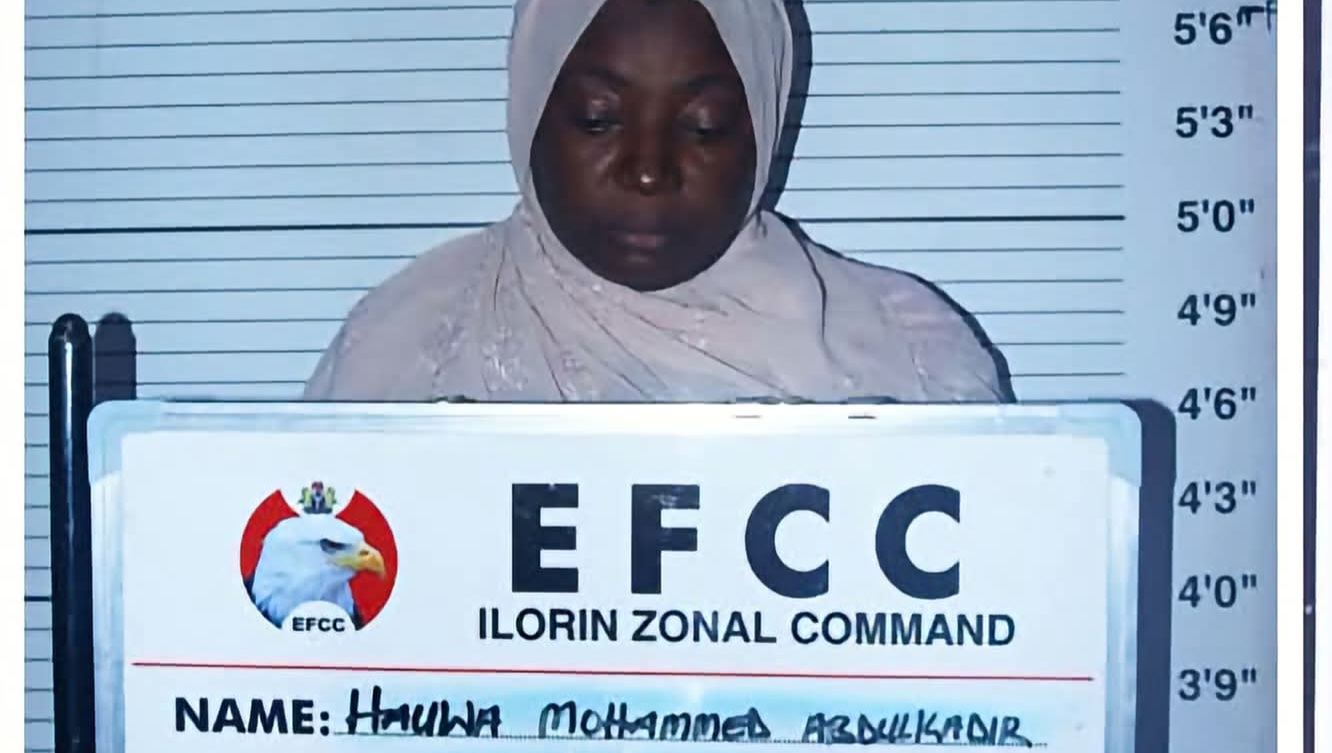
EFCC Arraigns Fake Visa Agent Hauwa Abdulkadir for Alleged N62.5m Hajj Pilgrims’ Fraud
The Ilorin Zonal Directorate of the Economic and Financial Crimes Commission, EFCC, has arraigned a self-styled visa agent, Hauwa Mohammed Abdulkadir, before the Kwara State High Court, Ilorin, for allegedly defrauding intending pilgrims to the tune of N62.5 million.
Eereporter.com
Abdulkadir was arraigned on Thursday, November 26, 2026, before Justice Haleema Saleeman on a seven-count charge bordering on obtaining money by false pretence, contrary to Section 1(1)(a) and punishable under Section 1(3) of the Advance Fee Fraud and Other Fraud Related Offences Act, 2006.
The defendant allegedly defrauded several intending pilgrims in March 2026 by falsely presenting herself as an agent responsible for processing travel documents. She allegedly collected various sums of money from the victims under the pretence of securing Saudi Arabian visas and flight tickets for them.
Count six of the charge reads:
“That you, Hauwa Mohammed Abdulkadir sometime between January and February, 2026 within the jurisdiction of this Honourable Court, with intent to defraud, obtained the sum of N39,570,000.00 (Thirty Nine Million, Five Hundred and Seventy Thousand Naira) from Saka Rauf Ajagbe, as payment for travel visa to enable him and some other persons he represented, to travel to the Kingdom of Saudi Arabia, for the purpose of performing the Muslim pilgrimage, by falsely representing yourself to him as travel agent with capacity and ability to procure the said visa, which representation you knew to be false and you thereby committed an offence contrary to Section 1(1)(a) of the Advance Fee Fraud and Other Fraud Related Offences Act, 2006 and punishable under Section 1(3) of the same Act, 2006.”
Count seven reads:

EFCC Arraigns Fake Visa Agent Hauwa Abdulkadir
“That you, Hauwa Mohammed Abdulkadir sometime between December, 2025 and April, 2026 within the jurisdiction of this Honourable Court, with intent to defraud, obtained the sum of N14,705,000.00 (Fourteen Million, Seven Hundred and Five Thousand Naira) from Abdulmehumeen Abdulsalam, as payment for travel visa to enable him and some other persons he represented, to travel to the Kingdom of Saudi Arabia, for the purpose of performing the Muslim pilgrimage, by falsely representing yourself to him as travel agent with capacity and ability to procure the said visa, which representation you knew to be false and you thereby committed an offence contrary to Section 1(1)(a) of the Advance Fee Fraud and Other Fraud Related Offences Act, 2006 and punishable under Section 1(3) of the same Act, 2006”
The defendant pleaded not guilty to the charges when they were read to her.
Following her plea, counsel to the EFCC, Rashidat Alao, urged the court to fix a date for the commencement of trial and asked that the defendant be remanded in proson custody pending trial. But, the defence led by, O. A. Teni, on the other hand, urged the court to admit the defendant to bail to enable her source for fund for restitution.
Justice Saleeman granted the defendant bail in the sum of N5 million, with three sureties in like sum, and adjourned the case until December 3, 2026, for trial.
Eereporter.com
News
Tinubu Praises Umahi as he Commissions Two Landmark Project in South-East, Approves Eastern Gas Pipeline, Rail Line
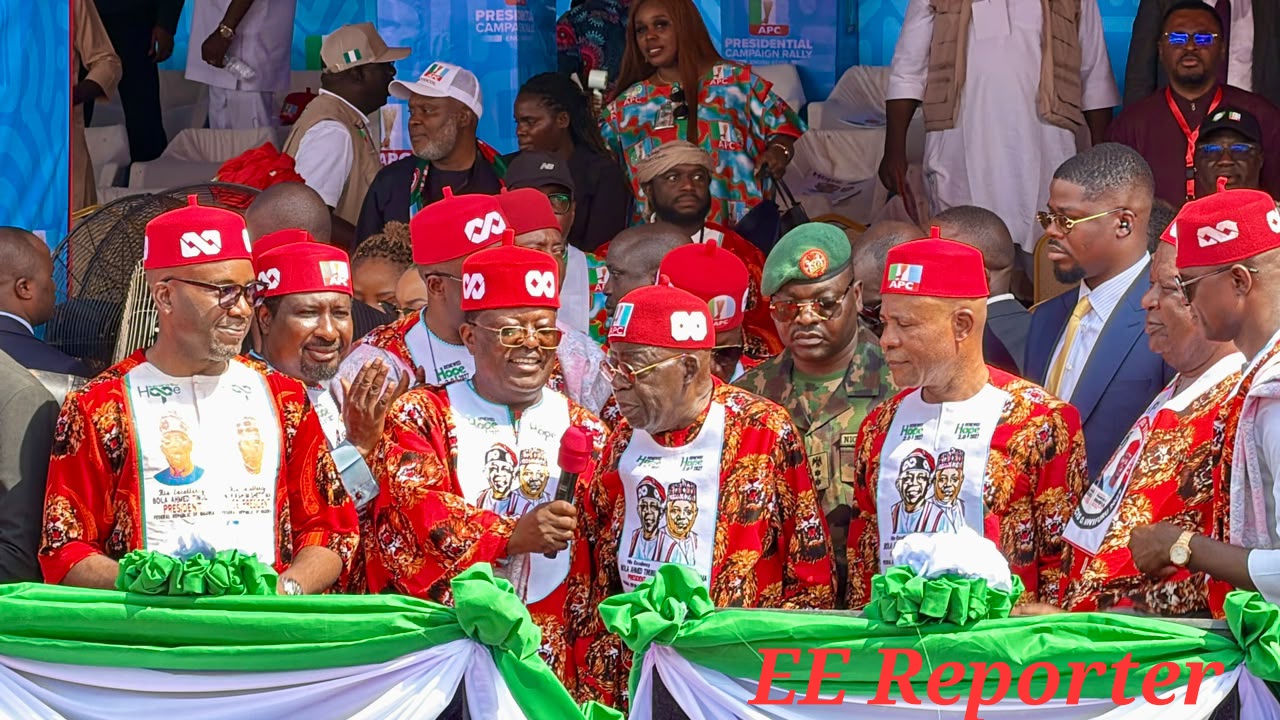
Tinubu Praises Umahi as he Commissions Two Landmark Project in South-East, Approves Eastern Gas Pipeline, Rail Line
President Bola Ahmed Tinubu has praised the Minister of Works, Senator Engr. David Umahi, CON, for his outstanding performance in infrastructure development, declaring that he has “performed wonders” as he commissioned two major road projects in Enugu State on Saturday, November 28, 2026.
Eereporter.com
The President made the remarks during the commissioning of the 23-span Eke Obinagu Flyover at the Eke Obinagu Junction and the completed 33-kilometre section of the Enugu–Onitsha Expressway, reconstructed with continuously reinforced concrete pavement, during the APC Presidential Campaign Rally at Okpara Square, Enugu.
Addressing the gathering, President Tinubu commended Umahi for what he described as “incredible development,” acknowledging the Minister’s contributions to the transformation of Nigeria’s road infrastructure.
“The Honourable Minister of Works, who has performed wonders of incredible development,” the President said.
He described the two projects as important investments for the comfort of the people, economic prosperity, progress and development, after formally commissioning them.
In a major boost to infrastructure development in the South-East, President Tinubu also announced the approval of the Eastern Gas Pipeline and the Eastern Nigeria Rail Line, projects expected to strengthen connectivity, support economic activities and deepen the region’s integration with other parts of the country.
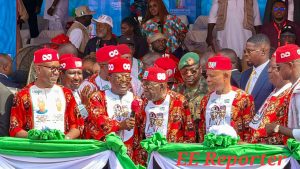
Tinubu Praises Umahi
“Eastern Gas Pipeline is approved. Also approved is Eastern Nigeria Rail Line. We will connect you, connect the East, connect the South and North. It’s our honest promise for development,” the President declared.
Earlier, while inviting the President to commission the projects, Umahi described the two road projects as only a glimpse of the infrastructure interventions being delivered across the country, including the South-East.
“It’s my pleasure to invite you to commission just a tip of the iceberg of what you are doing across the country, not forgetting the South-East. You are our declaration, Mr. President,” the Minister said.
Francis Nwaze, FIPMD
Senior Special Assistant to the Honourable Minister of Works (Media)
November 28, 2026
Eereporter.com
-
 Crime2 years ago
Kogi Assembly Considers Law To Regulate Rent, Establish Control Board: Tenancy Law
-
 News2 years ago
Atiku Reveals Why He Failed To Pick Wike As Running Mate In 2023
-
 Akwa Ibom2 years ago
The Apostolic Church Gets New Territorial Chairman, Exco
-

 Crime2 years ago
Federal High Court Jails 2 For Vandalizing Transformer, Telecom Mast In Kogi
-
 News2 years ago
The Apostolic Church Gets New National President, Executive
-
 Akwa Ibom2 years ago
Umo Eno Commences Payment Of 80,000 Naira Minimum Wage With Arrears
-

 News2 years ago
Senator Natasha Returns To Senate With Husband Amid Seat Dispute
-
 Economy2 years ago
Kiyosaki: Is Tinubu’s Government Afraid Of Ibrahim Traore?