
News
Senator Orji Kalu Rejects Call To Contest In 2027, Endorses Tinubu For Re-election


Senator Orji Kalu Rejects Call To Contest In 2027, Endorses Tinubu For Re-election
Senator Orji Kalu rejects call to contest in 2027, endorses Tinubu for re-election. Senator representing Abia North and Chairman of the Senate Committee on South East Development Commission (SEDC), Dr. Orji Uzor Kalu, has firmly rejected a call by the Northern Youth Leaders Forum (NYLF) to run for president in 2027.
The group had proposed Kalu as a candidate, suggesting Zamfara State Governor Dauda Lawal or Adamawa State Governor Umar Fintiri as his running mate.
The coalition of 40 groups made the request during a visit to former President Olusegun Obasanjo in Abeokuta, Ogun State.
NYLF President Eliot Afiyo named Obasanjo as the forum’s patron and listed Labour Party’s 2023 presidential candidate, Peter Obi, and Senator Kalu as their preferred flag bearers for 2027.
However, Kalu, in a statement issued by his media office and signed by George Maduka, distanced himself from any presidential ambitions, stressing that his focus remains on supporting President Bola Ahmed Tinubu’s administration.
He reaffirmed his loyalty to the All Progressives Congress (APC) and dismissed speculations about a rift within the party regarding the 2027 presidential ticket.
According to Kalu, President Tinubu requires support to sustain the economic reforms currently underway.
“The presidency in 2027 is definitely out of the question for Senator Kalu. He has publicly endorsed President Bola Ahmed Tinubu for re-election and is committed to supporting his administration’s policies,” the statement read.
Kalu further stated that Tinubu’s economic policies are vital for Nigeria’s stability and development.
“To sustain these reforms, there must be a focus on long-term stability, inclusivity, and adaptability, and the President needs the maximum eight years to achieve this,” he said.

Senator Orji Kalu
Kalu noted that his friendship predates their governorship tenures in 1999, even as he lauded Tinubu’s courage in tackling Nigeria’s economic challenges and urged citizens to rally behind his leadership.
“No Nigerian leader has taken on the challenge of reforming Nigeria’s dwindling economy like President Tinubu.
Since he has taken the bull by the horns, the best thing Nigerians can do is to encourage him and re-elect him in 2027 to complete the good work he has started,” Kalu stated.










News
Infrastructure Development: Some Nigerians Need Eyeglasses to See My Husband’s Achievements, Says Remi Tinubu
Infrastructure Development: Some Nigerians Need Eyeglasses to See My Husband’s Achievements, Says Remi Tinubu
According to Oluremi, the country is making progress, but some Nigerians have apparently failed to notice the developments.
Eereporter.com
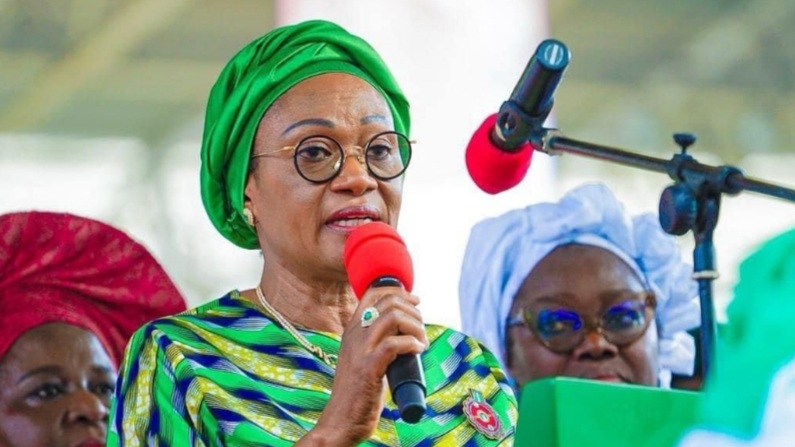
Senator Oluremi, President Bola Tinubu’s wife, has said Nigerians who fail to recognise the achievements of the current administration may need “eyeglasses” to see the changes taking place in the country.
Mrs Tinubu made the remark while inaugurating the Abuja headquarters of the PBAT Door-to-Door Movement, a grassroots mobilisation group campaigning for the President’s re-election in 2027.
According to Oluremi, the country is making progress, but some Nigerians have apparently failed to notice the developments.
“So things are happening in Nigeria, except, you know, those who don’t see; maybe we’ll give them some, you know, Bola Tinubu eyeglasses. We are doing that, JigiBola,” she said.
Mrs Tinubu referred to the Jigi-Bola eye-care initiative, introduced by her husband during his tenure as governor of Lagos State in 2001.
The programme provided eye screenings, eyeglasses and surgery, and was relaunched by the Lagos State Government in 2021.
She cited developments at Nigerian airports as evidence of progress under the current administration.
“I want to get to the airport. I want to travel, you know, so quickly. And you can see our airports too are changing,” she said.
She also expressed the hope that Nigeria would become a country she could enjoy after leaving the Presidential Villa in 2031.
“I want to leave Aso Rock, in 2031, by the grace of God, and enter a Nigeria that me as a 70-something-year-old woman will enjoy,” she said.
Her remarks came amid preparations for the 2027 general elections, with the PBAT Door-to-Door Movement mobilising support for President Tinubu’s anticipated re-election bid.
Mrs Tinubu subsequently commissioned the group’s Abuja headquarters and expressed confidence in her husband’s electoral prospects.

Remi Tinubu
Oluremi’s comments come as the administration continues to face public debate over its economic reforms, the cost of living and the extent to which Nigerians are experiencing improvements in their daily lives.
While the government has pointed to infrastructure projects and economic policy changes as signs of progress, many Nigerians continue to express concerns about household expenses and living conditions.
Eereporter.com
News
Nigeria Customs Sets to Host CGC’S Conference, C-PACT 2026 to Advance Border Security, African Trade Integration

Nigeria Customs Sets to Host CGC’S Conference, C-PACT 2026 to Advance Border Security, African Trade Integration
The Nigeria Customs Service (NCS) is set to host the Comptroller-General of Customs (CGC) Conference from 7 to 8 December 2026 and the Customs Partnership for African Cooperation in Trade (C-PACT) 2026 Conference from 9 to 11 December 2026 in Abuja, as part of its commitment to strengthening border security, facilitating legitimate trade and advancing regional economic integration.
Eereporter.com
The CGC’s Conference, themed “Securing Borders, Enabling Trade: A Customs Commitment to Safer Communities,” will provide a platform to review the Service’s modernisation efforts, assess progress against previous commitments, and reinforce the relationship between effective Customs administration, national security, and trade facilitation. C-PACT 2026, themed “One Border, Interconnected Systems: Advancing Customs Cooperation through One-Stop Border Posts,” will extend these discussions to the continental level, focusing on practical approaches to coordinated border management and digital connectivity across Africa.
The CGC’s Conference will bring together relevant government officials, Customs leadership, trade stakeholders and institutional partners to examine the Service’s progress in implementing modernisation and trade facilitation reforms. Under the sub-themes: “Enabling African Trade: Digital Customs, Trusted Corridors and Seamless Payments” and “Secure Borders, Safer Communities: Intelligence, Partnership and Trust at the Frontline,” the programme will also review commitments made in 2025 and results achieved in 2026, as well as feature presentations on Customs modernisation, Authorised Economic Operator (AEO) certificate presentation, and discussions on measuring the impact of reforms on trade and revenue. The conference will examine intelligence-led enforcement, emerging border threats, inter-agency collaboration, and officers’ professional responsibilities in protecting communities and maintaining public trust.
Furthermore, a major component of the CGC Conference will be the examination of how digital transformation and stakeholder partnerships are improving Customs operations.
Discussions will give stakeholders, including AEO beneficiaries, the National Single Window Secretariat, the Presidential Enabling Business Environment Council (PEBEC), excise-sector representatives, and other relevant institutions, an opportunity to assess reform outcomes and identify areas for further improvement. The second day of the conference will focus on coordinated responses to converging border threats, bringing together relevant security and enforcement institutions, including the Office of the National Security Adviser (ONSA), the NCS, the National Drug Law Enforcement Agency (NDLEA) and the Nigerian Financial Intelligence Unit (NFIU).
Building on the national conference, C-PACT 2026 will provide a continental platform for Customs administrations, policymakers, the African Continental Free Trade Area (AfCFTA) Secretariat, Regional Economic Communities, border management agencies, development partners, technology providers and private-sector stakeholders to advance cooperation in African trade.
The conference will address persistent challenges affecting cross-border trade, including fragmented procedures, duplicated controls, limited information exchange, incompatible digital systems, and insufficient coordination among border agencies. It will explore how One-Stop Border Posts (OSBPs), supported by interconnected Customs platforms, coordinated risk management, harmonised procedures and secure information exchange, can reduce delays, lower trade costs, and improve the predictability of goods movement across African trade corridors.
The C-PACT 2026 programme will feature high-level policy dialogue, strategic discussions among Customs administrations, technical sessions on connected borders, presentations of operational experiences from existing and emerging OSBPs, technology demonstrations and discussions on public-private partnerships for financing and delivering modern border infrastructure. The conference will focus on implementing relevant AfCFTA initiatives, including the AfCFTA Integrated Transit System, the Single Bond Guarantee Scheme, and the Electronic Certificate of Origin system.
The conference is expected to generate practical recommendations, identify priority technology and investment opportunities, strengthen institutional partnerships, and develop an implementation-oriented roadmap to advance interconnected, digitally enabled border systems across the continent.

Customs
The NCS, under the leadership of CGC Bashir Adewale Adeniyi MFR and its management members, reiterates its commitment to strengthening collaboration with national institutions, regional partners and international stakeholders to secure borders, facilitate legitimate trade and support Africa’s economic integration agenda. Through the CGC Conference and C-PACT 2026, the Service seeks to reinforce accountability for ongoing reforms while advancing practical solutions that connect border security with trade facilitation, technological innovation and safer communities.
The outcomes of both conferences are expected to improve Customs operations, strengthen regional cooperation, and advance the AfCFTA’s objectives of building a more integrated, competitive, and prosperous African market.
ABDULLAHI MAIWADA, PhD, mnipr, mniia
Deputy Comptroller of Customs
National Public Relations Officer
for Comptroller-General of Customs
25 October 2026
Eereporter.com
News
CAS Celebrates One Year of Decisive Airpower as NAF Records Over 6,100 Flying Hours, 2,900 Sorties
CAS Celebrates One Year of Decisive Airpower as NAF Records Over 6,100 Flying Hours, 2,900 Sorties
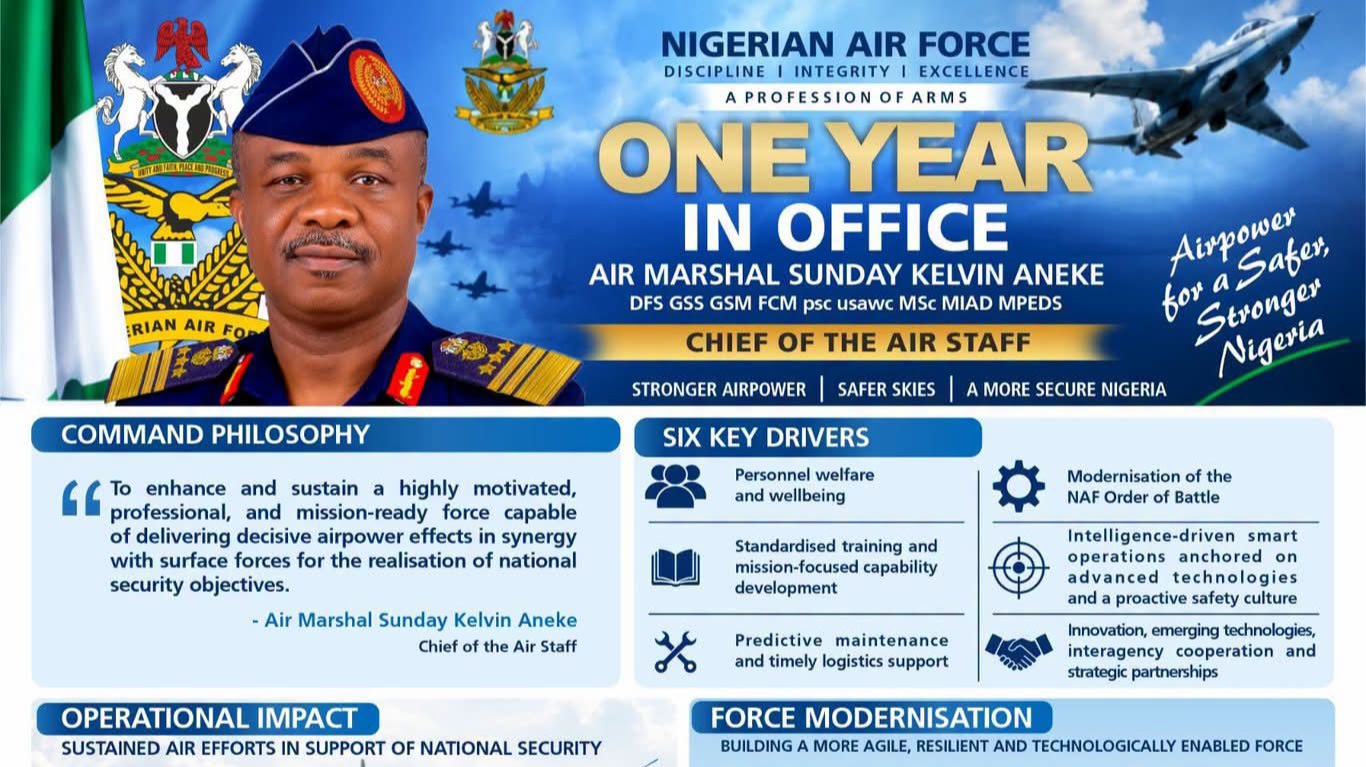
The Nigerian Air Force (NAF) has recorded significant operational, personnel, training, infrastructure and force modernisation milestones under the leadership of the Chief of the Air Staff (CAS), Air Marshal Sunday Kelvin Aneke, as he approaches his first anniversary in office on 30 October 2026. Guided by his command philosophy of sustaining a highly motivated, professional and mission-ready force capable of delivering decisive airpower effects in synergy with surface forces, the Service has pursued a focused transformation agenda anchored on operational effectiveness, personnel welfare, technological advancement and institutional accountability.
Eereporter.com
Between November 2025 and September 2026, the NAF recorded over 6,100 flying hours and more than 2,900 sorties, consuming close to 10 million litres of Jet A-1 fuel in support of national security operations. These missions encompassed precision air strikes, armed reconnaissance, surveillance, close air support and other tasks designed to degrade hostile elements, disrupt their freedom of action and enhance the effectiveness of surface forces. Central to this effort has been intelligence-led mission planning, with operations guided by actionable intelligence, defined objectives and assessments of mission outcomes. The emphasis remains on ensuring that every sortie serves a clear operational purpose and contributes meaningfully to national security.
Recognising personnel as the Service’s most valuable asset, Air Marshal Aneke has placed welfare at the heart of his leadership philosophy, encapsulated in the principle of “Welfare for Enhanced Warfare.” This approach recognises that adequately supported, professionally developed and highly motivated personnel are essential to sustained operational effectiveness. Accordingly, the Service has pursued improvements in personnel allowances and medical support, alongside the provision of accommodation and the development of supporting infrastructure to enhance living and working conditions across its formations. These initiatives, complemented by the reactivation of welfare airlift services for personnel in frontline operational theatres, reflect a deliberate commitment to strengthening morale, improving the wellbeing of personnel and their families, and enhancing readiness to discharge the NAF’s constitutional responsibilities of defending Nigeria’s territorial integrity and protecting its citizens. In further recognition of professional service and career progression, 57 senior officers were promoted to the ranks of Air Vice Marshal and Air Commodore, while 1,534 senior non-commissioned officers and 1,936 non-commissioned officers advanced to higher ranks. More than 550 personnel also participated in international training and professional engagements, while over 6,000 received local training, strengthening specialised competencies, technical proficiency and leadership capacity.
The NAF has equally advanced efforts to modernise its fleet and improve aircraft availability. In September 2026, the Service received five additional helicopters comprising three AW-109 Trekker Type B helicopters and two H125 helicopters, expanding its operational flexibility and support capacity. Beyond these deliveries, the Service is pursuing a broader acquisition programme that includes 12 AH-1Z attack helicopters and other planned aircraft and unmanned aerial systems intended to strengthen airlift, combat, training, intelligence, surveillance and reconnaissance capabilities. Maintenance and fleet regeneration efforts have also progressed, including the reactivation and upgrade of six L-39ZA aircraft in Slovakia and Nigeria, as well as the ongoing Periodic Depot Maintenance of a C-130 aircraft in Portugal. These efforts complement investments in technical support, indigenous upgrades and emerging aviation technologies.
Safety, accountability and responsible airpower employment have remained important pillars of the transformation agenda. The establishment of an Operational and Safety Audit Committee is intended to support independent assessments of operational, engineering and armament units, while a strengthened Safety Management System promotes leadership engagement, proactive risk management and a data-driven safety culture. The Service is also advancing Civilian Harm Mitigation and Response through dedicated structures, standardised training, and enhanced assessment and investigation capabilities. Plans to establish an Open-Source Intelligence Centre further reflect the drive to improve situational awareness and operational planning through better exploitation of available information and emerging technologies.
NAF
Infrastructure development and indigenous capability remain central to sustaining these gains. The NAF has approved 284 infrastructure projects, of which 145 have been completed and 139 remain ongoing. Covering residential accommodation, academic and medical facilities, administrative and operational infrastructure, roads, power, water supply and recreational facilities, these projects are designed to improve personnel welfare and strengthen the Service’s operational and institutional capacity. Complementing these investments are local production initiatives involving Aircraft Release Device 863 impulse release cartridges, a 250-kilogram bomb-loading trolley, and the development and ground testing of locally produced 57-millimetre rockets. Community-focused healthcare, educational and other special projects have also continued to strengthen civil-military relations and public confidence.
As Air Marshal Aneke approaches his first anniversary, the NAF remains focused on translating investments in people, platforms, training, technology and infrastructure into tangible operational results. Through stronger joint operations, strategic partnerships, improved maintenance, professional development and responsible employment of airpower, the Service continues to pursue greater readiness and effectiveness in addressing Nigeria’s security challenges. The objective is not simply to expand capability, but to sustain a professional, accountable and responsive force prepared for evolving threats. The enduring commitment remains clear: stronger airpower, safer skies and a more secure Nigeria.
Ehimen Ejodame
Air Commodore
Director of Public Relations and Information,
Headquarters, Nigerian Air Force.
25 October 2026
Eereporter.com
-
 Crime1 year ago
Kogi Assembly Considers Law To Regulate Rent, Establish Control Board: Tenancy Law
-

 News2 years ago
Atiku Reveals Why He Failed To Pick Wike As Running Mate In 2023
-

 Akwa Ibom2 years ago
The Apostolic Church Gets New Territorial Chairman, Exco
-

 Crime2 years ago
Federal High Court Jails 2 For Vandalizing Transformer, Telecom Mast In Kogi
-

 News2 years ago
The Apostolic Church Gets New National President, Executive
-
 Akwa Ibom2 years ago
Umo Eno Commences Payment Of 80,000 Naira Minimum Wage With Arrears
-

 News2 years ago
Senator Natasha Returns To Senate With Husband Amid Seat Dispute
-

 Economy1 year ago
Kiyosaki: Is Tinubu’s Government Afraid Of Ibrahim Traore?