
Security
NPF: IGP Disu Opens PMF Instructor’s Training at Ende-Hills, Tasks Trainers on Operational Readiness

NPF: IGP Disu Opens PMF Instructor’s Training at Ende-Hills, Tasks Trainers on Operational Readiness
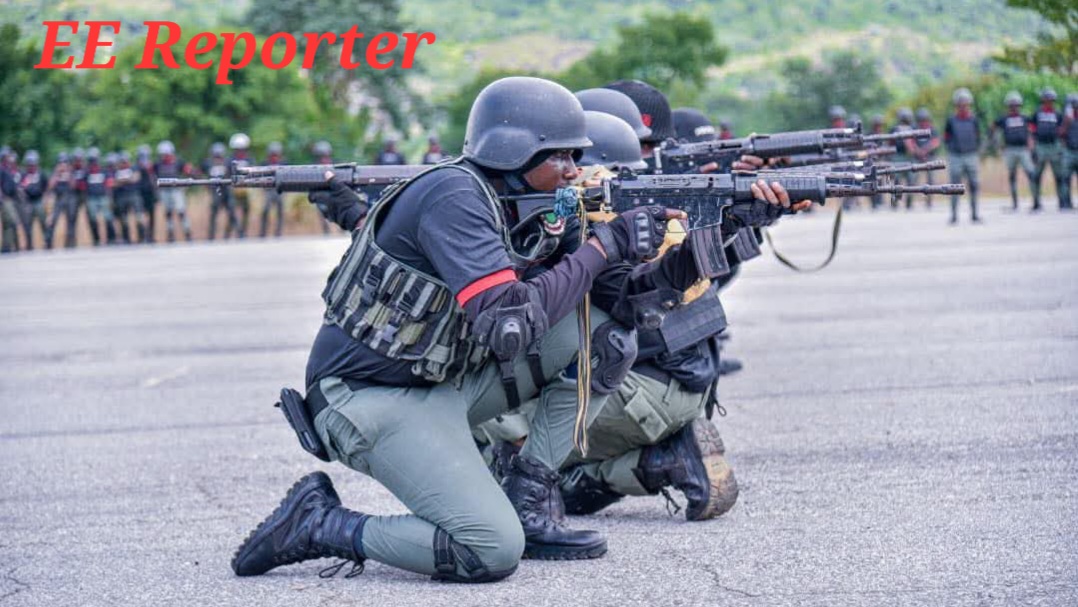
The Inspector-General of Police, IGP Olatunji Rilwan Disu, psc(+), NPM, today, 28th August, 2026, formally opened the Training Course for Trainers and Instructors of the Police Mobile Force (PMF) at the PMF Training College, Ende-Hills, Nasarawa State.
Eereporter.com
The training, which brings together selected PMF trainers and instructors from across the country, is aimed at strengthening instructional capacity, sharpening tactical competence and enhancing the operational readiness of the Force’s 84 PMF Squadrons.
The event was attended by DIG Umar Shehu Nadada, DIG Operations; AIG Alonyenu Idu, AIG in charge of the Police Mobile Force; DCP Sunday Audu Peter, Commandant, PMF Training College, Ende-Hills; Commandant Brah Samson Umoru, Nasarawa State Commandant of the Nigeria Security and Civil Defence Corps;and Commandants of other PMF Training Colleges.
The Executive Governor of Nasarawa State, Engr. Abdullahi A. Sule, who was briefly present at the ceremony, congratulated the IGP on his leadership and ongoing efforts towards strengthening the Nigeria Police Force.
Also speaking, AIG Alonyenu Idu commended the IGP’s leadership and commitment to repositioning the PMF, noting that the training had further charged personnel to uphold the glory and operational reputation of the Force’s tactical strike arm.
Addressing participants, the IGP described the programme as a strategic intervention in the operational future of the PMF, stressing that the changing security environment requires continuous learning, adaptation, discipline and tactical competence. He charged the trainers to become force multipliers by ensuring that knowledge acquired during the course is effectively transferred to personnel in their respective formations.
The IGP further emphasised that the modern PMF must combine tactical capability with intelligence, precision, discipline, professionalism and respect for the law, while making operational readiness a continuous culture. He urged the participants to focus not merely on acquiring certificates, but on developing competence that would translate into improved operational performance.
The ceremony featured a series of tactical displays and practical demonstrations by personnel undergoing the training, showcasing their skills, discipline and operational capabilities.
Police
The Nigeria Police Force remains committed to continuous professional training, modernisation, welfare and the provision of necessary tools and platforms to strengthen operational effectiveness and ensure that the Police Mobile Force remains a disciplined, agile and dependable tactical capability in the protection of lives and property across the country.
CSP Ani Iniedu, anipr
Force Public Relations Officer
Force Headquarters, Abuja
28th August , 2026
Eereporter.com







Navy Dismantles Illegal Refining Capacity, Destroys Site With 3 Storage Tanks in Rivers
The Nigerian Navy, through FOB BONNY, has dismantled an illegal refining site discovered in Promise Land Community along Nanabie Creek, Bonny Local Government Area of Rivers State, further denying criminal operators the infrastructure required to process stolen crude oil.
Eereporter.com
The site was discovered on 30 September 2026 following credible intelligence and comprised one large cooking pot and 3 large storage tanks intended for illegal refining activities. On 2 October 2026, the Commanding Officer, FOB BONNY, Captain SMC Umeh, led a team to the location, where the illegal refining site and associated equipment were destroyed in accordance with established regulations.
The intervention represents a further disruption of illegal refining capacity within the Bonny area, particularly by removing infrastructure that could be used to process and store stolen crude oil. It also follows recent operations by FOB BONNY under Operation DELTA SENTINEL that uncovered substantial volumes of suspected stolen crude oil and associated illegal refining infrastructure within its Area of Operations
Oil
The Nigerian Navy has continued to strengthen surveillance and monitoring across the area to prevent the establishment or reactivation of illegal refining sites and deny criminal operators the infrastructure required to sustain crude oil theft and related activities.
ABIODUN FOLORUNSHO
Navy Captain
Director Naval Information
Nigerian Navy
Eereporter.com

President Tinubu Tells EFCC: You Have Justified my Confidence in You
President Bola Ahmed Tinubu has applauded the efforts and performance of the Economic and Financial Crimes Commission, EFCC, in tackling economic and financial crimes and other acts of corruption in the country, stressing that it has justified the confidence reposed on it.
Eereporter.com
He gave this commendation on Friday, October 2, 2026 in Awka, Anambra State at the commissioning of a new Zonal Directorate of the EFCC. The President pointed out that there are evidential proofs of the success of the Commission in convictions, recoveries and other landmark achievements
Represented by Honourable Tajudeen Abbas, Speaker, House of Representatives, Tinubu noted that “supporting the EFCC is not particularly difficult. The agency has consistently demonstrated that the confidence reposed on it is well founded. Without mincing words, the evidential proof of the EFCC’s success speaks loudly in convictions secured, assets and properties recovered”
He affirmed that the strides of the Commission are in tandem with the Renewed Hope Agenda of his administration.
“When we came in three years ago, I highlighted nine major focal areas of my administration. Two of which are reforming the economy for sustained and inclusive growth and promotion of good governance. The anti-graft agency compliments this agenda as they are focused on accountability and transparency and appropriate deployment of resources”, he said.
At the commissioning, the Executive Chairman of the EFCC, Mr. Ola Olukoyede restated the commitment of the Commission to preventive frameworks in tackling economic and financial crimes and other acts of corruption in the country.
According to him, the Commission will continue its focus on making corrupt practices difficult by blocking avenues through which they may happen.
“This new Directorate will not only enforce the law professionally and courageously, it will be high on corruption prevention. It will engage government institutions, businesses, financial institutions, professional bodies, schools, markets, civil society organisations, traditional institutions, religious bodies and communities. It will educate stakeholders, build relationships and mobilise the people to own the fight against all forms of corrupt practices in the zone”, he said
He assured Nigerians that the EFCC would not relent in the pursuit of its mandate, recalling the achievements of the Commission in the last 34 months and describing them as impressive progress.
“The pursuit of our mandate has been our dominant engagement and in the past few years, we have made impressive progress. Between October 2023 and July 2026, the Commission received 49, 673 petitions, investigated 39, 615 cases, filed 14, 476 cases in court and secured 10, 872 convictions. This gives a conviction-to-filing ratio of 75.1 percent. In the first half of 2026 alone, we recorded 1, 370 convictions from 1, 889 filings. The Commission also recorded recoveries of N1, 233, 612, 040, 411. 11, $684, 478, 457. 32, £373, 905. 78, €9, 343, 803. 66 inn addition to recoveries in other currencies”, he said.
He noted that at the institutional level, the Commission has made radical reforms that have been yielding optimal results as there are consequential improvements in the agency’s processes and procedures, which partly explains the impacts the EFCC has made and will continue to make in all the matrices of law enforcement.
“Reforms that have strengthened the Commission during the period include new guidelines on arrest and bail, a review of sting operations, the establishment of the Department of Fraud Risk Assessment and Control, the Security Department, the Immigration and Visa Section and the Cybercrime Rapid Response Centre”, he said.
While charging Ndi Anambra on whistleblowing, the anti-graft czar said that the Commission has established channels through which members of the public can submit petitions and provide information. He noted that the Commission’s Eagle Eye App allows citizens to provide details of suspected wrongdoing and makes the provision of an informant’s personal details optional. “However, whistleblowing must be responsible and based on facts. It must not become an instrument for settling scores”, he said.

EFCC
He thereafter said that Anambra and Imo States deserve effective and responsive institutional presence as they are renowned for enterprise, innovation, commerce and an extraordinary culture of industry, adding that these legitimate activities must be protected from fraud, cybercrime, money laundering, investment fraud, diversion of public resources and other forms of economic and financial crimes. “Therefore, our coming to Awka is beyond geographical expansion. It is about taking the mandate of the EFCC closer to the people and closer to the economic activities we are meant to protect”, he said.
In their remarks, His Excellencies, Professor Chukwuma Soludo, Governor of Anambra State and Senator Hope Uzodinma, Governor of Imo State said that they were pleased with the activities and management of the EFCC under the leadership of Olukoyede. They pledged their support to the Commission as it opened a new Zonal Directorate in their domain.
The commissioning of the new Directorate witnessed massive turn out of distinguished Nigerians, including members of the National Assembly, civil society organisations, community leaders, students, media among others.
Eereporter.com

Nigerian Air Force Celebrates Nigeria’s 66th Independence Day with Families in Lagos
The Nigerian Air Force (NAF) marked Nigeria’s 66th Independence Anniversary with a family-centred celebration at the ATO Field, NAF Base Ikeja, Lagos, bringing together children and families of personnel in an atmosphere of patriotism, unity and camaraderie.
Eereporter.com
The Chief of the Air Staff, Air Marshal Sunday Kelvin Aneke, represented by the Air Officer Commanding Logistics Command, Air Vice Marshal AA Suleh, joined the celebration and presented gift items to the children. The event, facilitated by the Commander, 651 Base Services Group, Air Commodore MA Imam, featured games, music, cultural displays and other recreational activities.

Nigerian Air Force
The celebration reinforced the NAF’s commitment to personnel and family welfare as a key enabler of morale and operational effectiveness, in line with the CAS Command Philosophy, while reaffirming the NAF’s commitment to standing with Nigerians and contributing to a stronger, safer and more prosperous Nigeria.
Eereporter.com
-
 Crime1 year ago
Kogi Assembly Considers Law To Regulate Rent, Establish Control Board: Tenancy Law
-

 News2 years ago
Atiku Reveals Why He Failed To Pick Wike As Running Mate In 2023
-
 Akwa Ibom2 years ago
The Apostolic Church Gets New Territorial Chairman, Exco
-

 Crime2 years ago
Federal High Court Jails 2 For Vandalizing Transformer, Telecom Mast In Kogi
-
 News2 years ago
The Apostolic Church Gets New National President, Executive
-
 Akwa Ibom2 years ago
Umo Eno Commences Payment Of 80,000 Naira Minimum Wage With Arrears
-

 News2 years ago
Senator Natasha Returns To Senate With Husband Amid Seat Dispute
-

 Economy1 year ago
Kiyosaki: Is Tinubu’s Government Afraid Of Ibrahim Traore?