
Economy
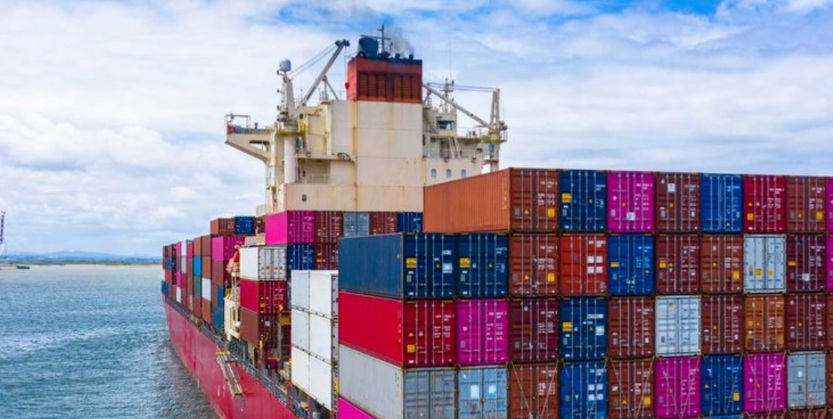
Nigerian Customs Suspend Implementation Of 4% FOB Import Charge

Nigerian Customs Suspend Implementation Of 4% FOB Import Charge
Nigerian Customs suspend implementation of 4% FOB import charge. Mr Maiwada explained that the suspension period would allow the service to further engage with stakeholders while ensuring proper alignment with the act’s provisions.
The Nigeria Customs Service (NCS) has suspended the implementation of the four per cent charge on the Free On-Board (FOB) value of imports.
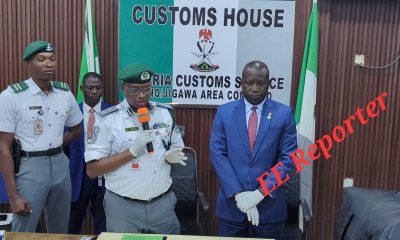
The service’s spokesman, Abdullahi Maiwada, made this known in a statement on Tuesday in Abuja.
The spokesman said the suspension was a sequel to ongoing consultations by Wale Edun, the Minister of Finance and Coordinating Minister of the Economy, with stakeholders.
He said the revised implementation timeline would be announced following the conclusion of the consultation.
Mr Maiwada explained that the suspension period would allow the service to further engage with stakeholders while ensuring proper alignment with the act’s provisions for the sustainable funding of its modernisation initiatives.
“This suspension will enable comprehensive stakeholder engagement and consultations regarding the act’s implementation framework.
“The timing of this suspension aligns with the exit of the contract agreement with the service providers, including Webb Fontaine, which were previously funded through the one per cent Comprehensive Import Supervision Scheme (CISS).
“This presents an opportunity to review our revenue framework holistically,“ he said.
The NCS on February 5 announced that it was implementing a four per cent charge on the FOB value of imports. Mr Maiwada said the move was in line with the provisions of section 18 (1) of the Nigeria Customs Service Act (NCSA) 2023.
The announcement has received criticism from experts and stakeholders in the sector, who said the move would worsen the country’s inflation rate.
Mr Maiwada explained that the previous funding arrangement, which was repealed by the NCSA 2023, separated the one per cent CISS and the seven per cent cost of collection.
He noted that this created operational inefficiencies and funding gaps in customs modernisation efforts.
According to him, the new act addresses the challenges by consolidating no less than four per cent of the Free-on-Board (FOB) value of imports to ensure sustainable funding for critical customs operations and modernisation initiatives.
He said the transition period would allow the service to optimise the management of these frameworks to better serve its stakeholders and the nation’s interests.
“The act further empowers the service to modernise its operations through various technological innovations.
“Specifically, section 28 of the NCSA 2023 authorises developing and maintaining electronic systems for information exchange between the service, other Government Agencies, and traders,“ he said.
He disclosed that NCS was already implementing several digital solutions, including the recently deployed B’Odogwu clearance system, which aims to automate trade operations and align the service with international standards.
Mr Maiwada noted that stakeholders were already benefiting from the system through faster clearance times and improved transparency.

Customs
He stated that other innovative solutions authorised by the act include Single Window implementation (Section 33), Risk management systems (Section 32), Non-intrusive inspection equipment (Section 59) and electronic data exchange facilities (Section 33(3).
He maintained that the NCS remains committed to implementing the provisions of the act in a manner that best serves stakeholders while fulfilling its revenue generation and trade facilitation mandate.











Gov Eno Flags Off Ikot Ekpene International Market, Targets Trade, Jobs, Economic Growth
Akwa Ibom State Governor, Pastor Umo Eno, has officially unveiled the design and performed the groundbreaking ceremony for the construction of the Ikot Ekpene International Market, describing the project as a strategic investment in trade, employment and economic development.
Eereporter.com
The ceremony, held on Wednesday, September 30, as part of activities marking the 39th anniversary of Akwa Ibom State, took place in Ikot Ekpene Local Government Area.
Speaking at the event, Governor Eno said the project demonstrated his administration’s commitment to delivering tangible infrastructure across the state.
He recalled earlier questions from the opposition regarding the number and location of the 39 projects promised as part of the anniversary activities.
“When we first started, the opposition asked, ‘Where are the 39 projects?’
“Today, we can gladly tell them to come and see,” the Governor said.
Governor Eno explained that the project was not merely about constructing a market but about investing in the economic future of Akwa Ibom State.
“Today, we are not just laying a foundation or turning the sod for this market; we are laying a foundation for prosperity, building infrastructure for opportunities, and creating a platform upon which our traders, entrepreneurs, artisans, manufacturers, and young people can build their dreams,” he said.
Also speaking, the Commissioner for Trade and Investment, Captain Iniobong Ekong (Rtd.), said the project reflected the administration’s efforts to position Akwa Ibom as a hub for trade, tourism and industrialisation.
According to him, the first phase of the market comprises 30 blocks of double-deck structures containing 108 shops, alongside two warehouses, restaurants, cold rooms, a police station, asphalt and concrete roads.
Ekong said the strategic location of the market would attract traders and customers from neighbouring states and beyond, particularly Cross River, Abia and Rivers states, as well as Cameroon.
“Upon completion, this market is going to generate income and revenue, create employment, and connect us with the trade hubs of the Gulf of Guinea,” he said.
The Director-General of Campaigns, Ambassador Chief Assam Assam (SAN), commended Governor Eno for initiating the project, noting that its strategic location would make it accessible to communities across the state.
He recalled the Governor’s earlier promise to establish an international market in Ikot Ekpene, describing the project as the fulfilment of that commitment.
“I remember that the Governor was in Ikot Ekpene Stadium when he said he was going to build an international market in Ikot Ekpene. This market is this Governor’s dream child,” Assam said.
Speaking on behalf of stakeholders in the area, Senator Emmanuel Ibokessien said the project was conceived by the people of Ikot Ekpene in 2010 but remained unrealised through successive administrations.
He commended Governor Eno for actualising the project.
“This project started in 2010 when it was conceived by the people of Ikot Ekpene. And through three administrations, this project did not see the light of day, but when you came with the finisher’s anointing, this project is now actualised,” he said.
Earlier, the Chairman of Ikot Ekpene Local Government Area, Hon. Elder Aniefiok Nkom, expressed appreciation to Governor Eno for commencing the long-awaited project.
Nkom recalled previous discussions on the economic importance of the market, noting that its location was expected to redirect commercial traffic and attract traders who ordinarily travel to other commercial centres.
He described the Governor as “a man of his word,” saying the people of Ikot Ekpene were excited by the commencement of the project.

Ikot Ekpene International Market
The Paramount Ruler of Ikot Ekpene Local Government Area, His Royal Majesty, Okuku Okon Udo Ukut, also expressed gratitude to the Governor, describing the project as a significant development for the area.
Upon completion, the Ikot Ekpene International Market is expected to strengthen commercial activities, create employment opportunities and expand Akwa Ibom State’s trade links with neighbouring states and the wider Gulf of Guinea region.
Eereporter.com
Economy
NAF Boosts Grassroots Economic Development, Commissions Special Intervention Project in Benue
NAF Boosts Grassroots Economic Development, Commissions Special Intervention Project in Benue
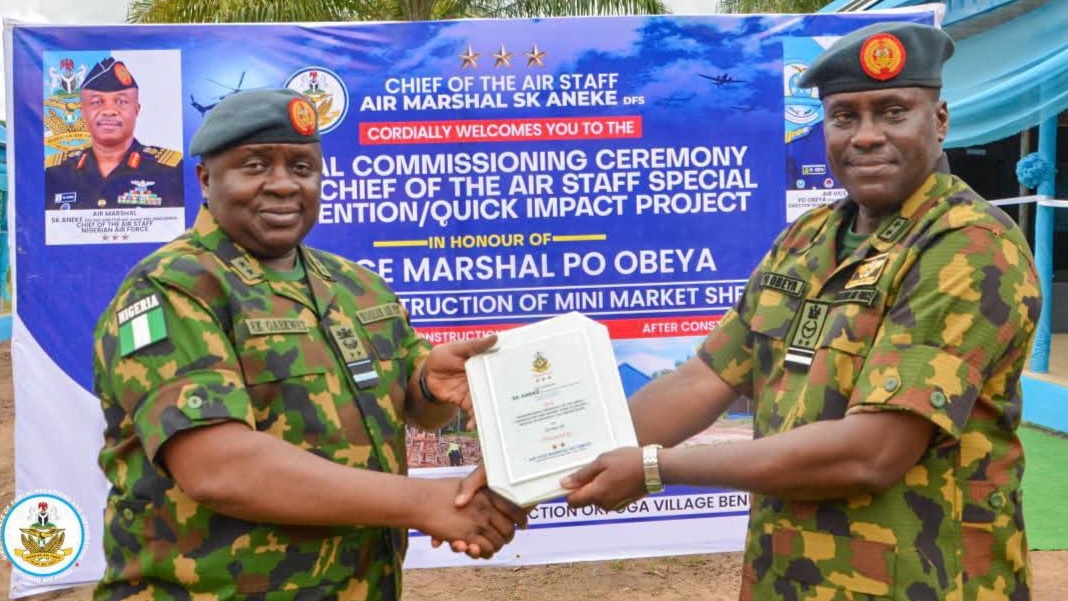
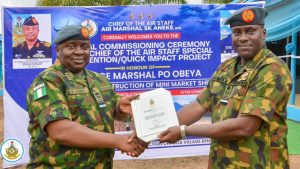
A new chapter in community development was opened in Oklenyi, Okpoga, Benue State, as the Nigerian Air Force (NAF) commissioned a Chief of the Air Staff (CAS) Special Intervention Project, executed in honour of one of its distinguished senior officers and an illustrious son of the State, Air Vice Marshal Patrick Owoicho Obeya.
Eereporter.com
The CAS, Air Marshal Sunday Kelvin Aneke, represented by the Chief of Civil-Military Relations, Headquarters NAF, Air Vice Marshal Edward Gabkwet, said the initiative reflects the NAF’s commitment to winning hearts and minds, strengthening public trust and deepening cooperation with host communities. He noted that it is one of 21 similar interventions executed nationwide in honour of distinguished senior officers in their respective homelands.
The CAS said the newly commissioned market sheds, administrative block and water facilities are designed not only to provide essential infrastructure, but also to stimulate economic activity and improve livelihoods at the grassroots. He commended AVM Obeya for facilitating the intervention and urged the Oklenyi community to take ownership of and protect the facilities.
He further emphasised that sustained civil-military cooperation and the timely sharing of actionable intelligence remain critical to supporting the Armed Forces in tackling security threats and safeguarding Nigeria’s territorial integrity.
For AVM Obeya, the intervention represents a meaningful opportunity to give back to his community. The facilities comprise two market sheds capable of accommodating up to 48 traders, a furnished administrative block and a solar-powered water reticulation system supported by two deep wells.
NAF
The Executive Governor of Benue State, Rev. Fr. Hyacinth Alia, represented by the Secretary to the State Government, Dcns. Serumun Deborah Aber, commended the NAF for complementing its traditional defence role with community development, noting that the intervention aligns with the State Government’s rural transformation agenda.
He urged the people of Okpoga to protect and sustain the facilities for the benefit of present and future generations.
Eereporter.com
Economy
NAF, Innoson Vehicle Manufacturing (IVM) Sets for Partnership to Advance Indigenous Defence Capacity
NAF, Innoson Vehicle Manufacturing (IVM) Sets for Partnership to Advance Indigenous Defence Capacity
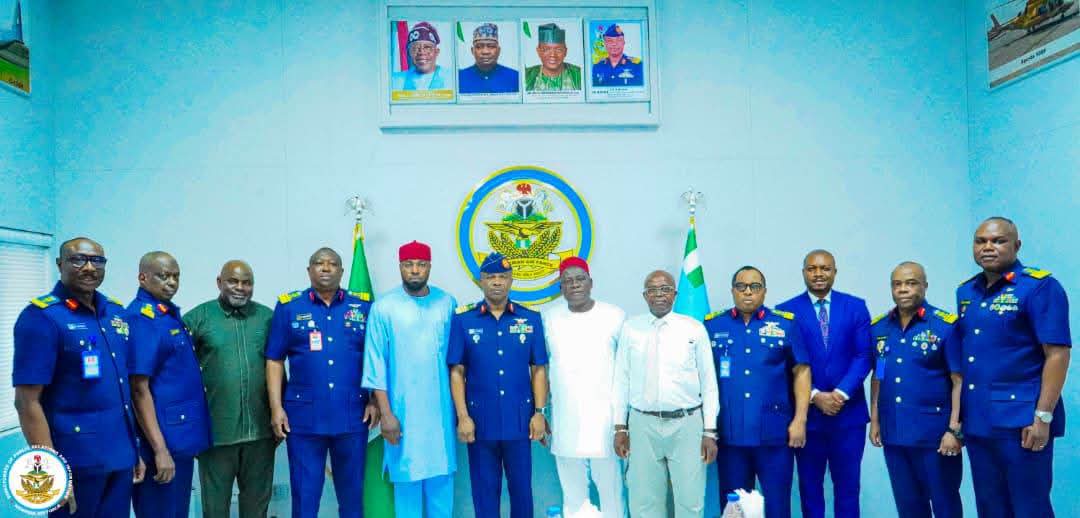
The Chief of the Air Staff (CAS), Air Marshal Sunday Kelvin Aneke, has expressed the readiness of the Nigerian Air Force (NAF) to explore a strategic partnership with Innoson Vehicle Manufacturing (IVM) to strengthen indigenous capacity in aircraft spares production, technology transfer and specialised technical training.
Eereporter.com
The CAS stated this on 29 September 2026 when the Chairman of IVM, Chief Dr Innocent Ifediaso Chukwuma, CON, paid a courtesy visit to him at Headquarters NAF, Abuja.
Discussions focused on leveraging IVM’s indigenous manufacturing capabilities to support NAF operational requirements and advance local content in the defence sector. Chief Chukwuma highlighted IVM’s interest and capability in the production of selected aircraft parts and spares, while also showcasing its CNG and electric vehicle manufacturing capabilities.
The CAS welcomed the initiative and reaffirmed NAF’s commitment to partnerships that promote local production, technology transfer and human-capacity development. He also expressed interest in exploring affordable vehicle acquisition options for NAF personnel through convenient payment arrangements, subject to further engagement and applicable procedures.

Innoson Vehicle Manufacturing (IVM)
The engagement underscores the CAS’s drive to harness indigenous innovation and local expertise to strengthen NAF capability and personnel welfare, while supporting Nigeria’s broader pursuit of technological self-reliance and industrial development.
Eereporter.com
-
 Crime1 year ago
Kogi Assembly Considers Law To Regulate Rent, Establish Control Board: Tenancy Law
-

 News2 years ago
Atiku Reveals Why He Failed To Pick Wike As Running Mate In 2023
-

 Akwa Ibom2 years ago
The Apostolic Church Gets New Territorial Chairman, Exco
-

 Crime2 years ago
Federal High Court Jails 2 For Vandalizing Transformer, Telecom Mast In Kogi
-
 News2 years ago
The Apostolic Church Gets New National President, Executive
-
 Akwa Ibom2 years ago
Umo Eno Commences Payment Of 80,000 Naira Minimum Wage With Arrears
-

 News2 years ago
Senator Natasha Returns To Senate With Husband Amid Seat Dispute
-

 Economy1 year ago
Kiyosaki: Is Tinubu’s Government Afraid Of Ibrahim Traore?