
News
IGP Visits Oba Of Benin To Strengthen Security Collaboration Between NPF, Traditional Institutions

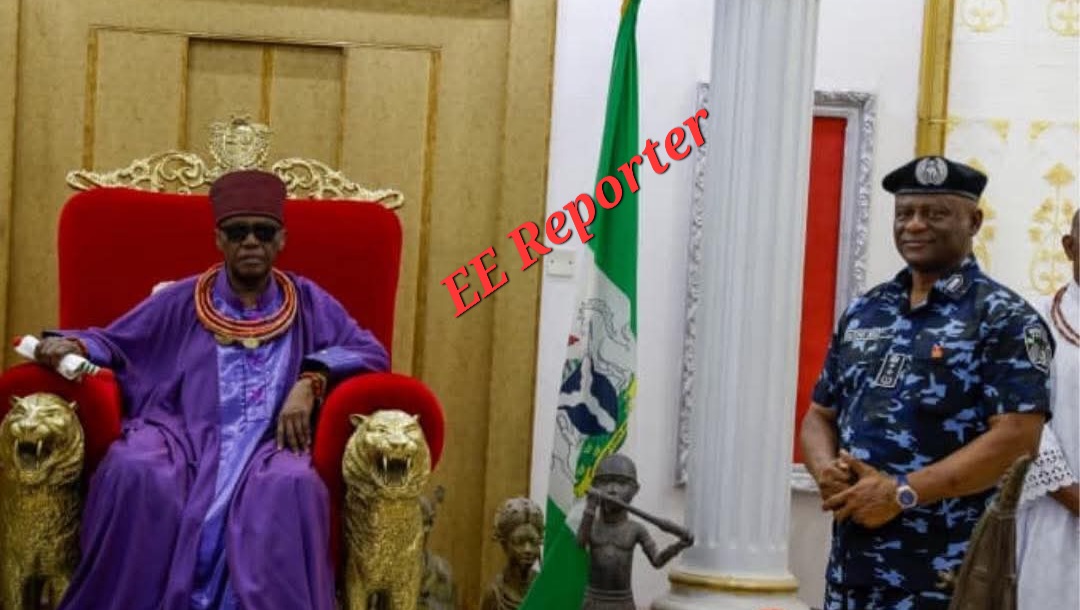
IGP Visits Oba Of Benin To Strengthen Security Collaboration Between NPF, Traditional Institutions
The Inspector-General of Police, IGP Olatunji Rilwan Disu, psc(+), NPM, paid a working visit to the Edo State Police Command as part of ongoing engagements aimed at strengthening policing operations and enhancing security across the State.
Eereporter.com
During the visit, the IGP also paid a courtesy call on His Royal Majesty, Omo N’Oba N’Edo, Uku Akpolokpolo, Oba Ewuare II, CFR, the 40th Oba of the historic Benin Kingdom, at his palace in Benin City.

Oba Of Benin, IGP
The engagements underscored the importance of collaboration between the Nigeria Police Force and traditional institutions in promoting peace, public safety, and community-based security initiatives within the State.












Nigeria Police Force Debunk Fake Statement on Training of 50,000 New Constables
The Nigeria Police Force has disclaimed a fake press statement circulating widely on social media, which claimed that the Inspector-General of Police, Olatunji Disu, had ordered the commencement of training for 50,000 newly recruited police constables.
Eereporter.com
The Force, in a disclaimer issued on Friday, said the document was not issued or authorised by any of its organs, despite being packaged to bear the letterhead of the Nigeria Police Force and the name of the Force Public Relations Officer, CSP Ani Iniedu.
The forged statement, which had been making the rounds on WhatsApp and other platforms, was titled, “IGP Olatunji Rilwan Disu Directs Commencement Of Training For 50,000 Newly Recruited Police Constables.”
It claimed that the IG had directed the Deputy Inspector-General of Police in charge of the Department of Training and Development to make arrangements for the training of the recruits in line with approved standards, with emphasis on discipline, professionalism, integrity, human rights and effective policing.
The fake release further claimed that successful candidates should begin checking the official police recruitment portal from Monday, September 14, 2026, for information on their allocated training institutions and dates of resumption.
It also purportedly quoted the IG as expressing appreciation to President Bola Tinubu for his support in tackling insecurity and strengthening the country’s security architecture.
But debunking the document, the Force said, “The Nigeria Police Force disclaims the purported Press Release titled, ‘IGP OLATUNJI RILWAN DISU DIRECTS COMMENCEMENT OF TRAINING FOR 50,000 NEWLY RECRUITED POLICE CONSTABLES,’ currently in circulation and bearing the name and designation of the Force Public Relations Officer, CSP Ani Iniedu, anipr.”
The Force cautioned members of the public, especially candidates seeking to join its ranks, against falling for the document, insisting that only its verified channels should be trusted.
It said, “Members of the public, particularly Police recruitment candidates, are advised to disregard its contents and rely only on information published through the official Police recruitment portal and verified NPF communication channels.”
The Force also revealed that it had commenced a manhunt for those behind the fabrication and distribution of the false statement, warning that they would face legal consequences once apprehended.

Police
It said, “The Force is currently on the trail of the persons responsible for generating and circulating the false document and will take appropriate legal action against those found culpable.”
The disclaimer comes amid a spate of fake recruitment-related statements attributed to security agencies, which have continued to mislead unsuspecting job seekers and members of the public.
Eereporter.com

Nigeria Police Arrest Suspects Over Obi’s Convoy Blockade in Benue
The Benue State Police Command has arrested some people in connection with the blockade of the convoy of the presidential candidate of the Nigeria Democratic Congress, Peter Obi, on Tuesday.
Eereporter.com
The Commissioner of Police, Cletus Nwadiogbu, who disclosed this at a press conference held in Makurdi on Wednesday, did not give the number of those arrested.
According to the CP, the police officers deployed for the visit of the former governor of Anambra State acted in a professional and tactical manner to avoid an escalation that could have resulted in loss of lives and destruction of property.
While stating that the tactical decision taken by the command should not be mistaken for inaction, the CP said that Obi was subsequently safely escorted back to the airport.
“Unfortunately, Mr. Obi’s movement was obstructed by a group of persons, creating tension and a situation that could have degenerated into violence.
“At that point, the Police took a professional and tactical decision to avoid an escalation that could have resulted in loss of lives and destruction of property. Mr. Obi was subsequently safely escorted back to the airport and departed the state peacefully.
The police boss, who said that the command remained a neutral and professional institution, added that every Nigerian has the right to freedom of movement, irrespective of political affiliation, status or personal belief.
“No individual or group has the right to unlawfully obstruct another person’s movement,” he said.

Peter Obi
The command assured the public that all those found culpable would be dealt with in accordance with the law.
He urged members of the public to remain calm and allow the police to conclude their investigation.
Eereporter.com
News
ICPC, NCS Advocate for a Robust Collaborative Framework to Safeguard Public and National Revenue

ICPC, NCS Advocate for a Robust Collaborative Framework to Safeguard Public and National Revenue
The Independent Corrupt Practices and Other Related Offences Commission (ICPC) has underscored the critical necessity of integrity within the Nigeria Customs Service (NCS), advocating for a robust collaborative framework to protect public revenue and bolster governmental trust.
Eereporter.com
The Commission articulated this stance during a high-level courtesy visit from the newly appointed Customs Area Controller for the Ondo/Ekiti Command, Deputy Comptroller Patience O. Ita, at the ICPC’s Ondo State headquarters in Akure.
During the meeting, the Resident Anti-Corruption Commissioner (RACC) for Ondo and Ekiti States, Mr. Tiku Andrew Menge, stressed that the NCS’s pivotal role in border management, enforcement, and trade facilitation renders ethical conduct paramount.
He warned that systemic revenue leakages and the abuse of regulatory powers not only erode public confidence but also critically impair the efficacy of state institutions, creating a fertile ground for corrupt practices.
Mr. Menge elaborated on the ICPC’s holistic preventive mandate, clarifying that its remit extends well beyond the investigation and prosecution of graft; further noting that the Commission is actively engaged in identifying systemic vulnerabilities and reinforcing institutional controls, thereby fostering an environment where corrupt activities are intrinsically difficult to initiate or sustain.
Highlighting the transformative potential of modernisation, the RACC advocated for the integration of technology, automation, and data-driven processes within Customs administration.
He explained that such advancements could significantly enhance traceability and accountability by curbing discretionary human intervention, though he cautioned that these measures must be underpinned by ethical leadership, rigorous supervision, and robust internal controls.
In a salient clarification, Mr. Menge asserted that the objectives of corruption prevention and trade facilitation are not mutually exclusive but are, in fact, symbiotic. He argued that transparent and predictable Customs processes effectively diminish the appeal of informal channels, thereby cultivating a more reliable and secure environment for legitimate commercial ventures.
Proposing a strategic roadmap for future collaboration, the Commissioner suggested that both agencies could benefit from practical engagements in corruption-risk identification, integrity sensitisation, and stakeholder dialogue.
He emphasised that such cooperation should be guided by the overarching public interest, rather than fostering a hierarchical dynamic where one institution supervises the other, but rather leveraging their respective mandates for a common good.
In her response, Deputy Comptroller Ita affirmed that her visit was primarily to establish a constructive working relationship following her recent deployment.

ICPC, Customs
She expressed her command’s unequivocal readiness to sustain engagement with the Commission on matters of mutual concern, particularly in the realms of compliance, enforcement, and the effective administration of public services.
However, Mr. Menge concluded with a firm caveat, reminding all parties that collaborative ventures must not compromise the statutory independence of either institution.
His parting words served as a stark reminder of the fundamental principles underpinning their shared mission: “Partnership creates trust; it does not create immunity.”
Eereporter.com
-

 Crime1 year ago
Kogi Assembly Considers Law To Regulate Rent, Establish Control Board: Tenancy Law
-

 News1 year ago
Atiku Reveals Why He Failed To Pick Wike As Running Mate In 2023
-

 Akwa Ibom2 years ago
The Apostolic Church Gets New Territorial Chairman, Exco
-

 Crime2 years ago
Federal High Court Jails 2 For Vandalizing Transformer, Telecom Mast In Kogi
-

 News2 years ago
The Apostolic Church Gets New National President, Executive
-
 Akwa Ibom2 years ago
Umo Eno Commences Payment Of 80,000 Naira Minimum Wage With Arrears
-

 News2 years ago
Senator Natasha Returns To Senate With Husband Amid Seat Dispute
-

 Economy1 year ago
Kiyosaki: Is Tinubu’s Government Afraid Of Ibrahim Traore?