
News
ICPC Uncovers Two More Fake Agencies in PFIPC Probe

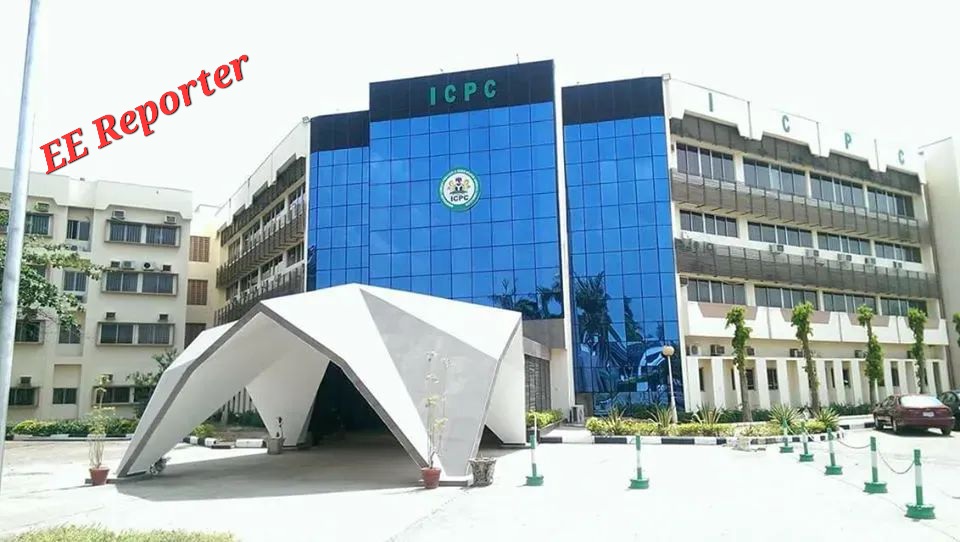
ICPC Uncovers Two More Fake Agencies in PFIPC Probe
The Independent Corrupt Practices and Other Related Offences Commission has uncovered two additional fake government agencies linked to Adeniyi Matthew Adeyemi, the self-proclaimed Director-General of the Presidential Foreign Intervention Promotion Council, as investigations into the alleged fraud deepen.
Eereporter.com
ICPC Chairman, Dr. Musa Adamu Aliyu, disclosed this on Thursday, while briefing State House correspondents after presenting the commission’s interim investigation report to President Bola Tinubu at the Presidential Villa, Abuja.
Aliyu said investigators established that Adeyemi was never appointed by the Federal Government and that the Presidential Foreign Intervention Promotion Council had no legal backing, having neither been created by an Act of the National Assembly nor by an executive order.
According to the interim findings, the appointment letter used by Adeyemi was forged, while the fake PFIPC unlawfully took over the offices and official instruments previously used by the defunct Presidential Economic Advisory Council.
The ICPC chairman said the syndicate operated from the former PEAC office and engaged in impersonation, false representation and other illegal activities by exploiting gaps in verification procedures and coordination among government agencies.
He revealed that investigators also discovered two other fictitious government agencies, the FCT Investment Promotion Agency and the Foreign Investment Promotion Agency.
“These agencies were created using forged legislative instruments and were used to open bank accounts for illegal activities,” he said.
Aliyu further disclosed that Adeyemi later altered the name of the fake organisation from the Foreign Investment Promotion Council to the Foreign Intervention Promotion Council in an attempt to broaden its scope to include revenue generation.
The commission recommended the prosecution of Adeyemi, disciplinary action against public officials alleged to have aided the operation of the fake agency, and reforms to strengthen internal controls across government institutions.
According to the report, officials from the Office of the Secretary to the Government of the Federation (OSGF), the Office of the Head of the Civil Service of the Federation, the Office of the Accountant-General of the Federation, the Budget Office of the Federation and the National Information Technology Development Agency (NITDA) were identified as collaborators in the scheme.
Aliyu stressed that investigations were still ongoing.
“The report is interim and the investigation continues to uncover more details to file criminal charges against Adeyemi and his collaborators,” he said.
He added that President Tinubu had been briefed on the findings and reaffirmed his administration’s commitment to transparency and accountability in resolving the matter.
The ICPC launched an investigation after questions were raised over the existence and activities of the Presidential Foreign Intervention Promotion Council, an organisation that allegedly presented itself as a federal agency despite lacking any legal foundation.
ICPC
Earlier investigations established that the council was never created by law, while its alleged director-general, Adeniyi Matthew Adeyemi, was found to have used forged appointment documents and unlawfully occupied facilities belonging to the former Presidential Economic Advisory Council.
Eereporter.com





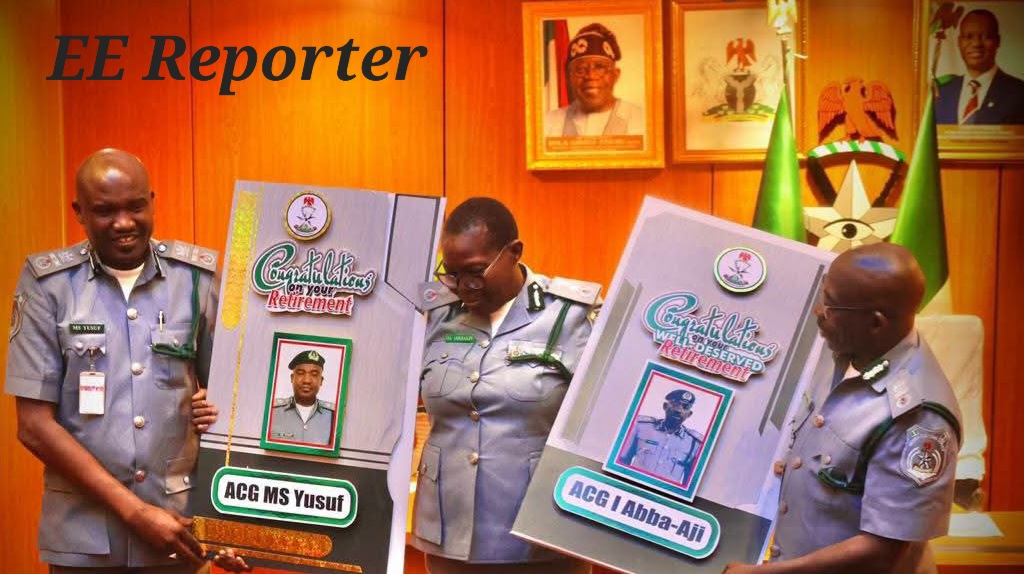
Nigeria Customs Celebrates Two ACGs After Meritorious Years of Service
The Nigeria Customs Service (NCS) has bid farewell to Assistant Comptrollers-General Mohammed Yusuf and Ibrahim Abba-Aji after meritorious years of dedicated service to the Service and the nation.
Eereporter.com
The two senior officers were honoured at a retirement ceremony attended by colleagues and friends, who celebrated their contributions, sacrifices and progression through the ranks during their careers in the NCS.
Deputy Comptroller-General, Finance, Administration, Technical and Support, Kikelomo Adeola, led the tributes, commending the retiring officers for their dedication and commitment. She described retirement as a transition “from pressure to pleasure” and wished them good health and fulfilment in the next phase of their lives.
DCG Trade and Tariff, Caroline Niagwan, also paid tribute to the officers, drawing on her long association with them to appreciate their contributions to the Service. She prayed that their tomorrow would be better than their today and that retirement would bring renewed purpose and satisfaction.
As part of the ceremony, DCG Timi Bomodi presented gifts to the retiring ACGs, while commemorative cards were also presented to the celebrants by colleagues, families and friends.
Speaking at the ceremony, ACG Mohammed Yusuf thanked God and the NCS management for the opportunity to serve. Reflecting on his career, he said, “Life is transient. We never thought we’d leave one day. The good you do stays after you leave; try and discharge your jobs well,” while appreciating the management for improvements in officers’ welfare.
ACG Ibrahim Abba-Aji also expressed appreciation to the Service and the Comptroller-General Adewale Adeniyi for the opportunity to serve at the highest levels of the institution. He described retirement as a milestone to be embraced, saying, “Retirement isn’t a bad thing. Congratulations to all of us for coming this far. Long live the Nigeria Customs Service.”

Nigeria Customs
The ceremony marked the close of active careers spanning 35 years for ACGs Mohammed Yusuf and Ibrahim Abba-Aji, as colleagues celebrated their service and wished them fulfilment in their retirement and the years ahead.
The event ended with a cake-cutting session to mark the completion of their 35 years of service.
Eereporter.com

39th Anniversary: Akwa Ibom Journalists Forum Congratulates Governor Eno, Citizens
The Akwa Ibom Journalists Forum, Abuja, has congratulated Akwa Ibom State Governor, Pastor Umo Eno, and the people of the state on the 39th anniversary of the creation of Akwa Ibom State.
Eereporter.com
In a congratulatory message dated September 23, 2026, and signed by the Chairman of the Forum, Dominic Edem, and Secretary, Nathan Williams, the journalists commended the Eno administration for its development initiatives under the ARISE Agenda.
The Forum specifically highlighted the administration’s efforts in road infrastructure, healthcare, agriculture, education and economic empowerment, describing them as areas with direct impact on the people of the state.
The journalists also acknowledged the government’s efforts towards the payment of retirees’ gratuities, the development of Ibom Air and the sustenance of peace and security across Akwa Ibom.
The Forum further congratulated Governor Eno on the commissioning of 39 projects across the state as part of activities marking the 39th anniversary.
It also commended the addition of a new Airbus A220-300 aircraft to the Ibom Air fleet, describing the development as another milestone in the state’s aviation sector.
The Akwa Ibom Journalists Forum, Abuja, reaffirmed its commitment to responsible journalism and constructive engagement in promoting the image, development and interests of Akwa Ibom State.

Akwa Ibom Journalists
The Forum said it would continue to play its role as journalists and stakeholders in the Akwa Ibom project by providing responsible coverage of developments in the state.
The journalists prayed for continued wisdom, strength and divine guidance for Governor Eno as he leads the state, while wishing Akwa Ibom continued prosperity, peace, unity and development.
The statement concluded with prayers for the progress of Akwa Ibom State and the Federal Republic of Nigeria.
Eereporter.com
NADF Sets to Boost Agricultural Funding with Non-interest Finance
The National Agricultural Development Fund has commenced the validation of its proposed Non-Interest Finance Framework and Guidelines to widen access to agricultural financing and support the Federal Government’s food security objectives.
Eereporter.com
This was contained in a statement issued by NADF on Tuesday following a Strategic Roundtable and Validation Session on the proposed framework and guidelines.
According to the statement, the initiative is aimed at ensuring that farmers, agribusinesses and other players across the agricultural value chain have access to diverse and innovative financing options.
The Executive Secretary/Chief Executive Officer of NADF, Mohammed Ibrahim, said non-interest finance had become an important component of Nigeria’s financial system, providing ethical, asset-backed and risk-sharing financing models that complemented conventional finance.
“Our objective is not simply to introduce another financing framework. It is to broaden the financing ecosystem for agriculture by ensuring that every credible financing option is available to Nigerian farmers, agribusinesses, and other value chain actors,” Ibrahim said.
According to the statement, the proposed framework would provide a structured and transparent basis for delivering agricultural interventions through licensed non-interest financial institutions while institutionalising governance, operational and Shari’ah compliance standards.
Ibrahim said the documents were deliberately presented as drafts to allow stakeholders to scrutinise them and contribute their expertise before finalisation.
“Today’s gathering marks an important milestone in that journey,” he said, urging participants to examine the draft documents critically, challenge assumptions where necessary and share practical experiences.
The statement quoted the Director of the Development Finance Advisory Department of the Central Bank of Nigeria, Dr Paul Oluikpe, as saying that significant work remained to be done to improve access to agricultural finance in Nigeria.
Oluikpe welcomed the proposed non-interest finance framework, describing it as an opportunity to bring an often-overlooked dimension of agricultural financing into the mainstream.
Also speaking, the Deputy Chairman of the CBN’s Financial Regulation Advisory Council of Experts, Professor Bashir Aliyu Umar, said the proposed framework was consistent with efforts to promote financial inclusion and expand access to finance.
“What we are witnessing today is also following this trajectory of financial inclusion and easing access to finance and having a level playing field and even developmental perspective for the whole country whereby no segment of society is left out,” he said.
NADF
Providing an overview of the initiative, NADF’s Head of Investment, Olalekan Alabi, said the framework and guidelines were designed to establish a structured mechanism for deploying non-interest financing to eligible agricultural activities and value-chain interventions.
“Together, the Framework and Guidelines are expected to provide clarity on how NADF’s non-interest financing interventions will be structured, assessed, approved, implemented, monitored and reported,” Alabi said.
He added, “We are not here simply to confirm that the documents have been prepared. We are here to test their technical robustness and practical applicability.”
Alabi said stakeholders were expected to identify gaps, inconsistencies, overlaps and provisions requiring further clarification before the documents were finalised.
“Our objective is to have a set of Framework and Guidelines that are clear, technically sound, operationally practical, appropriately governed and capable of supporting NADF’s non-interest agricultural financing interventions,” he said.
The statement said the validation session brought together representatives of government institutions and regulatory agencies, development partners, non-interest finance experts, financial institutions and other stakeholders in the agricultural and financial sectors.
Eereporter.com
-
 Crime1 year ago
Kogi Assembly Considers Law To Regulate Rent, Establish Control Board: Tenancy Law
-

 News1 year ago
Atiku Reveals Why He Failed To Pick Wike As Running Mate In 2023
-
 Akwa Ibom2 years ago
The Apostolic Church Gets New Territorial Chairman, Exco
-

 Crime2 years ago
Federal High Court Jails 2 For Vandalizing Transformer, Telecom Mast In Kogi
-
 News2 years ago
The Apostolic Church Gets New National President, Executive
-
 Akwa Ibom2 years ago
Umo Eno Commences Payment Of 80,000 Naira Minimum Wage With Arrears
-

 News2 years ago
Senator Natasha Returns To Senate With Husband Amid Seat Dispute
-

 Economy1 year ago
Kiyosaki: Is Tinubu’s Government Afraid Of Ibrahim Traore?