
Economy
Government Begins 6-Week Training For Teachers On Learning Deficiency In Bayelsa

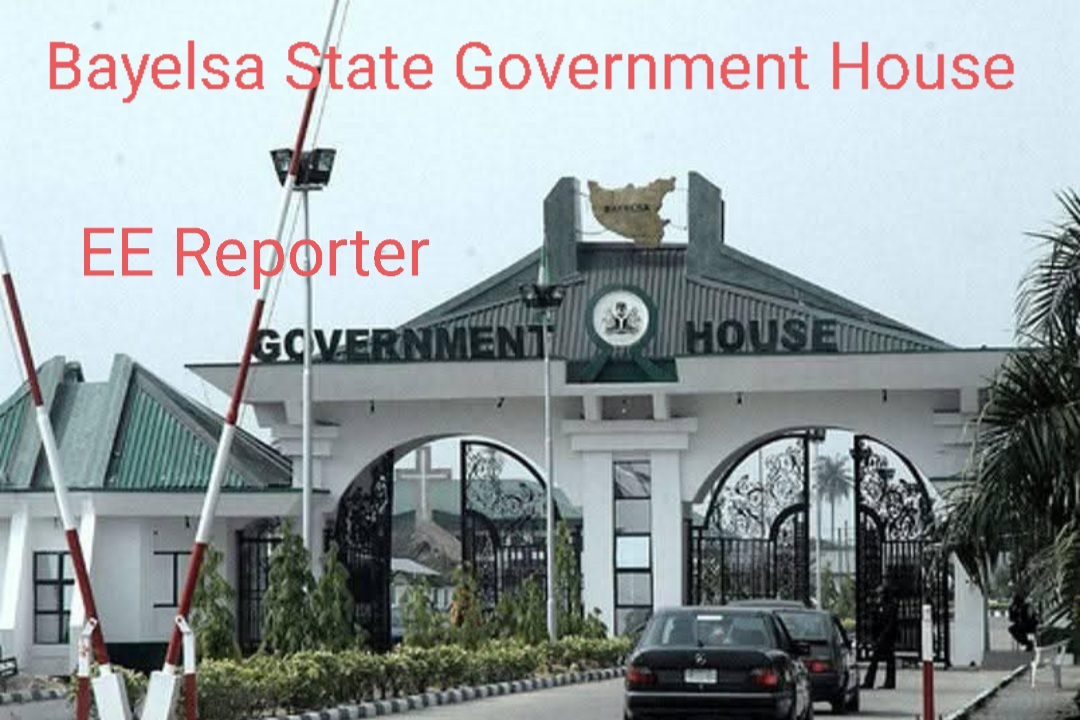
Government Begins 6-Week Training For Teachers On Learning Deficiency In Bayelsa
Government begins 6-week training for teachers on learning deficiency in Bayelsa. She urged the benefitting teachers to go beyond participating in the training to be advocates of inclusive education.
The Bayelsa Education Development Trust Fund (BEDTF), on Saturday, commenced a six-week training for teachers aimed at overcoming learning deficiencies among children in public schools.
The programme is a collaboration between the BEDTF and the Teachers Training, Registration and Certification Board (TTRCB) in partnership with the Bridge Academy in the United States of America.
Speaking at the opening ceremony, Gentle Emelah, commissioner of education in Bayelsa, noted that inclusive education, which emphasises special attention to students with learning disabilities, would make inclusive education a reality.
Mr Emelah, who was represented by Charles Daniel, chairman, Bayelsa Assembly committee on education, noted that education remains a priority to the Bayelsa government. He applauded the BEDTF for the training and urged the selected teachers to utilise the opportunity to accommodate children with learning difficulties.
In her remarks, Alice Atuwo, executive secretary of the BEDTF, noted that the fund had identified a gap in learning amongst children, noting that the learning needs of children with learning deficiencies were often neglected.
She explained that the training would be held in six modules every Saturday for the next six weeks.
“I am happy because we are here today to learn how to handle a critical sector in our educational system which has hitherto been neglected, that is special education or to be specific, learning disabilities.
“Research has shown that every child has what it takes to be great, no matter how challenged they may be, if given extra support from those who understand them.
“This is the crux of today’s training, where inclusive education is practised in every classroom.
Classrooms where children with special needs are given equal treatment, learning without discrimination,” Ms Atuwo said.
Also speaking, Peremoboere Ugolo, acting chairman of TTRC, noted that the concept of inclusive education would improve learning outcomes and urged the participating teachers and school administrators to imbibe and use the knowledge garnered.
She explained that teachers remained fundamental drivers in knowledge propagation in society and so are crucial in translating educational policies and in moulding the character of children under their tutelage.
Mabel Joel of the Bridge Institute, United States, noted that she volunteered her expertise in learning disabilities to give back to her state of origin, where she was born and raised.
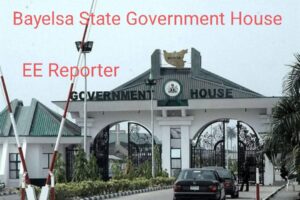
Bayelsa Government House
Mrs Joel, who is the resource person, delivered the training virtually from her United States base. She urged the benefitting teachers to go beyond participating in the training to be advocates of inclusive education.
She noted that children who showed signs of learning difficulties often turned out to be geniuses and great innovators who often make inventions that transform the world, adding that such children deserved inclusive learning.
Mrs Joel noted that teachers and school administrators were in a position to identify children with learning disabilities and give them the required attention by appropriate methodology to get them at par with others.
She urged the participants to go beyond being beneficiaries of the training to become ambassadors of inclusive education to bring out the best in Bayelsa children and help them develop their inert potential.








NNPC Ltd Offers N66 Fuel Discount Throughout the Nation
The Nigerian National Petroleum Company Limited (NNPC Ltd.) has unveiled a nationwide ₦66 fuel discount promotion for customers using the NNPC Fuel App.
Eereporter.com
In a post obtained from its X handle on Friday, the promotion, which runs from October 1 to 7, is being held across NNPC stations nationwide as part of activities marking the period.
“The ₦66 Discount Promo is ongoing & the excitement is already happening across our stations nationwide!
“All over Nigeria, our customers are getting in on the action & there’s still time for you to benefit!
The promo runs from 1–7 October on the NNPC Fuel App,” the post read.
NNPC said customers across the country have already begun participating in the promotion, with highlights from the first day showing activities at several stations.
“Keep fueling, keep transacting and keep your eyes on our pages,” the post read.

NNPC
NNPC also shared moments from the first day of the promotion and said more pictures and activities from stations across the country would be released.
The company urged customers not to miss the opportunity to participate before the promotion ends on October 7.
The ₦66 discount offer is available through the NNPC Fuel App during the stated promotional period.
Eereporter.com
President Tinubu Tells EFCC: You Have Justified my Confidence in You
President Bola Ahmed Tinubu has applauded the efforts and performance of the Economic and Financial Crimes Commission, EFCC, in tackling economic and financial crimes and other acts of corruption in the country, stressing that it has justified the confidence reposed on it.
Eereporter.com
He gave this commendation on Friday, October 2, 2026 in Awka, Anambra State at the commissioning of a new Zonal Directorate of the EFCC. The President pointed out that there are evidential proofs of the success of the Commission in convictions, recoveries and other landmark achievements
Represented by Honourable Tajudeen Abbas, Speaker, House of Representatives, Tinubu noted that “supporting the EFCC is not particularly difficult. The agency has consistently demonstrated that the confidence reposed on it is well founded. Without mincing words, the evidential proof of the EFCC’s success speaks loudly in convictions secured, assets and properties recovered”
He affirmed that the strides of the Commission are in tandem with the Renewed Hope Agenda of his administration.
“When we came in three years ago, I highlighted nine major focal areas of my administration. Two of which are reforming the economy for sustained and inclusive growth and promotion of good governance. The anti-graft agency compliments this agenda as they are focused on accountability and transparency and appropriate deployment of resources”, he said.
At the commissioning, the Executive Chairman of the EFCC, Mr. Ola Olukoyede restated the commitment of the Commission to preventive frameworks in tackling economic and financial crimes and other acts of corruption in the country.
According to him, the Commission will continue its focus on making corrupt practices difficult by blocking avenues through which they may happen.
“This new Directorate will not only enforce the law professionally and courageously, it will be high on corruption prevention. It will engage government institutions, businesses, financial institutions, professional bodies, schools, markets, civil society organisations, traditional institutions, religious bodies and communities. It will educate stakeholders, build relationships and mobilise the people to own the fight against all forms of corrupt practices in the zone”, he said
He assured Nigerians that the EFCC would not relent in the pursuit of its mandate, recalling the achievements of the Commission in the last 34 months and describing them as impressive progress.
“The pursuit of our mandate has been our dominant engagement and in the past few years, we have made impressive progress. Between October 2023 and July 2026, the Commission received 49, 673 petitions, investigated 39, 615 cases, filed 14, 476 cases in court and secured 10, 872 convictions. This gives a conviction-to-filing ratio of 75.1 percent. In the first half of 2026 alone, we recorded 1, 370 convictions from 1, 889 filings. The Commission also recorded recoveries of N1, 233, 612, 040, 411. 11, $684, 478, 457. 32, £373, 905. 78, €9, 343, 803. 66 inn addition to recoveries in other currencies”, he said.
He noted that at the institutional level, the Commission has made radical reforms that have been yielding optimal results as there are consequential improvements in the agency’s processes and procedures, which partly explains the impacts the EFCC has made and will continue to make in all the matrices of law enforcement.
“Reforms that have strengthened the Commission during the period include new guidelines on arrest and bail, a review of sting operations, the establishment of the Department of Fraud Risk Assessment and Control, the Security Department, the Immigration and Visa Section and the Cybercrime Rapid Response Centre”, he said.
While charging Ndi Anambra on whistleblowing, the anti-graft czar said that the Commission has established channels through which members of the public can submit petitions and provide information. He noted that the Commission’s Eagle Eye App allows citizens to provide details of suspected wrongdoing and makes the provision of an informant’s personal details optional. “However, whistleblowing must be responsible and based on facts. It must not become an instrument for settling scores”, he said.
EFCC
He thereafter said that Anambra and Imo States deserve effective and responsive institutional presence as they are renowned for enterprise, innovation, commerce and an extraordinary culture of industry, adding that these legitimate activities must be protected from fraud, cybercrime, money laundering, investment fraud, diversion of public resources and other forms of economic and financial crimes. “Therefore, our coming to Awka is beyond geographical expansion. It is about taking the mandate of the EFCC closer to the people and closer to the economic activities we are meant to protect”, he said.
In their remarks, His Excellencies, Professor Chukwuma Soludo, Governor of Anambra State and Senator Hope Uzodinma, Governor of Imo State said that they were pleased with the activities and management of the EFCC under the leadership of Olukoyede. They pledged their support to the Commission as it opened a new Zonal Directorate in their domain.
The commissioning of the new Directorate witnessed massive turn out of distinguished Nigerians, including members of the National Assembly, civil society organisations, community leaders, students, media among others.
Eereporter.com
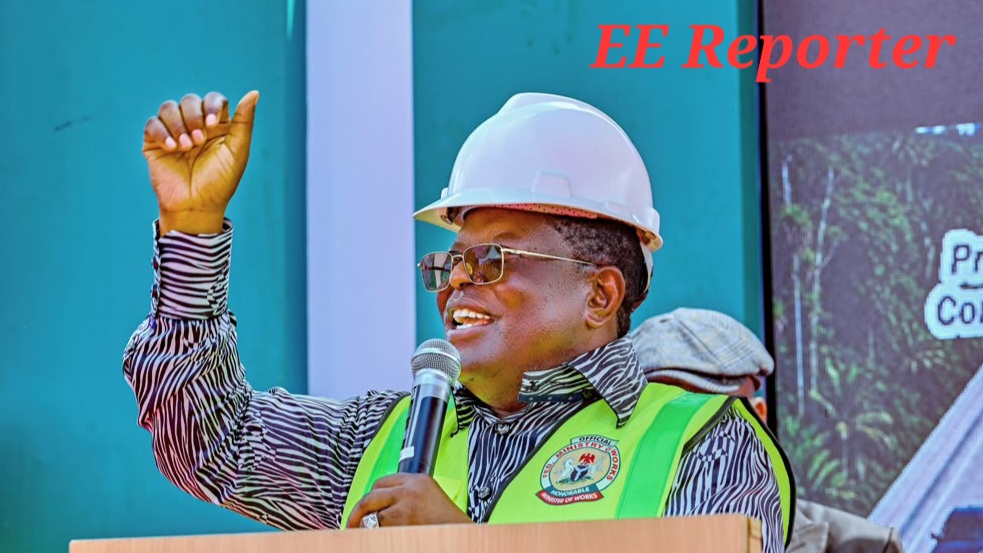
Umahi has Worked More than Obi for Southeast, Says Francis
Valentine Obienyem in his article titled “Dave Umahi and Incestuous Reasoning” praises Peter Obi as a model while offering no proof of what he delivered for Ebonyians or Ndigbo. That is the arithmetic of selective inclusion: Obi receives the credit for emptiness; Umahi receives the insults for the result delivered.
Eereporter.com
Beneath the rhetoric is a simple question he has refused to answer: What did Obi do for Ebonyians and the wider Igbo community that makes him the standard by which Umahi must be judged, or the candidate they should be expected to support?
However, I agree with some of his comments, especially when he said that Obi happened by circumstances. I feel this is truly the finger of God speaking through him. If not, what else could anyone say the phenomenon around Obi was about, if not the accident of EndSARS?
There is a saying that if one does not know where to place his hand, he holds his knees. That is exactly what happened with Obi and Obidients.
Now, the masses have seen what they consider the emptiness in all the struggles, the fake life, the false, the emptiness of promises and the contradictions in many of his speeches. The anger is that the truth is now becoming visible to many, and the rejection of Obi by those who have seen the light of day is becoming clearer. I understand his pain.
Obienyem begins by protesting that the Obidients do not attack people merely for opposing Peter Obi. But why make that defence unless the charge has a basis? His own words confirm the very conduct he tries to excuse. Attacks happen, he says, when they decide who to attack.
In other words, Obi’s supporters decide which disagreement deserves punishment. What a distasteful confirmation. A group that cannot tolerate opposition without branding its critics enemies of reason is not above reproach; it is simply a political attack dog. We are pleased to get your confirmation.
For clarification, let me mention and confirm that what Umahi said was that Ebonyi State would not vote for Peter Obi because he would not win. This does not exclude Ebonyi State from the Southeast.
He was particular about Ebonyi State because he was addressing Ebonyians at the time of his visit to the state, especially concerning the treatment meted out to Ebonyians living in Anambra State and the discrimination against them during Obi’s tenure as Governor, as well as Obi’s silence when major issues and struggles, such as the renaming of Abakaliki Street, were being discussed.
On several occasions, Umahi has told the people of the Southeast to utilise their votes and not waste them on Obi’s political venture, which will eventually fail. That is his advice and those are the words of wisdom which I equally encourage Obienyem to consider by looking inward, being realistic and possibly towing the same line.
I took time to go through his poorly constructed write-up to see whether he was able to mention Obi’s inclusiveness of Ebonyians in his cabinet or leadership circle. I was disappointed when I discovered that he was only able to mention that some of Obi’s security details were from Ebonyi State. What a disappointment.
It only confirms Umahi’s argument that the people of Ebonyi State were taken for granted, except when it came to security personnel who were naturally posted to serve their country in Anambra State. He could have equally mentioned that they were his house helps, but I understand his pain.
The reality today is that such an arrangement is no longer enough for Ebonyi State. The state has moved forward in pursuit of its own development and is not waiting for him and their ill plots.
Can he confirm whether people from Ebonyi State occupied or held any serious positions in Anambra State during Obi’s tenure as Governor, just as was the case during Umahi’s tenure in Ebonyi State?
Umahi’s record is easier to name.
Anambra-born Charles Emeka Akpuenika served as Ebonyi Commissioner for Youths and Sports. Rose Ezeadikwa served with the State Universal Basic Education Board. Mr. Chinaco Nzeakor was Special Assistant to the Governor on Internal Security. Rev. Euphraim Ononye served as Chairman of the Ebonyi State Pilgrims Board, while Uchem Oka was a Technical Assistant to the Governor.
These were people from Anambra who served in Umahi’s administration during his time as Governor.
That is the contrast Obienyem avoids. He praises Obi’s with anecdotes but does not produce a comparable list of Ebonyians appointed to meaningful roles under Obi.
I also want to agree with him when he said:
“In a breathless rush to make Ebonyi outpace its peers, he (Umahi) engaged in ‘vanity’ projects…”
Those words are correct, but perhaps not in the way he intended them, though with a mix of his attack-dog mentality.
He understands that Umahi was in a hurry to develop Ebonyi State while serving as Governor. Obi, on the other hand, took the opposite approach in Anambra. He can make his own assessment of the consequences, including the argument that funds that could have been used for development were kept idle while the state incurred debts and contractors were issued postdated cheques. All thanks to the leaders who came after him, who have continued to do everything possible to move Anambra forward.
Ibadan-Ijebu Ode
Let me tell him a little about how Umahi transformed Ebonyi State and pursued his aim of moving the state ahead of its peers. Umahi embarked on the construction of 14 twin flyovers at strategic locations, each of which was valued at between ₦1.8 billion and ₦2.5 billion at the time. This is something you should verify for yourself. Today, those same flyovers, if reconstructed at current costs, would cost between N15 billion and N30 billion. Many were achieved through direct labour. This is part of Umahi’s record. This is how he saved money for Ebonyians. This is the development we are talking about.
When he built the David Umahi Federal University of Health Sciences, the same philosophy was applied: achieving major projects with limited resources. Then there is the airport, which is at the stage of recommencing commercial flights. There is the Ebonyi State International Shopping Mall. There is the introduction of concrete roads across Ebonyi State, which has helped reduce the burden of road reconstruction on the current administration. These are just a few examples.
It does not appear that he did enough research before writing about Umahi. He need to go back and verify these things before attempting to speak about his record.
Yes, I remember that he earlier classified the Obidients as “attack dogs.” That was an interesting read.
In the Southeast, he should also acknowledge what Umahi has done through the instrumentality of President Bola Ahmed Tinubu, GCFR, particularly in the transformation of federal roads across the region. He is focused on deliberately connecting the Southeast to the Centre.
I am certain that it gives him some satisfaction when travelling from Enugu to Onitsha, both at night and during the day, and see the solar lights, the tree planting, the reinforced concrete pavement and the CCTV infrastructure underway. Yet he chose not to mention these in his write-up. Why?
The Enugu-Port Harcourt Road, the Eke-Obinagu Flyover, the access roads to the Second Niger Bridge, the repair and reconstruction of the First Niger Bridge and, very importantly, the Calabar-Ebonyi-Enugu-Benue-Nasarawa-Abuja Superhighway are all part of the infrastructure transformation currently taking place in Igboland courtesy of President Bola Ahmed Tinubu through Umahi. These are tangible projects. They are visible. They are projects people can see, feel and touch.
So, the question remains: What has Obi done for the people of the Southeast that should make them abandon what they are seeing and experiencing for something they have not seen? What has he done that is comparable to the visible and tangible infrastructure now being delivered in the region? That is the question he should answer.
David Umahi has served as Deputy Governor of Ebonyi State, Governor of Ebonyi State, Chairman of the South-East Governors’ Forum, Senator representing Ebonyi South and, today, Nigeria’s Minister of Works.
Peter Obi’s principal record in elected office is his tenure as Governor of Anambra State, he is not close to the breadth of Umahi’s political and public-service experience and result, particularly with Umahi now responsible for Nigeria’s works portfolio.
The references to Umahi’s family and to Mary Habila’s death do not provide the needed answers to the question asked.
Habila’s death has been publicly discussed, and her parents also spoke about her health condition while she was alive. It should not be turned into a political prop.
By using such words as “Judas,” “mad dog,” “crude” and “nonsense,” Obienyem has confirmed himself as an attack dog. Those are not arguments; they are personal attacks. What a distasteful confirmation.
The comparison remains clear. Umahi has demonstrated an approach to public service that has included people from different parts of the Southeast, infrastructure development in Ebonyi, regional leadership through the Southeast Governors’ Forum, representation in the Senate and, now, responsibility for a federal ministry whose projects reach across the Southeast and the country.
Obi offers a security detail, a palliative tour and private anecdotes, then asks the public to accept him as a champion. What a joke.
That is not enough. What has Obi done for the people of the Southeast to warrant support for him over President Bola Ahmed Tinubu, whose administration’s projects are visible across the region and whose public record is open to examination? Where are the durable, region-wide results? Where are the institutions and projects that demonstrate his impact across Igboland?
Umahi’s advice to Ebonyians is a political judgment and a call to use their votes according to their own interests and for the benefit of the people of the Southeast.
Ebonyi people have risen and are committed to President Tinubu through Umahi.
Francis Nwaze, FIPMD
Senior Special Assistant to the Honourable Minister of Works (Media)
Southeast Zonal Coordinator, New Media
2027 Tinubu/Shettima Presidential Campaign Council.
Eereporter.com
-
 Crime1 year ago
Kogi Assembly Considers Law To Regulate Rent, Establish Control Board: Tenancy Law
-
 News2 years ago
Atiku Reveals Why He Failed To Pick Wike As Running Mate In 2023
-
 Akwa Ibom2 years ago
The Apostolic Church Gets New Territorial Chairman, Exco
-

 Crime2 years ago
Federal High Court Jails 2 For Vandalizing Transformer, Telecom Mast In Kogi
-
 News2 years ago
The Apostolic Church Gets New National President, Executive
-
 Akwa Ibom2 years ago
Umo Eno Commences Payment Of 80,000 Naira Minimum Wage With Arrears
-

 News2 years ago
Senator Natasha Returns To Senate With Husband Amid Seat Dispute
-
 Economy1 year ago
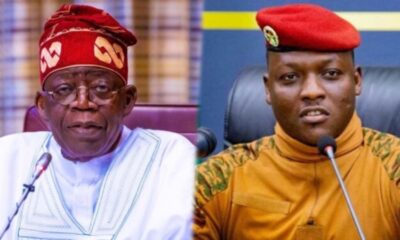
Kiyosaki: Is Tinubu’s Government Afraid Of Ibrahim Traore?