
Akwa Ibom
Akwa Ibom Community Accuse Sterling Petrochemical Of Wreaking Environmental Havoc, Forced Evictions


Akwa Ibom Community Accuse Sterling Petrochemical Of Wreaking Environmental Havoc, Forced Evictions
Akwa Ibom community accuse Sterling Petrochemical of wreaking environmental havoc, forced evictions. Uyo, Akwa Ibom State – The communities of Obianga and Ikonta in Eastern Obolo, Akwa Ibom State, have raised serious allegations against Sterling Petrochemical and Fertilizer Limited (SPFL), accusing the company of illegal actions that threaten their ancestral lands, livelihoods, and the environment.
Addressing the media, the spokesperson for the community and the village head of Emereoke, Chief Joshua Mathew Ayagwung, said the disputes stem from the acquisition of 1,736 hectares of land by the Akwa Ibom State Government in 2022, intended for SPFL’s operations.
The land was taken from several communities in Eastern Obolo, including Ikonta and Obianga.
The media briefing was attended by the Paramount Ruler of Eastern Obolo, (Rt. Hon). Uboon Harry J. Etetor, village heads of the affected communities, representatives from the Ijaw Youth Council (IYC), women’s groups, and the chairman of SPFL communities, Sir G. I. Harry, among others.
Ayagun stated that the acquisition of their lands had been accompanied by unlawful activities, including the forceful closure of creeks, planned displacement of entire villages, and severe environmental degradation.
Illegal Closure of Vital Waterways. A major point of contention is the closure of the Okolo Obianga/Ikonta and Okolo Otuita creeks, which are essential for the survival of the host communities. These waterways are federal navigable routes, serving as the only access points to and from the villages.
The statement asserts that despite a court order from the Akwa Ibom State High Court, the creeks were shut down by SPFL, allegedly backed by military personnel and militants.
“The closure has trapped our people, preventing access to markets, schools, hospitals, and other essential services,” stated the community leader. The blockade has already led to a cholera outbreak, which has claimed the lives of at least 20 people in one of the affected communities.
Forceful Displacement Plans. Further allegations center around a supposed plan by SPFL to forcibly relocate the people of Ikonta and Obianga, a move the community asserts they never agreed to. According to the communities, no clause in the tripartite agreement signed with the Akwa Ibom State Government and SPFL in 2022 supports such relocation.
“We have credible information that the company intends to drive us out of our ancestral homes,” the chief warned. “We will resist any attempts to displace us and will take legal action to protect our land.”
The forced displacement would exacerbate the crisis, as residents claim the company has already been poisoning the environment with hazardous substances, causing irreparable damage to the ecosystem, which is central to their livelihoods. Environmental Impact and Breach of Legal Framework
The residents have also accused SPFL of violating multiple environmental laws. There are claims that SPFL has failed to present an Environmental Impact Assessment (EIA) or an environmental management plan to address the damage caused by its operations.
Experts have reported that local fishing, the primary livelihood for the communities, has suffered, and the surrounding ecosystem has been significantly harmed.
Additionally, the company’s activities are said to be inconsistent with global sustainable development goals. There have been reports of severe pollution, including acidic rainfall and surface water contamination.
Violation of Local Content and Employment Laws. The communities have further criticized SPFL for violating Nigeria’s Local Content Law. Despite the law requiring certain jobs to be reserved for local workers, SPFL is accused of employing over 1,000 foreign nationals, primarily from India, for both skilled and unskilled jobs.
The company is also said to be awarding contracts to itself through a network of companies, bypassing local contractors.
The influx of foreign workers, many allegedly undocumented, has raised serious national security concerns, the residents argue, with calls for investigations by the relevant authorities.
Failure to Meet Corporate Social Responsibility. The residents also accuse SPFL of neglecting its social responsibilities to the host communities. Despite the company profiting from the land, the communities claim SPFL has failed to provide basic services like clean drinking water and infrastructure.
“The people of Emereoke are suffering from a cholera outbreak, and SPFL has done nothing to help,” said a local spokesperson. “This is a company that profits from our land but refuses to contribute to our well-being.”
Akwa Ibom
Demands for Immediate Action. In response to these grievances, the affected communities have made several demands, including the reopening of the blocked waterways to restore access for local residents.
They also call for an end to plans to forcibly relocate the people of Ikonta and Obianga, as well as compensation for the environmental damage, estimated at $100 million, and for trespassing on ancestral lands.
The residents have given SPFL a 14-day ultimatum to address their demands. Failure to comply, they warn, will result in “peaceful protests and all lawful means” to assert their rights.
Calls for Government Intervention. The communities have called on the Akwa Ibom State Government, the Federal Government, and international organizations to intervene and ensure that SPFL operates in compliance with Nigerian laws and international best practices.
The communities also request that relevant government agencies investigate the alleged illegal activities, particularly the presence of undocumented foreign workers and the use of armed groups to intimidate locals.









Akwa Ibom
Umo Eno Urges Stakeholders To Safeguard Educational Facilities, Distributes Materials, Sports Equipment
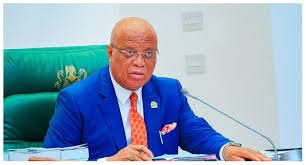
Umo Eno Urges Stakeholders To Safeguard Educational Facilities, Distributes Materials, Sports Equipment
Akwa Ibom State Governor, Pastor Umo Eno,PhD has charged teachers, school administrators, and community stakeholders to take collective responsibility in protecting and maintaining the facilities and materials provided by government to ensure their durability and continued impact.
The Governor spoke when he flagged off the distribution of teaching and learning materials, as well as sports equipment, to basic education schools across Akwa Ibom State, reaffirming government’s commitment to strengthening foundational education.
The items, acquired by Akwa Ibom State Universal Basic Education Board(AK-SUBEB), in collaboration with the Universal Basic Education Commission (UBEC), were distributed at the SUBEB Headquarters in Uyo to mark the first phase of the distribution exercise, to 75 primary schools and 33 junior secondary schools across the State.
Representing the Governor, the Commissioner for Education, Prof. Ubong Umoh, applauded teachers for their resilience and unwavering dedication to nurturing young minds.
He noted that the present administration which places high premium on basic education has injected a counterpart funding of N3.5bn yearly to access UBEC projects and programmes.
He further urged pupils and stakeholders to remain appreciative of government efforts and to make judicious use of the materials provided.
Prof. Umoh described Governor Umo Eno as a visionary and education-friendly leader who has consistently prioritized the welfare of both teachers and students as a strategic pathway to academic excellence.
Earlier in his opening remarks, the Chairman of AK-SUBEB, Rt Hon. Anietie Etuk, Ph.D, expressed profound appreciation to the Governor for his strong commitment to supporting education through collaboration with UBEC.
This, Dr Etuk said, has continued to yield positive outcomes in the basic education sector.
He highlighted the ongoing remodeling of primary schools across the 31 Local Government Areas as a clear demonstration of the administration’s commitment to revitalizing education at its foundation.
Dr. Etuk also extended gratitude to President Bola Ahmed Tinubu, GCFR, for his sustained federal interventions targeted at improving the learning environment for school children nationwide.
He noted that the current distribution exercise is part of such strategic interventions designed to bridge gaps and promote inclusive access to quality education.
Representing the UBEC Executive Secretary, Aisha Garba, the South-South Director of UBEC, Mr. Ossom Akapn Ossom, commended the AK-SUBEB Chairman for maintaining high standards and effective coordination within the sector.
He assured stakeholders that UBEC remains committed to rolling out additional programmes and interventions to further strengthen basic education delivery.
The SSA to the Governor on Research and Documentation, Dr. Essien Ndueso commended the Governor for his strong commitment to the education sector, noting that from his first day in office, he made it clear that massive investment in education would be a top priority.
Umo Eno
He emphasized that the governor’s interventions are driven by genuine concern rather than public showmanship, explaining that his focus remains on ensuring that children learn in comfortable and well-equipped environments.
Dr. Ndueso, further encouraged parents to enroll their children in public schools, stressing that the standard of facilities and quality of teachers now surpassed what’s obtained in some private schools.
Other dignitaries, including the Permanent Secretary, AK-SUBEB, Dr. Roseline Etuk, the Permanent Secretary of the State Secondary Education Board, and Dean of Education Secretaries Mr John Ekefre, in their separate remarks, lauded the collaboration between UBEC and SUBEB.
They described the initiative as timely and impactful, while also commending Governor Umo Eno for his visible commitment to educational development.
Akwa Ibom, Cross River Will Remain Brothers, Says Governor Eno
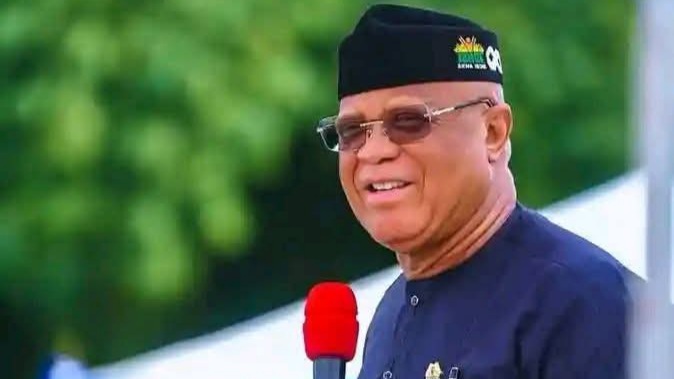
Akwa Ibom, Cross River will remain brothers, says Governor Eno…commends Helen Ukpabio for steadfast service to God, Humanity.
Akwa Ibom State Governor, Pastor Umo Eno, has reaffirmed the enduring bond between the people of Akwa Ibom State and Cross River State, describing both as brothers who must continue to live in peace and harmony.
The governor gave the assurance during a special Sunday worship service at Liberty Gospel Church in Calabar, where he urged Akwa Ibom indigenes residing and working in Cross River to promote peaceful coexistence and support the development of both states.
According to him, the historical relationship between the two states remains strong despite the creation of Akwa Ibom out of Cross River.
“The people of the two states will continue to be brothers because of our bond. Our unity, oneness and peace have always been our goal,” the governor said.
He noted that Akwa Ibom residents in Cross River should continue to pray for and work towards the peace and progress of their host state.
“Akwa Ibom State was created out of Cross River State, but then, we are still brothers. Those of you living here must not stop praying for the peace of Jerusalem as instructed in the Bible. Cross River State is your Jerusalem because you are resident here. Continue to live in peace, love and brotherliness for our overall growth,” he said.
Governor Eno also lauded the virtues of Apostle Helen Ukpabio, describing her as a servant of God whose life and ministry reflect integrity, dedication and compassion for humanity.
He urged the cleric to remain steadfast in her divine calling, noting that criticism often accompanies meaningful work and should not discourage those with genuine vision.
“As a matter of fact, I have come to learn that if people do not disagree with what you are doing, then you are not doing anything. They are free to disagree because God did not give them the vision but you,” he stated.
The governor further commended Apostle Ukpabio for what he described as being “consistently consistent” in her commitment to drawing people closer to God through her ministry.
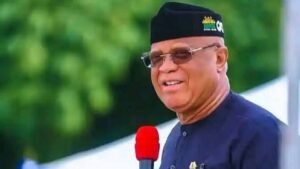
Umo Eno
In her sermon titled “Commanding the Blessing,” drawn from Book of Psalms 133:3, Apostle Akpabio explained that blessings are superior to curses and often manifest through God’s pronouncements of multiplication and dominion in the lives of believers.
She urged Christians to maintain personal and environmental cleanliness as a way of positioning themselves to receive God’s blessings in their lives and endeavours.
The cleric also described Governor Eno as a compassionate leader and pastor whose administration has demonstrated commitment to people-oriented development.
She thanked the governor for attending the church service and prayed for the continued success of his administration, asking God to grant him strength, grace and wisdom to lead Akwa Ibom State to greater heights.
Members of the governor’s entourage included the Dean of the College of Commissioners and Commissioner for Local Government and Chieftaincy Affairs, Frank Archibong; former senator Effiong Bob; President General, ARISE with Renewed Hope Initiative, Engr. Uwem Okoko; Commissioner for Information, Aniekan Umanah; and Commissioner for Works and Fire Service, Eno Ibanga, among others.
How Governor Umo Eno Creating Cities Out Of A City
How Governor Umo Eno creating cities out of a city. On Dominic Utuk Avenue in Uyo, the Akwa Ibom State capital, where a menacing erosion gully once swallowed land, livelihoods and hope, a new geography has emerged.
It is not merely a construction project; it is an audacious reimagining of space and the recreation of the biblical “City Made of Gold”. The ARISE Palm Resort standing on the space today is a proof that vision, when matched with execution, can convert ecological scars into economic signatures.
Before bulldozers progressively arrived the site, the 70–71 hectares were a troubled landscape—deep ravines, criminal hideouts, and advancing erosion threatening nearby public and private infrastructure. What could have remained an environmental liability has instead become an engineered ecosystem, courtesy of the visionary leadership of the Akwa Ibom State Governor, Pastor Umo Eno.
At the construction site of the “City” which unarguably is the first of its kind in Nigeria, ten to twelve metres of unstable earth have been excavated and replaced. A massive drainage control tunnel—about 3.5 metres high and 6 metres wide—now channels water responsibly. This is not beautification; it is environmental surgery, and the narrative shift from danger zone to economic citadel sends a powerful development message: decay is not destiny.
At the center of the resort is a cynosure of a Palm tree, which is both symbolic and instructive. This, perhaps, explains why Palm forms part of the name. In local culture, the palm tree represents resourcefulness—every part productive, every yield valuable. In similar fashion, the resort has been structured so that each facility—sports, hospitality, retail, conferencing, entertainment—becomes a revenue stream.
The foregoing implies that the ARISE Palm Resort is not an isolated beautification effort. It is a coordinated strategy aligning erosion control, tourism development, employment generation, renewable energy adoption and revenue expansion within a single framework. Few public projects attempt such multi-layered integration.
To understand the scale, one must see the resort not as a leisure park but as a multi-sector economic city. At its heart lies a nine-hole golf course built across hills, slopes and a bridge that spans a water channel—challenging terrain that meets international sporting standards.
Around it radiate villas, apartments, banquet halls, exhibition galleries, sports complexes, retail spaces and waterfront attractions. This is urban planning within a single perimeter.
Additionally, the economic projections are striking. When fully operational, the resort is expected to generate between ₦22 and ₦27 billion annually in internally generated revenue. In an era where subnational governments struggle with fiscal sustainability, this single development could significantly strengthen the state’s revenue base and foreign exchange inflows through tourism and events.
But macroeconomics often hides the human pulse. During construction alone, about 2,000 direct jobs were created, with an estimated 10,000 indirect engagements across supply chains. If each worker supports an average family of four, the livelihood impact extends to tens of thousands. Bricklayers, welders, ICT experts, gardeners, food vendors, POS operators—an entire micro-economy found oxygen.
Expressing her excitement about the all-in-one project, Grace Etim, a food vendor at the site confided thus: “I used to worry about feeding my children,” . “Now, lunch hour feels like harvest time.” Another artisan admitted candidly that steady site work kept many young men away from destructive paths. Development, in this sense, became a social stabiliser.
Significantly, the execution leaned heavily on local content. No expatriates dominated the workforce. Nigerian professionals—about 75 percent from Akwa Ibom—interpreted, developed and delivered the governor’s vision. It is infrastructure built by indigenous competence, reinforcing confidence in local capacity.
At the resort, power is not an issue as energy sustainability forms another pillar that makes the center unique and distinctively different. A 1.5-megawatt solar farm powers the complex, complemented by a dedicated public electricity line and standby generators. This layered power architecture reduces vulnerability and aligns with global hospitality standards where uninterrupted service is non-negotiable.
Again, security and institutional presence further reinforce investor confidence. With a police post, fire service station, clinic, pharmacy, bank, and 24/7 CCTV control room, the resort functions like a self-contained municipality. It is leisure fused with governance infrastructure—order embedded within recreation.
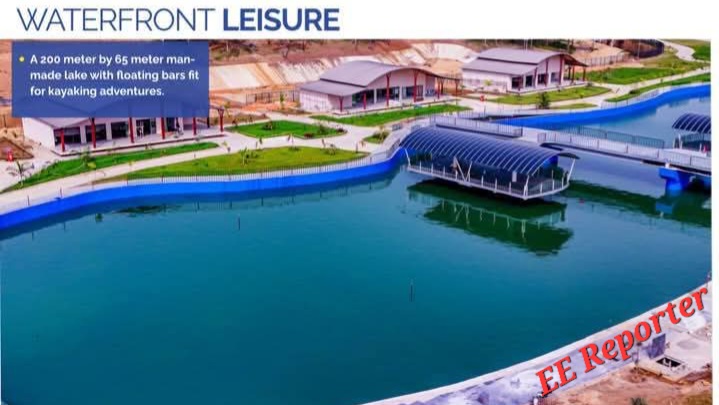
The artificial lake, stretching about 2.6 kilometres in its expanded design, introduces aquatic tourism—floating bars, canoe rides and planned electric boats. Waterfront dining and landscaped walkways extend over 1.5 kilometres, encouraging family recreation and wellness culture. It is environment curated as experience.
Sports tourism is another strategic layer. Beyond golf, other sporting activities that will take place at the resort include football, tennis, basketball, volleyball, badminton, squash, bowling, gymnastics and yoga. With a 1,500-capacity banquet hall expandable toward 2,000 seats and six breakout rooms, the resort positions Uyo as a conference and events destination capable of hosting national and international gatherings.
Quite commendable is the proximity of the resort to the Victor Attah International Airport. Delegates can land and arrive at a world-class leisure and conference environment within minutes. In tourism economics, accessibility determines viability. Here, geography cooperates with vision.
The residential component—20 luxury apartments (15 two-bedroom and five three-bedroom units) with smart-room features and curated services—signals long-stay hospitality potential. The Phase Two’s additional villas further amplify revenue streams and property value appreciation within the axis.
Critics may call it ambitious. Supporters may call it transformative. But its structural logic is undeniable: creating an attraction that multiplies value across sectors—agriculture (through food supply), transport, retail, entertainment, real estate and professional services. The multiplier effect is already visible in surrounding communities.
Importantly, the resort rebrands Uyo psychologically. Cities grow not only by population but by perception. A destination city attracts conferences, destination weddings, sporting tournaments and cultural festivals. Each event translates into hotel bookings, restaurant bills and transport fares.
How Governor Umo Eno Creating Cities Out Of A City
For Governor Umo Eno, this is more than bricks and landscaping. It is governance as place-making. By reclaiming a threatened terrain and converting it into a revenue-yielding asset, he demonstrates how leadership can create cities within cities—self-sustaining enclaves that relieve pressure on government finances while uplifting citizens.
Ultimately, the ARISE Palm Resort is a statement that development need not be incremental; it can be catalytic. From ravine to revenue hub, from erosion site to economic citadel, the transformation challenges conventional limits of subnational ambition.
In the final analysis, the ARISE Palm Resort is less about luxury and more about leverage. It leverages reclaimed land into revenue, recreation into employment, and vision into measurable economic value.
In doing so, it offers a template for how bold subnational leadership can indeed create cities out of a city—transforming geography into growth and aspiration into architecture. This is what the Arise Agenda of Governor Umo Eno represents- leadership with a human face.
Venerable Richard Peters is a Public Relations manager and writes from Uyo.
-
 Crime11 months ago
Kogi Assembly Considers Law To Regulate Rent, Establish Control Board: Tenancy Law
-

 News12 months ago
Atiku Reveals Why He Failed To Pick Wike As Running Mate In 2023
-

 Akwa Ibom1 year ago
The Apostolic Church Gets New Territorial Chairman, Exco
-

 Crime1 year ago
Federal High Court Jails 2 For Vandalizing Transformer, Telecom Mast In Kogi
-

 News1 year ago
The Apostolic Church Gets New National President, Executive
-
 Akwa Ibom1 year ago
Umo Eno Commences Payment Of 80,000 Naira Minimum Wage With Arrears
-

 News1 year ago
Senator Natasha Returns To Senate With Husband Amid Seat Dispute
-

 Economy10 months ago
Kiyosaki: Is Tinubu’s Government Afraid Of Ibrahim Traore?