
Akwa Ibom
Umo Eno Commissions 14.8km Road In Akwa Ibom Community


Umo Eno Commissions 14.8km Road In Akwa Ibom Community
Umo Eno commissions 14.8km road in Akwa Ibom community…upbeat on connecting Akwa Ibom with Abuja.
Governor Umo Eno has reaffirmed his determination to link all parts of Akwa Ibom State to the capital, just as he is taking decisions that will effectively link the State to Abuja.
The Governor who assured of maximum service to the entire people of the State, maintained that irrespective of the location of the political pendulum, “we remain who we are, and we will continue to pursue the ARISE Agenda in the interest of a United Akwa Ibom.
“It is in that unity that we find progress and that is what we will continue to do.”
Governor Eno narrated his ordeal on the reconstructed road while he resided in Eket, and maintained that it used to be difficult for him to get to the airport.
“He said his administration relied on a contractor with a good track record because of the importance of the road.
“We had to reconstruct this road, there were places you had to go in as if you are going into the valley of the shadow of death.
“We thank God for this road and we thank Setraco. When we are looking for reliable contractors, we will not forget you.”
“We thank Setraco for the good work they have done and for finishing the job within the one year timeline they were given”
The Governor acknowledged few spurs off the road that have been brought to his notice and promised to give attention to those new concerns.
He used the occasion to assure of his cordial relationship with the media, maintaining that the recent uproar over the reposting of some correspondents at Government House, was merely a routine occurrence in any establishment.
“I do not have any problem with the media. It is within the purview of the Chief Press Secretary to request for change of correspondents within the Government House.
“If you have served in a post for up to 10 years, and the Chief Press Secretary decides to request for a replacement, that is not a fight, it is within the prerogative of his office.
“The Governor does not have to know. This afternoon, Channels is here and they are beaming us live. Does it look like we have problem with them?”
The Governor said he will continue to work with all media houses, and announced that he will soon flag off the commencement of construction of an ultra- modern House for the Akwa Ibom Broadcasting Corporation in Uyo.
“My job is a very serious one, ensuring there is development, my job is to make sure there is welfare, my job is to make sure there is security. My job does not include checking which correspondent is being transferred from one location to another.
In a landmark event that reinforces his administration’s commitment to infrastructure renewal under the ARISE Agenda, Governor Umo Eno on Monday commissioned the newly-rehabilitated 14.28-kilometre Ikot Ubo-Odot Road, a critical link between Nsit Ubium and Nsit Atai Local Government Areas.
Speaking earlier on behalf of both LGAs, the Chairman of Nsit Ubium, Mr. Alfred Charles described the Governor as “the pride of Nsit Ubium and the son of the land of fulfillment.”
“This is the shortest route to the airport and had been due for rehabilitation for decades. We thank the Governor for fulfilling this long-standing need, and we pledge the unwavering support of our people until the very end of his tenure,” he declared.
Commissioner for Works and Fire Service, Prof. Eno Ibanga, provided technical insights into the project.
He explained that what has been delivered is not merely a resurfacing but a full-scale rehabilitation.
“This road had totally collapsed. We replaced both the base course and sub-base, introduced two culverts and 7.1 kilometers of drainage to manage runoff water.
It features a two-layer design—binder and wearing courses—guaranteeing durability for up to 30 years.
It was one of the first projects awarded in February 2024, with mobilization commencing in May 2024,” Prof Ibanga stated.
He commended Setraco Nigeria Ltd., the project contractor, for delivering the road to specification and praised the Governor for the foresight that birthed the initiative.
The event drew goodwill messages from a cross-section of political and community leaders. Chairmen of both the APC and PDP in Nsit Atai and Nsit Ubium, including Richard Thompson, lauded the administration for transforming access and mobility across the region.
Members representing Nsit Ubium and Nsit Atai in the Akwa Ibom State House of Assembly, Barr. Otobong Bob and Prince Attah, described the Governor as “the captain of Team Akwa United,” emphasizing the project’s far-reaching economic implications, even extending benefits to the Eket region.

Akwa Ibom
Federal lawmaker for Uyo Federal Constituency, Rt. Hon. Mark Esset, praised the Governor as “the golden governor and man of the moment.”
“What we are witnessing is full-scale construction. Your second term is non-negotiable. We are proud to speak confidently about you in the Green Chambers.”
Elder statesman, Rt. Hon. Nduese Essien, acknowledged initial skepticism when the road was first mentioned, admitting he considered it “political talk.”
However, he expressed surprise and delight at the quality and completion of the project, noting its strategic importance as the most direct route to the airport for his people in Eket and neighbouring local government areas.
Political leader of Uyo, Senator Effiong Bob, and other dignitaries also expressed gratitude for the Governor’s performance, reaffirming their support for his administration.
Commenting on the project, the Area Manager of Setraco, Mr Michel Issa expressed appreciation to the state government for the trust placed in his firm.
“This project is a testament to your inclusive governance and infrastructure vision. We are committed to maintaining the highest standards of delivery, and this road is no exception,” he said.
The commissioning ceremony marks another fulfilled promise under the Governor’s ARISE Agenda, underscoring his administration’s focus on people-centered development, connectivity, and economic growth.








Workers’ Day: Akwa Ibom Gov Announces N160m Support Fund, Gifts Labour Leaders Cars
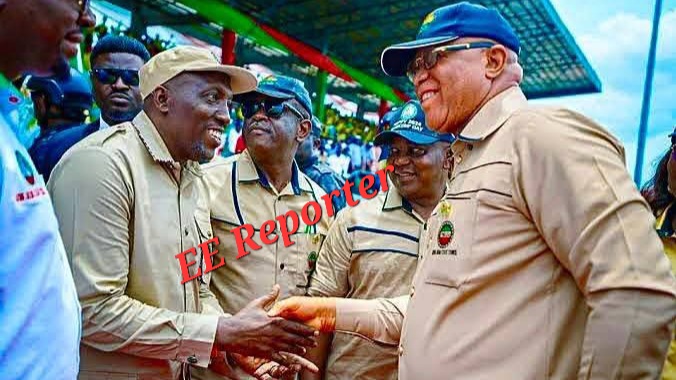
Akwa Ibom State Governor, Pst. Umo Eno has announced a support fund of N160 million for Akwa Ibom State Workers.
The Governor also gifted the Chairman of Trade Union Congress (TUC) Comrade Kingsley Akpan and the State Chairperson of the Joint Public Sector Negotiation Committee, Comrade Kingsley Ekong brand new Cars in commemoration of the day.
The Deputy Governor, Sen. Akon Eyakenyi who represented the Governor at the event, said it was a commitment by Gov Eno to supporting Akwa Ibom State Workers as their dedication, resilience and productivity have significantly boosted productivity in the state’s overall development.
She described Akwa Ibom as one of the most peaceful states in the country, attributing the steady influx of organisations and groups holding meetings in the state to its safety and stability, noting that recent commendations came in yesterday as the Inspector General of Police, Tinju Disu and the Chief of Air Staff, Air Marshall Sunday Kelvin further underscored the Government’s investments in security and peaceful coexistence.
“Just yesterday the IGP of Police and Chief Air Staff applauded the Gov for the peaceful and decent nature of the state.
“ And this speaks to the commitment and investment made by the Governor of the state.”
Eyakenyi, however, urged the Trade Union Congress to acknowledge the administration’s efforts in maintaining security and empowering youths, stressing that such initiatives had significantly contributed to the calm atmosphere in the state.
She disclosed that the leadership of the Nigeria Labour Congress and TUC had earlier paid a courtesy visit to the Governor to present key issues affecting workers, noting that the Governor promptly constituted a committee to address the concerns within one month.
She also paid tribute to the outgoing NLC Chairman, Comrade Sunny James, praising his patriotism and commitment to the growth of the state as she expressed optimism that he would continue to contribute to development even after his tenure.
Eyakenyi announced further that the state government was rewarding Comrade Akpan and Mr. Ekong, with official vehicles to support their work. She reiterated the government’s commitment to worker’s welfare, including the payment of gratuities, revealing that about N82 billion had been paid out of over N100 billion.
She added that the government had also provided housing for civil servants through a transparent raffle system and sustained training programmes to enhance manpower development, pledging that worker’s welfare would remain a top priority of the administration.
The Special Adviser to the Governor on Labour Matters, Sir Udo Kierian, in his tone setting, said May Day remained a significant occasion set aside globally to celebrate hardworking employees across both public and private sectors, noting that the state workforce had every reason to celebrate in view of the government’s favourable policies.
He stated that since assuming office in May 2023, the governor had carried workers along in governance, adding that the administration’s vision and mission had been effectively interpreted through various ministries and government offices.
Also, the NLC State Chairperson, Comrade Sunny James, commended the administration of Governor Eno for efforts in promoting workers, and sued for a more speedy process in implementation.
He also appreciated the Governor for paying gratuities till date.
“We have a leader who loves workers and is gradually clearing gratuities,” he said.
James described his tenure which began in April of 2019 as “not an easy one” noting that despite challenges, his leadership has recorded significant strides in representing workers’ interest.
He urged workers to remain committed and united as he bows out honourably in few months.
He further noted that even in moments of disagreement, Governor Eno had consistently demonstrated a willingness to find common ground, resolving issues amicably.
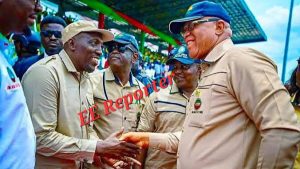
Akwa Ibom Governor
In their various solidarity messages, Head of Civil Service, Mrs. Elise Peter, Speaker, House of Assembly, Rt. Hon. Udeme Otong, Chief Judge represented by Justice Effiong Effiong, TUC Chairman Mr. Akpan, State Chairperson Joint Public Sector Negotiation Committee, Comrade Akpan, commended the Governor for his commitment to worker’s welfare, noting that despite occasional disagreements, the governor had always sought for ways of bettering the lots for workers.
They also acknowledged his administration’s efforts in promoting workers, mobilising contractors back to sites, and gradually clearing outstanding gratuities, while expressing optimism that the existing cooperation between labour and government would further enhance development and industrial harmony in the state.
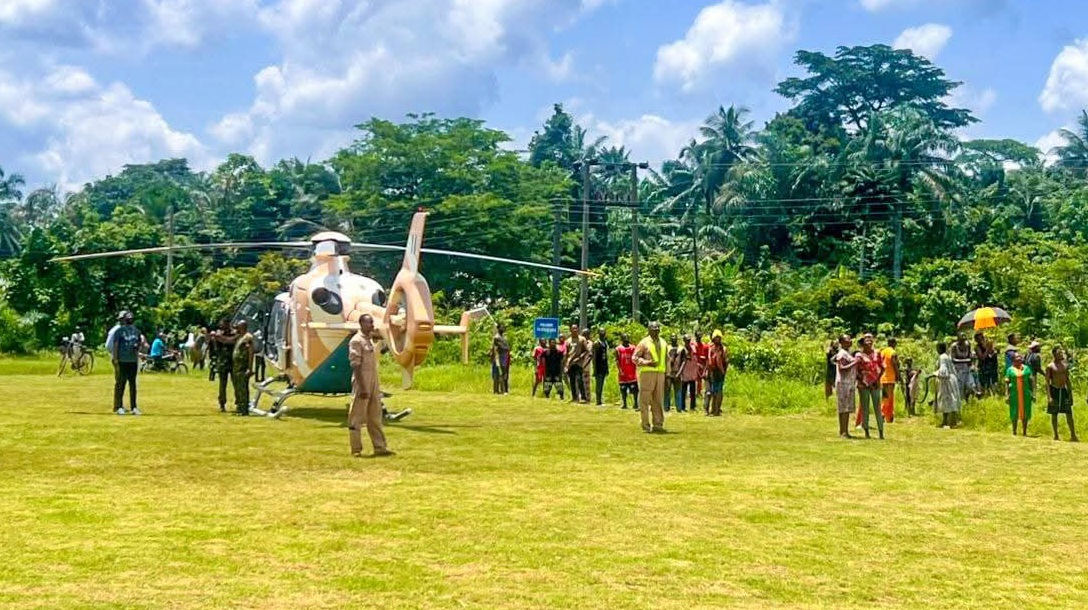
NAF Helicopter Landing Inspires Youths, Strengthens Bonds In Akwa Ibom Community
A routine flight turned into an unforgettable moment in Nsit Ibom as Nigeria marked Workers’ Day. The Nigerian Air Force (NAF) demonstrated its people-focused service during a routine liaison mission within the Niger Delta area.
While en route on the mission, the crew executed a precautionary landing at a primary school football field in Nsit Ibom LGA, in line with standard safety procedures.
The unexpected arrival of the helicopter transformed the quiet community space into a scene of excitement, drawing children and youths from Afaha Abia and Ikot Obio Asanga villages, many witnessing a military helicopter up close for the first time. What began as a routine mission quickly evolved into a meaningful moment of connection and inspiration.
Eereporter.com
Seizing the opportunity, NAF personnel engaged warmly with the young audience, sharing insights into career pathways and emphasizing the values of discipline, service, and patriotism. The interaction ignited hope and aspiration among the youths, with several expressing a desire to join the Service.
NAF
Seamless coordination between Nigerian Air Force and Nigerian Army personnel, alongside the warm reception by community leaders, further reinforced the strong bond between the military and the people.
Following necessary aviation procedures, the helicopter safely departed and has since returned to base, leaving behind more than just a story, it sparked hope, pride, and stands as a powerful testament to the Nigerian Air Force’s enduring commitment to national defence, community engagement, and inspiring the next generation.

Akwa Ibom Airport Commences International Operations With Maiden Flight To Ghana
Today, the people of Akwa Ibom State rolled out the drums, once again, in celebration of a milestone achievement with the completion of the international terminal and the commencement of international operations at the Victor Attah International Airport.
Eereporter.com
The Minister of Aviation and Aerospace Development, Festus Keyamo, SAN, was on ground, and officially declared the airport ready for international operations.

Ibom Air
The State Governor, Pastor Umo Eno, expressed satisfaction with the development, saying, “I am indeed proud to be an Akwa Ibomite.”
Details Loading >>>
-
 Crime1 year ago
Kogi Assembly Considers Law To Regulate Rent, Establish Control Board: Tenancy Law
-

 News1 year ago
Atiku Reveals Why He Failed To Pick Wike As Running Mate In 2023
-
 Akwa Ibom2 years ago
The Apostolic Church Gets New Territorial Chairman, Exco
-

 Crime1 year ago
Federal High Court Jails 2 For Vandalizing Transformer, Telecom Mast In Kogi
-
 News2 years ago
The Apostolic Church Gets New National President, Executive
-
 Akwa Ibom2 years ago
Umo Eno Commences Payment Of 80,000 Naira Minimum Wage With Arrears
-

 News1 year ago
Senator Natasha Returns To Senate With Husband Amid Seat Dispute
-
 Economy1 year ago
Kiyosaki: Is Tinubu’s Government Afraid Of Ibrahim Traore?