
News
Rivers Proxy Battle Between Nyesom Wike, Simi Fubara Before Supreme Court: Chidi Odinkalu

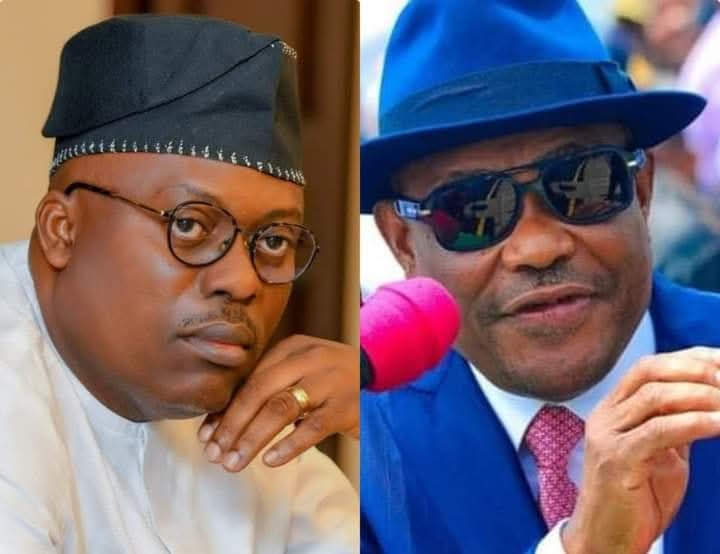
Rivers Proxy Battle Between Nyesom Wike, Simi Fubara Before Supreme Court: Chidi Odinkalu
Rivers proxy battle between Nyesom Wike and Simi Fubara before dupreme court. One important difference, though, is that the issues in Rivers State today hardly involve principle or the public interest.
Depending on one’s perspective, February 10, 2025, promises to be Proxy Wars Day at the Supreme Court of Nigeria in Abuja.
On that day, a panel of five Justices will hear arguments on seven appeals connected with the synthetic political crisis in Rivers State.
The issues that the court will be asked to decide include the validity of last October’s local government elections in the state, the fate of the faction in the Rivers State House of Assembly that claims to have switched affiliations from the Peoples’ Democratic Party (after being elected on the platform) to the ruling All Progressives Congress (APC), the legality of the state’s 2025 budget passed by the rump of the state House of Assembly, and the effort to importune judges into denying Rivers State access to its share of the federation account.
The effort to frame these as legal issues is transparently valiant.
Despite the shameful conversion of judges into politicians in the Rivers State crisis—or indeed because of precisely that fact—the imminence of Rivers State Proxy Wars Day at the Supreme Court is evidence of what has gone wrong with Nigeria’s judicial system and why fixing it is essential for the health of Nigeria’s attempt at government with electoral legitimacy.
This is not the first time that legal disputes about power and how to share the spoils from it have ended up at the highest court in the land.
That tendency in Nigeria is over a century old. It arguably goes back to the 1921 judgment of the Judicial Committee of the Privy Council in the case of Amodu Tijani over the effort by the colonial authorities to split Herbert Heelas Macaulay from his support for Eshugbayi Eleko, the Oba of Lagos.
To hear those cases before the Judicial Committee of the Privy Council in 1920, Herbert Macaulay travelled to London with the Oba’s Staff of Office in support of Amodu Tijani and the Idejo Chiefs of Lagos.
From London, he issued a statement claiming that the Eleko was the King of over 17 million Nigerians and in possession of territory more than three times that of Great Britain.
Despite a healthy revenue of over £4 million, he claimed, the British had reneged on a treaty commitment to compensate the Eleko.
Embarrassed at being publicly called duplicitous in this way, the British required the Eleko to disown Herbert Macaulay.
He issued a public statement clarifying his position on Herbert Macaulay’s statement but declined to disown him through the Oba’s Bell Ringers, as the Brits required.
Unable to secure the popular Eleko’s support, the colonists decided to head off rising tension by deposing him.
On 6 August 1925, they issued an ordinance de-stooling him, and two days later, on 8 August, they arrested and removed Eleko for internal banishment in Oyo. In his place, they installed Oba Ibikunle Akitoye.
Oba Akitoye’s rule lasted an uncomfortably brief three years, largely because he lacked the support of the people of Lagos. Indeed, in 1926, he suffered a physical assault by his people.
Supported by the elite and people of Lagos, the deposed Eleko took his case to the courts, fighting again to the Privy Council, which decided on 19 June 1928 in favour of his claim for leave for a writ of habeas corpus. This sealed the fate of Oba Akitoye, suspected to have facilitated his earthly demise shortly thereafter.
The crisis in Rivers State shares some unsettling similarities with the events in Lagos nearly one century ago.
In Rivers today, as in Lagos then, a powerful man – in this case, the current Minister of the Federal Capital Territory and immediate past governor of Rivers State, Nyesom Wike – seeks to banish the current governor of Rivers State, Siminalayi Fubara, from office using surrogates beholden to him in the state House of Assembly.
One important difference, though, is that the issues in Rivers State today hardly involve principle or the public interest. Framed though they are in legalese, these cases from Rivers State are about power and money grab.
This is not a first. It is the standard procedure of the current FCT Minister to seek to inveigle judges into acting as his political surrogates under a ruse of law.
In instigating this crisis, Mr Wike suffered a characteristic failure of his frontal lobe. He forgot his public vow to “give himself that respect” and not interfere in the affairs of the state after his exit from the office in May 2023. Rather, since leaving office as the state governor, Mr Wike has sought to install himself as the minister in Abuja and sole administrator in Port Harcourt.
He makes no effort to conceal that much of what passes as his political dare-devilry appears to be accomplished under the influence of sufficiently gluttonous amounts of dangerous beverage to entitle him to access to a defence of automatism in criminal law.
In October 2024, he told Seun Okinbaloye on Channels Television with undisguised hubris that the only solution to the crisis in Rivers State was for the incumbent governor to “obey court judgment.”
This was no advocate for the rule of law, however. Instead, Mr. Wike projected an air of political impregnability purchased with a currency bearing a distinct whiff of procured judicial cookery.
This is not entirely unexpected of an ambitious Nigerian politician without an alternative address (apologies to Deji Adeyanju). What is more difficult to overlook is the high judicial tolerance for the undisguised political importuning of judges.
Nigeria’s judicial system has been overtaken by a category known as “political cases.” In November 2023, former Chief Justice of Nigeria, Olukayode Ariwoola, reported that his Supreme Court registered 1,271 motions and appeals from September 12, 2022, to July 11, 2023. The court “heard 388 political appeals, 215 criminal appeals and 464 civil appeals.”
Two years earlier, in 2021, Ariwoola’s predecessor, Tanko Muhammad, reported that the court’s portfolio of 269 appeals disposed of included 139 civil appeals, 102 criminal appeals, and 28 “political cases”.
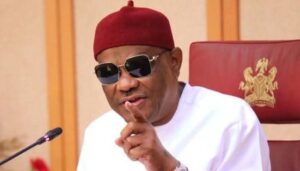
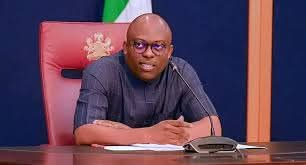
Nyesom Wike
According to CJN Ariwoola’s report, the court “delivered a total number of 251 judgments, of which 125 were political appeals, 81 were civil appeals, and 45 were criminal appeals.” The court’s output fell by 6.69% in just two years, but “political cases” rose from 10.67% to 49.8%. Even allowing for the fact that 2023 was an election year, this is a system collapse.
Nigeria’s judges appear to have decided that politicians are the only people entitled to exit from the courts. In turn, the politicians are happy to enjoy this exclusivity and to overwhelm the courts to the point that even judges now complain. They hire the priciest lawyers to frame undisguised power and money grabs as questions of law.
The Supreme Court can end this, but it is reluctant. Instead, the court affords powerful politicians the tolerance they are unwilling to extend to lesser mortals, preferring to enable this joint enterprise of senior lawyers and politicians. At the same time, it fetters its capacity to determine what should be a question of law deserving of its rarefied attention.
This sucks for many reasons. It prostitutes the bench, casualizes the constitutional guarantee of fair trial “within a reasonable time,” and portrays the judiciary as captured.
To describe this as Supreme pusillanimity is to be generous. It is a form of judicial lasciviousness syndrome, promenading judicial wares before political gawkers in a peonage system where the only effective currency is high political patronage.
The Supreme Court can make a bold statement in these Rivers State cases. It should be ready for many more proxy war days if it doesn’t.








News
Remi Tinubu Condemns Ozoro ‘Rape Festival’, Says “No Tradition Allows Violation Of Women’s Rights”
Remi Tinubu Condemns Ozoro ‘Rape Festival’, Says “No Tradition Allows Violation Of Women’s Rights”
Remi Tinubu condemns Ozoro ‘rape festival. Mrs Tinubu maintained that no custom can justify violence or abuse against women.
In a statement on her X page on Sunday, Mrs Tinubu said she watched “horrific viral footage” showing girls being physically and sexually assaulted and subjected to humiliation and cruel treatment during what was meant to be a community celebration.
While expressing respect for Nigeria’s diverse cultures and traditions, she mentioned that no custom can justify violence or abuse against women.
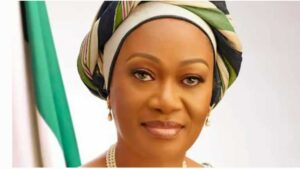
Oluremi Tinubu
“No tradition or custom grants any man the right to violate the dignity or freedom of any woman or girl,” she said.
The first lady commended the Nigeria Police Force for the arrest of suspects and urged authorities to ensure that all perpetrators face the full weight of the law.
She also encouraged victims to seek medical and psychological help, and offered her prayers.
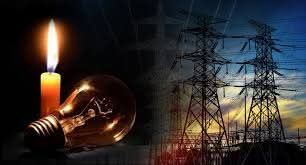
Persistent Grid Collapse, Weak Power Supply Worsening Economic Hardship: Oyintiloye
Speaking with journalists on Sunday in Osogbo, Oyintiloye said the situation had continued to deteriorate despite assurances and reforms introduced by authorities.
He described unreliable electricity as a major setback to the federal government’s reforms in the power sector.
He appealed to President Bola Tinubu to urgently intervene, noting that poor power supply is worsening economic hardship across the country.
Oyintiloye said the poor supply has compounded the effects of the current heatwave, making living conditions more difficult for many Nigerians.
The former lawmaker called for the constitution of a panel to investigate recurring national grid collapses and persistent supply challenges despite significant investments.
“It is a terrible situation across Nigeria with persistent poor power supply,” he said.
“Many small-scale businesses and large industrial players are affected, while most homes cannot boast of even three hours of electricity supply daily for domestic use.
“Despite numerous reforms and promises, the national grid continues to collapse. The situation is now compounded by gas supply shortages, weak transmission infrastructure, and chronic underinvestment across the power value chain.
“Nigerians are groaning, and urgent action must be taken by the Minister of Power, Adebayo Adelabu, and his team. The situation cannot continue like this.”
Oyintiloye warned that the situation has already triggered protests in parts of the country and could escalate if not addressed promptly.
“The situation must be quickly addressed before it becomes a national embarrassment. Nigerians need to be informed whether the issue is due to structural failure or sabotage within the power sector,” he said.
Electricity
“This epileptic power supply has led to a series of peaceful protests nationwide. I appeal for the President’s intervention before these protests turn violent.
“Electricity is essential for households and the survival of businesses. Since the end of last year, there has been no stable power supply across the country, despite assurances by those in charge and huge investments in the sector.
“Poor power supply should not be added to the challenges Nigerians are currently facing. The high cost of fuel has also made it difficult for those relying on generators to cope.”
News
CAS Kelvin Aneke Commends Troops Sacrifice, Reaffirms Operational Resolve At Eld-el-fitr Luncheon In Kaduna
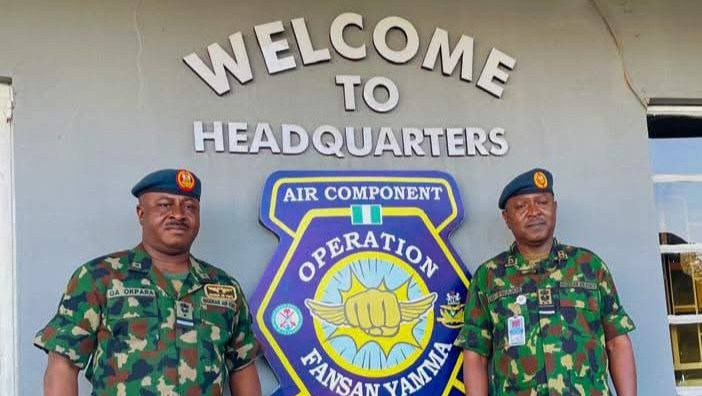
CAS Kelvin Aneke Commends Troops Sacrifice, Reaffirms Operational Resolve At Eld-el-fitr Luncheon In Kaduna
The Chief of the Air Staff (CAS), Air Marshal Sunday Kelvin Aneke, on 21 March 2026, hosted Nigerian Air Force personnel at an Eid-el-Fitr luncheon held at the Joint Task Force North West, Operation Fansan Yamma Sector 1 in Kaduna, in recognition of their sacrifices in ongoing counter-terrorism operations.
Represented by the Chief of Communications Information Systems, Headquarters Nigerian Air Force, Air Vice Marshal DD Pwajok, the CAS commended personnel for their resilience, professionalism, and steadfast commitment to national security.
He emphasised that the spirit of sacrifice and devotion symbolised by Eid reflects the core ethos of military service, while reaffirming the Nigerian Air Force’s continued focus on operational readiness, personnel welfare, training, and the enhancement of air capabilities. He also expressed appreciation to President Bola Ahmed Tinubu for his sustained support to the Service.
In his remarks, the Air Component Commander, Air Commodore OA Okpara, conveyed profound gratitude for the CAS’s unwavering support, noting that it has significantly strengthened morale and operational effectiveness.
Kelvin Aneke
He highlighted the impact of sustained air operations, precision engagements, intelligence, surveillance, and rapid mobility missions in disrupting terrorist activities, constraining their freedom of movement, and improving security conditions across affected communities. He reaffirmed the resolve of personnel to maintain operational momentum and consolidate gains achieved in the theatre.
The event, marked by cultural performances, entertainment, and the presentation of souvenirs, reinforced unity, camaraderie, and esprit de corps among personnel, while also providing an opportunity for reflection on shared values of sacrifice, discipline, and service to the nation.
Such engagements continue to strengthen cohesion, inspire renewed dedication, and underscore the Nigerian Air Force’s enduring commitment to professionalism and mission success in the defence of Nigeria.
-
 Crime11 months ago
Kogi Assembly Considers Law To Regulate Rent, Establish Control Board: Tenancy Law
-

 News12 months ago
Atiku Reveals Why He Failed To Pick Wike As Running Mate In 2023
-
 Akwa Ibom1 year ago
The Apostolic Church Gets New Territorial Chairman, Exco
-

 Crime1 year ago
Federal High Court Jails 2 For Vandalizing Transformer, Telecom Mast In Kogi
-
 News1 year ago
The Apostolic Church Gets New National President, Executive
-
 Akwa Ibom1 year ago
Umo Eno Commences Payment Of 80,000 Naira Minimum Wage With Arrears
-

 News1 year ago
Senator Natasha Returns To Senate With Husband Amid Seat Dispute
-
 Economy10 months ago
Kiyosaki: Is Tinubu’s Government Afraid Of Ibrahim Traore?