
News
The Man Who Saw Tomorrow: Senator Akpabio And The Uncommon Politics Of Certainty

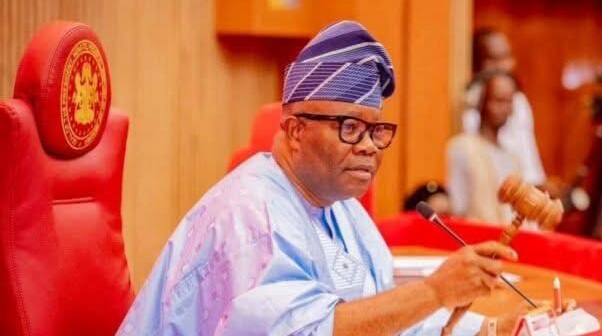
The Man Who Saw Tomorrow: Senator Akpabio And The Uncommon Politics Of Certainty
By
Hon Eseme Eyiboh
Eereporter.com
Let us begin with a confession. There is something unsettling about a politician who no longer appears to struggle.
In the turbulent theatre of Nigerian politics, where noise is often mistaken for relevance, where primaries resemble wrestling contests and delegate management demands the instincts of a hostage negotiator, a man who walks in unopposed does not merely win. He transforms the entire contest into a rehearsal.
On Monday, May 18, 2026, at Methodist Primary School, Ukana, in Essien Udim Local Government Area, Senator Godswill Akpabio did exactly that. No contest. No drama. No nervous counting of votes. He simply emerged as the candidate of the All Progressives Congress for the Akwa Ibom North West Senatorial District without a single challenger.
While many politicians remain trapped in the exhausting rituals of horse trading, factional bargaining, and survival politics, Akpabio’s good works delivered something far rarer in Nigeria’s political environment than gold itself. Absolute consensus.
To the casual observer, an unopposed return may suggest the absence of competition. That would be a dangerously shallow interpretation.
Those familiar with the political phenomenon long associated with the “Uncommon Transformer” understand the distinction clearly. An unopposed ticket does not mean nobody desired to contest. Politics naturally attracts ambition the way light attracts insects. Power always generates interest. Influence always provokes aspiration.
What an unopposed return truly means is far more significant: potential challengers surveyed the landscape, studied the numbers, weighed the networks, measured the emotional connection between the man and the political structure around him, and quietly concluded that the road to victory simply did not exist.
There is a profound difference between lack of opposition and the collapse of viable opposition
Why is there no road to victory for others? Because what Akpabio has built in Akwa Ibom State in general and Akwa Ibom North West in particular is no longer merely a political structure. It is a fortress. Its walls are not made of concrete. They are made of cultivated loyalty. Enduring networks. Strategic generosity. And the unspoken understanding that confronting him politically is not simply difficult. It is often futile and absurd.
The atmosphere at the ward centre resembled less a political exercise and more a carnival of affirmation. Supporters, community leaders, women groups, youths, and party faithful gathered not to determine an outcome but to endorse a grace carrier already settled in the public imagination. The votes were counted without end. The votes were celebrated.
Here is the remarkable part.
The whispers surrounding Akpabio’s dominance do not come only from admirers. They come from seeming opponents too.
Eereporter.com
They do not fear his voice. They fear his results. They do not tremble at confrontation. They confront something more sobering: the recognition that within his political territory, the arithmetic has been solved with almost clinical precision.
While others are still assembling coalitions, Akpabio consolidated his long ago. While rivals continue calculating delegate figures, he has already moved to the next question: what happens after victory? How does political power translate into enduring relevance and measurable impact?
That is the distinction between a career politician and a political architect. One chases office. The other shapes the terrain on which the chase itself occurs.
Since assuming office as President of the 10th Senate, Akpabio has projected a measure of stability within the Red Chamber. That should not be understated.
The Nigerian Senate has earned a reputation for turbulence over the years. Leadership rebellions. Internal fractures. Floor dramas that generate headlines while weakening governance and social democratic structures. Against that backdrop, a Senate President capable of maintaining institutional stability without recurring crises becomes more than merely effective. He becomes uncommon.
His admirers see in him a politician who has consistently combined institutional authority with emotional loyalty from his base through the National to International arena. From Governor to Minister to Senate President, his rise is framed as the journey of a man who understood tomorrow before others arrived there. A politician deeply conscious of timing, alignment, and the delicate craft of converting social capital into durable influence and uncommon power (political capital).
This point matters enormously. Political capital is easy to squander. This point matters enormously. Political goodwill is easy to destroy. Many politicians exhaust it through arrogance, exclusion, or the endless pursuit of personal advantage. But Akpabio appears to understand something deeper about leadership: goodwill grows when people genuinely feel seen, valued, included, and carried along.
Over the years, he has cultivated relationships not merely through politics, but through accessibility, generosity of spirit, loyalty to associates, and an unusual ability to make people feel remembered even in the midst of high office. That is why his support structure often appears less like a coalition held together by convenience and more like a community bound by shared experience and enduring personal connection.
What some interpret merely as political dominance may actually be the long-term harvest of sustained human investment.
And perhaps that explains the ease with which the field gradually cleared around him. Not because opposition was forcibly silenced, but because many within the political environment saw little wisdom in disrupting a consensus built around continuity, stability, experience, and an existing relationship of trust.
His commitment to continue working closely with President Bola Ahmed Tinubu and Governor Umo Eno reinforces a broader message of continuity and strategic alignment. At a time when fragmentation remains the temptation of many ambitious actors, Senator Akpabio has chosen coordination. That is not a weakness. It is political arithmetic.
And this is where the conversation shifts from the present to the near future. The same political capital that secured his senatorial return without resistance is not a one-use currency. It accumulates. It compounds. The goodwill he has cultivated, the equilibrium he has maintained, and the pragmatic preference for results over rhetoric are not merely tools for another Senate term. They form the foundation of something larger and forthcoming.
The crystal ball is not required to observe the trajectory. A Senate President who secures his own return effortlessly, stabilises a chamber historically associated with instability, aligns himself with the centre of national power grid while maintaining grassroots legitimacy, is a Senate President who has solved one of Nigerian politics’ most difficult equations.
He has demonstrated to his colleagues that he can deliver. He has shown the party hierarchy that he can be trusted. He has reassured constituents that proximity to power has not disconnected him from them.
This combination is rarer than any single attribute standing alone. So when the 11th Senate eventually convenes and the question of leadership emerges once again, the conversation may prove shorter than many anticipate. Not because there will be no interested contenders. There always are. But because the arithmetic of loyalty, institutional experience, strategic alignment, and demonstrated political capacity will already have completed its quiet work.
Akpabio has not formally declared interest in leading the 11th Senate. He does not need to. The declaration already exists in the pattern of his movements, the stability of his stewardship, and the political field he has cleared without visible strain. It is simply the discipline of reading political signs as they present themselves* .
In the end, Nigerian politics rewards those who understand the people more deeply than those who merely master performance and noise.That is not sentimentality. It is a political reality.
A politician capable of delivering his constituency without violence, panic, or emergency intervention is a politician who understands something fundamental: power is never truly declared. It is demonstrated. And it is demonstrated most convincingly when nobody steps forward to challenge it.
On that Monday in Ukana, the drums rolled. Praises echoed across the gathering. And the political message arrived without ambiguity. In Akwa Ibom North West, the conversation has moved beyond opposition. What remains is an audience waiting to see the next chapter unfold without ceasing.
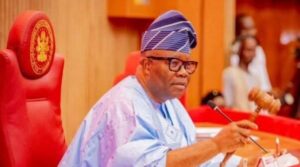
Akpabio
Senator Godswill Akpabio has once again reminded observers that in certain political spaces, dominance is not always loud.
Sometimes, it is simply complete. And in the intricate chessboard of Nigerian politics, where many players are still learning how the pieces move, that level of mastery remains rare, consequential, and deeply potent.
The man who saw tomorrow understood something else too. The loudest voice in the room is rarely the one that prevails.
The one that prevails is the one that no longer needs to shout because everybody already understands. And that is what Senator Godswill Akpabio has demonstrated that he is the man who saw tomorrow.
Rt Hon Eseme Eyiboh mnipr is a former member and Spokesperson of the House of Representatives and currently Special Adviser, Media/Publicity and official Spokesperson to the President of the Senate.
Eereporter.com







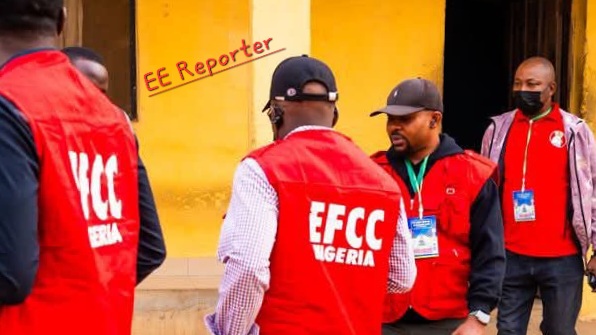
EFCC Arraigns ALSCON, Director for Alleged N582.43m Money Launderin
The Economic and Financial Crimes Commission, EFCC, on Monday, October 12, 2026, arraigned Aluminium Smelter Company of Nigeria, ALSCON, plc, and its Director, Zavyalov Dmitry, before Justice O. A. Egwuatu of the Federal High Court, Abuja, for alleged money laundering offences involving N582,430,250.00 (Five Hundred and Eighty-Two Million, Four Hundred and Thirty Thousand, Two Hundred and Fifty Naira).
Eereporter.com
The company and its director were arraigned on a six-count amended charge, marked FHC/ABJ/CR/644/2025. Dmitry is said to be at large.
According to the charge, the company, a Designated Non-Financial Business and Profession, DNFBP, and Its Director, Dmitry, failed to report in writing to the Special Control Unit against Money Laundering (SCUML) single transfers made from the company’s account between March and July 2024, as required under Section 11(1)(b) of the Money Laundering (Prevention and Prohibition) Act, 2022.
The transfers include N147,515,050.00 in March 2024, N156,026,860.00 in April 2024, N121,425,200.00 in May 2024 and N127,338,190.00 in July 2024, all paid to UDATSON NIGERIA. Others are N15,124,950.00 paid to Urico Global Services in April 2024 and N15,000,000.00 paid to one Christopher Azogu in June 2024.
Count one reads: “That you, Aluminium Smelter Company Of Nigeria Limited, plc, a Designated Non-Financial Business and Profession (DNFBP) and Zavyalov Dmitry (at large) being Director of the said DNFBP sometime in March, 2024 in Abuja within the jurisdiction of this Honourable Court, failed to report in writing to the Special Control Unit against Money Laundering (SCUML), a single transfer of the sum of N147,515,050.00 (One Hundred and Forty Seven Million, Five Hundred and Fifteen Thousand, Fifty Naira) paid into UDATSON NIGERIA from account no. 1013726291 operated by Aluminium Smelter Company Of Nigeria Plc as specified under Section 11(1)(b) of the Money Laundering (Prevention and Prohibition) Act, 2022 and you thereby committed an offence contrary to and punishable under Sections 11 (3), 19(2) (b), and 22 of the same Act.”
Count two: “That you, Aluminium Smelter Company Of Nigeria, plc, a. Designated Non-Financial Business and Profession (DNFBP) and Zavyalov Dmitry (at large) being Director of the said DNFBP sometime in April, 2024 in Abuja within the jurisdiction of this Honourable Court, failed to report in writing to the Special Control Unit against Money Laundering (SCUML), a single transfer of the sum of N156,026,860.00 (One Hundred and Fifty Six Million, Twenty Six Thousand, Eight Hundred and Sixty Naira) paid into UDATSON NIGERIA from account no. 1013726291 operated by Aluminium Smelter Company Of Nigeria Plc as specified under Section 11(1)(b) of the Money Laundering (Prevention and Prohibition) Act, 2022 and you thereby committed an offence contrary to and punishable under Sections 11 (3), 19(2) (b), and 22 of the same Act.”
Count four of the charge sheet reads, “That you, Aluminium Smelter Company Of Nigeria Plc, a Designated Non-Financial Business and Profession and Zavyalov Dmitry (at large) being Director of the said DNFBP sometime in May, 2024 in Abuja within the jurisdiction of this Honourable Court, failed to report in writing to the Special Control Unit against Money Laundering (SCUML), a single transfer of the sum of N121,425,200.00 (One Hundred and Twenty One Million, Four Hundred and Twenty Five Thousand, Two Hundred Naira) paid into Udatson Nigeria from account no. 1013726291 operated by Aluminium Smelter Company Of Nigeria Plc as specified under section 11(1)(b) of the Money Laundering (Prevention and Prohibition) Act, 2022 and you thereby committed an offence contrary to and punishable under sections 11 (3), 19(2) (b), and 22 of the same Act.”
EFCC
Lead counsel to the EFCC, Ekele Iheanacho, SAN, told the court that the offences are punishable under sections 11(3), 19(2)(b) and 22 of the Money Laundering (Prevention and Prohibition) Act.
When the charges were read, the company’s Acting Managing Director, Ime Monday Inyang, pleaded not guilty to all six counts on its behalf.
Counsel to the company had asked the court to quash the charges, claiming that the company was innocent of the charges.
In view of the plea, Justice Egwuatu adjourned the matter to January 27, 2027 for commencement of trial.
Dele Oyewale
Head, Media & Publicity
October 12, 2026
Eereporter.com
News
Taiwo Oyedele, Cardoso Meet World Bank President Banga on Nigeria’s Shift From Stability to Growth
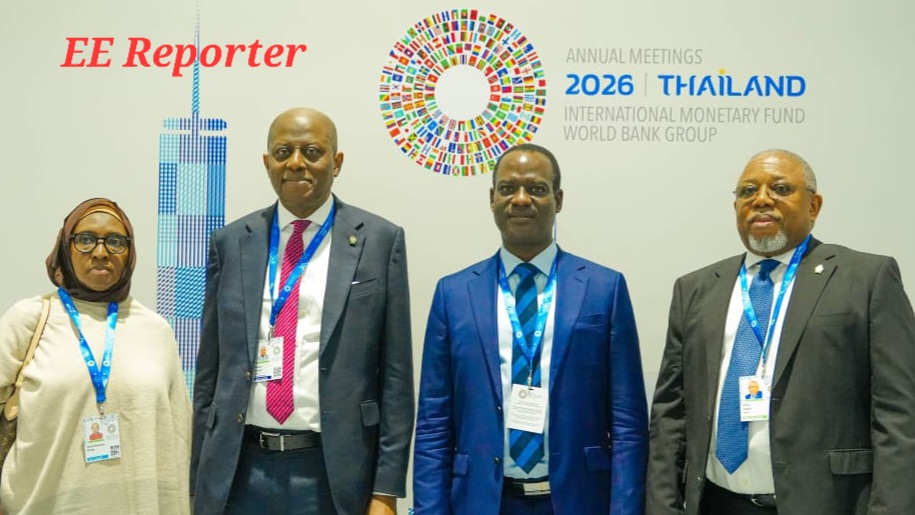
Taiwo Oyedele, Cardoso Meet World Bank President Banga on Nigeria’s Shift From Stability to Growth
Bangkok, 12 October 2026. The Honourable Minister of Finance and Coordinating Minister of the Economy, Taiwo Oyedele, and the Governor of the Central Bank of Nigeria, Olayemi Cardoso, met the President of the World Bank Group, Ajay Banga, on Monday. The meeting took place on the sidelines of the 2026 IMF and World Bank Group Annual Meetings in Bangkok, Thailand, where Oyedele leads Nigeria’s delegation.
Eereporter.com
The meeting reviewed Nigeria’s reform progress and the next phase of its agenda: turning macroeconomic stability into faster growth, more private investment and stronger domestic revenues.
Banga commended the progress of Nigeria’s reforms. He pointed to the rise in private capital inflows from about $300 million in 2023 to nearly $6 billion in 2026, a twentyfold increase.
Oyedele highlighted the rising economic growth and noted that Nigeria’s tax-to-GDP ratio rose from about 7 per cent to 12.5 per cent over the same period. This gives the government more room to fund public investment without resorting to deficit monetisation.
The meeting discussed how Nigeria can make greater use of World Bank guarantee instruments. These guarantees can unlock financing for infrastructure and draw more private capital into the domestic market.
Power infrastructure and human capital were identified as priorities for continued public investment, given their importance to business competitiveness, productivity and job creation. The meeting also stressed the quality of public spending, so that each naira delivers measurable economic and social returns.
Taiwo Oyedele, Cardoso
The meeting is part of the Federal Government’s wider engagement with development partners to lock in reform gains and attract new investment. As Nigeria moves from stability to growth, the priority is to turn stronger fundamentals into productive investment, more jobs and better living standards for Nigerians.
Efe Ovuakporie
Head of Media
Federal Ministry of Finance
12 October 2026
Eereporter.com
High Court Dismisses Aisha Achimugu’s Fundamental Rights Suit Against EFCC
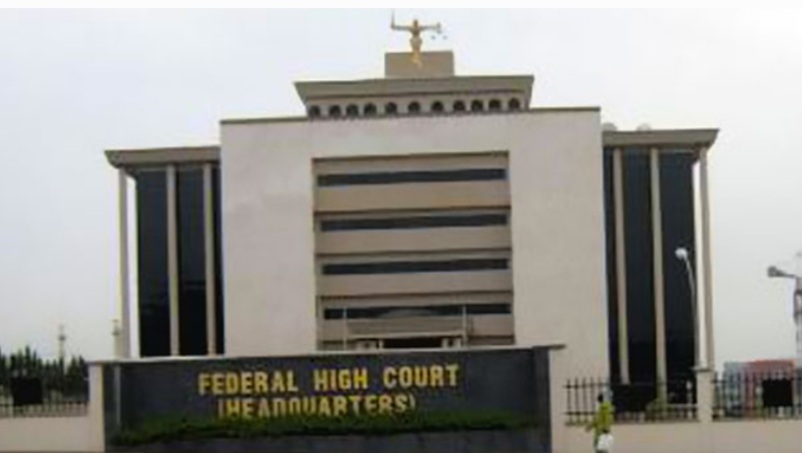
Justice M.S. Liman of the Federal High Court sitting in Abuja has dismissed a fundamental human rights suit filed by Abuja-based businesswoman, Aisha Achimugu against the Economic and Financial Crimes Commission, EFCC.
Eereporter.com
In the originating suit no : FHC/ABJ/CS/466/2026, Achimugu approached the court for determination of whether the defendant, EFCC’s action of searching her house and seizing her cars and jewelries and other items was within the powers of the Commission.
Achimugu also asked the court to enforce her rights to privacy, including an order of the court restraining the defendant from threatening or harassing and invading her private residence.
Part of her claim was for the court to award a N10,000,000,000 (Ten Billion Naira) damage against the EFCC for what she described as invasion of her privacy.
Delivering judgment in the suit on Monday, October 10, 2026, Justice Liman dismissed the suit and held that the defendant has the power to search the plaintiff’s property after receiving intelligence on the alleged criminal activities of the plaintiff. “EFCC has the right to search the residence,” he said.
The judge said that Achimugu and her legal representatives failed to show reason to warrant the kind of damage she demanded from the EFCC and equally dismissed the request for N10 billion damages.
On the whole, Justice Liman agreed that there was nothing that should have stopped the EFCC from carrying out its statutory duties. The court therefore held that the matter lacked merit and was dismissed because “ it is frivolous and it was brought in bad faith”. The damage she sought was also denied.
Federal High Court
Reacting to the judgment, counsel to the EFCC, Emenike Mgbemele said the judgment was in the interest of justice, adding that the suit was a ploy to waste the time of the court.
Dele Oyewale
Head, Media & Publicity
October 12, 2026
Eereporter.com
-
 Crime1 year ago
Kogi Assembly Considers Law To Regulate Rent, Establish Control Board: Tenancy Law
-
 News2 years ago
Atiku Reveals Why He Failed To Pick Wike As Running Mate In 2023
-
 Akwa Ibom2 years ago
The Apostolic Church Gets New Territorial Chairman, Exco
-
 Crime2 years ago
Federal High Court Jails 2 For Vandalizing Transformer, Telecom Mast In Kogi
-
 News2 years ago
The Apostolic Church Gets New National President, Executive
-
 Akwa Ibom2 years ago
Umo Eno Commences Payment Of 80,000 Naira Minimum Wage With Arrears
-
 News2 years ago
Senator Natasha Returns To Senate With Husband Amid Seat Dispute
-
 Economy1 year ago
Kiyosaki: Is Tinubu’s Government Afraid Of Ibrahim Traore?