
News
NAF Prepares Pilots For Incoming Modern Platform, Hail President Tinubu

NAF Prepares Pilots For Incoming Modern Platform, Hail President Tinubu
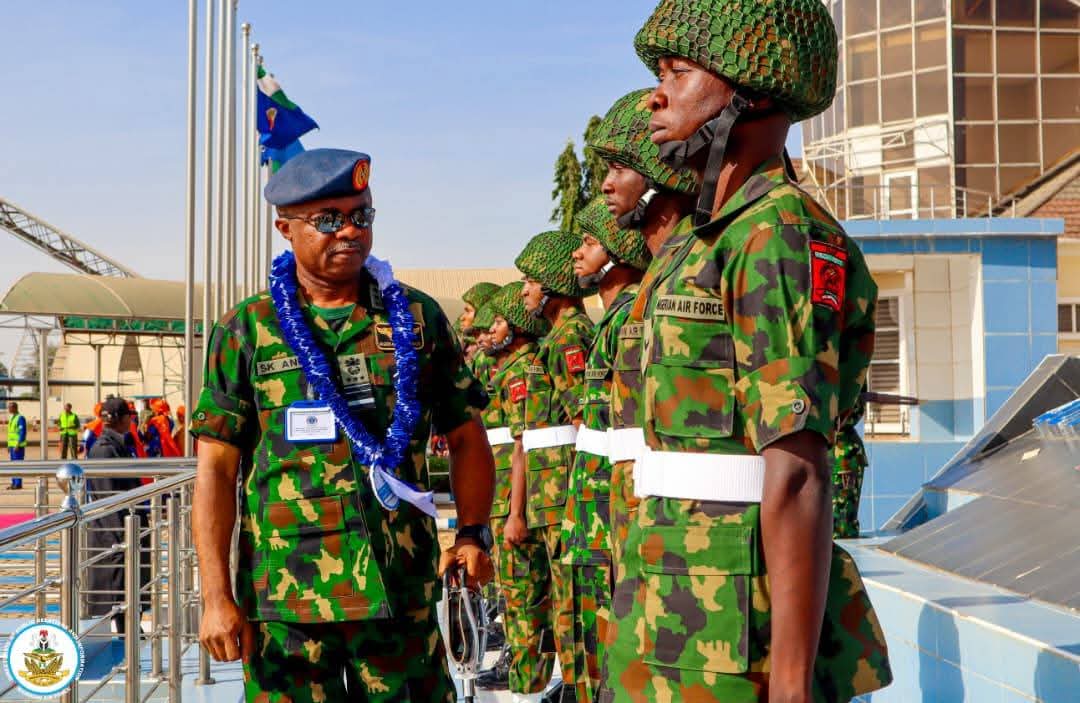
NAF prepares pilots for incoming modern platform, hail President Tinubu. The Nigerian Air Force (NAF) has taken a major step in preparing its personnel for the operation of incoming modern and advanced aircraft, as the Chief of the Air Staff (CAS), Air Marshal Sunday Kelvin Aneke, on 13 February 2026 commissioned key infrastructural projects at NAF Base Kaduna. During the ceremony, the CAS said the developments are critical to readying the next generation of pilots who will operate the Service’s incoming platforms.
“In this regard, the completion of the Student Pilots’ Quarters is a major step in preparing pilots who will operate modern advanced aircraft, enabling the projection of smart and decisive airpower to eliminate terrorist threats while safeguarding our people,” he said.
Air Marshal Aneke emphasised that the commissioning goes beyond infrastructure. “My mission here is not just about buildings but about fulfilling my command philosophy, to enhance and sustain a highly motivated, professional, and mission-ready force capable of delivering decisive airpower effects in synergy with surface forces for the realisation of national security objectives,” he stated. The CAS expressed profound appreciation to the President and Commander-in-Chief of the Armed Forces, President Bola Ahmed Tinubu, for his unwavering commitment to national security.
“We salute President Tinubu for his unwavering support to national security, as demonstrated by his bilateral engagement with the Government of the Republic of Türkiye for defence equipment, including the acquisition of advanced helicopters and Unmanned Aerial Vehicles for the Nigerian Air Force,” he added.
Highlighting the Service’s ongoing transformation, Air Marshal Aneke disclosed that strategic engagements in the United States, Italy, and Türkiye are already yielding results. “We are fast-tracking the procurement of 24 M-346 Fighter Ground Attack Aircraft, 12 AH-1Z Viper attack helicopters, and 10 AW-109 Trekker helicopters, all aimed at enhancing our operational effectiveness across the full spectrum of air operations,” he noted.
The infrastructure projects commissioned include six blocks of 12 one-bedroom Student Pilots’ Quarters, a block of six three-bedroom flats initiated by the Ministry of Defence and completed by the NAF, and a block of 30 one-bedroom studio apartments for airmen and airwomen of the Military Training Centre.
The CAS urged personnel to maintain the highest standards of discipline and professionalism. “Use these structures with care and a deep sense of responsibility. Let them reflect a strong culture of maintenance and pride, ensuring they remain a source of comfort and dignity for current and future occupants,” he said.
He appreciated the former CAS, Air Marshal HB Abubakar for the foresight in initiating the project, commended the Logistics Branch, the Air Officer Commanding, and all contractors for the timely delivery of the projects, while acknowledging the Federal Government and the leadership of the National Assembly for enabling fiscal releases that made the developments possible.
NAF Prepares Pilots For Incoming Modern Platform
He reaffirmed the Service’s commitment to the President’s Renewed Hope Agenda: “We pledge to be critical stakeholders in the actualisation of a safe, secure, and prosperous Nigeria.”
In his welcome address, the Air Officer Commanding, Air Training Command, Air Vice Marshal EP Efanga, praised the leadership of the CAS and the dedication of personnel and contractors involved in completing the projects.
“These facilities mark a significant milestone in strengthening operational readiness and improving personnel welfare,” he said. “They will play a key role in preparing our pilots to operate the advanced platforms that will shape the future of the Nigerian Air Force.”
He also expressed gratitude to the CAS for his unwavering support to the Command, noting that it has been instrumental in elevating the Command to its present level of excellence.









APC Accuses Atiku, ADC Leaders of Owing Workers Salaries
The All Progressives Congress (APC) has accused the African Democratic Congress (ADC), led by former Senate President David Mark and former Osun State Governor Rauf Aregbesola, of owing its workers salaries for more than one year.
Eereporter.com
The ruling party, through its Presidential Campaign Council, also accused the ADC presidential candidate for the 2027 general elections, Atiku Abubakar, of owing his employees.
The APC Presidential Campaign Council made the allegations in a statement issued on Monday, October 26, 2026, by its spokesperson, Dele Alake, describing the alleged non-payment of salaries as evidence that Atiku cannot be trusted to govern Nigeria.Buy Maps
The ruling party urged Nigerians and Nigerian workers to reject Atiku, the ADC, and all candidates contesting under the party in the 2027 general elections.
The statement followed reports alleging that the ADC National Working Committee failed to pay the party’s workers for over 12 months.
The APC campaign council described the alleged development as “unconscionable,” arguing that the party could not credibly promise Nigerians better governance while allegedly failing to meet its obligations to its own employees.
“We find it unconscionable that a political party that has made many grandiose promises to hoodwink Nigerians owes its workers for more than 12 months,” Alake stated.
“Owing staff who come to work every day and who rely on the salaries for their daily sustenance is wicked and reprehensible.”
The APC campaign spokesperson said the alleged failure to pay ADC workers exposed what he described as the “emptiness and insincerity” of those presenting themselves as alternatives to the current administration.
Alake further accused Atiku and other ADC leaders of being motivated by personal ambition and opposition to President Bola Tinubu rather than a genuine desire to improve Nigeria.
“We have clearly stated that ADC leaders and their presidential candidate, Alhaji Atiku Abubakar, do not mean well and can do nothing for our country,” Alake stated.
“Their desperation for power is driven by personal aggrandisement and venomous ill will against President Bola Tinubu.”
Alake also alleged that Atiku has a history of owing workers, citing reported disputes involving his businesses, including Gotel Communications.
“Atiku Abubakar, the ADC’s leader and Presidential candidate, has a reputation for owing his employees,” he alleged.
“While he regularly junkets to the UAE, staff at his Gotel Communications and other businesses also went months without pay and staged protests over unpaid salaries and other benefits.”
The APC campaign council also attacked Aregbesola’s record as governor of Osun State between 2010 and 2018, accusing his administration of failing to regularly pay workers and pensioners.
According to Alake, Aregbesola’s administration introduced quarter-salary and, at times, half-salary payments during the period.
He further alleged that pensioners were left without their entitlements for more than four years, claiming that some died as a result of the hardship.
“The record of the ADC General Secretary, Rauf Aregbesola, on paying workers’ salaries and pensioners in Osun State, where he was a governor for 8 years, was abysmal,” Alake said.
“As governor, he mismanaged the state’s finances to the point that he could not pay workers. His government thus introduced quarter-salary and, at times, half-salary payments.
APC
“As for pensioners, he abandoned them for more than four years. Many died because they could not afford the basics of life.”
The APC campaign council consequently described the alleged salary crisis within the ADC as consistent with what it called the records of its leading figures.
“We are therefore not surprised that ADC, harbouring birds of the same feather, cannot pay its workers’ salaries,” Alake said.
The ruling party called on Nigerian workers and voters to reject the ADC and its candidates in the 2027 elections.
“We are sounding a warning to Nigerians and working people now: reject ADC. Reject Atiku Abubakar and reject all ADC candidates in the next general elections,” Alake added. “They do not have the interest of our country and our people at heart.”
Alake said a political party aspiring to take control of the Federal Government must first demonstrate that it can responsibly manage its own affairs and protect the welfare of its workforce
“A party that aspires to govern Nigeria and which cannot be trusted with something as basic as the management of its own affairs and the welfare of its workforce should be rejected by Nigerians,” he said
News men efforts to get the comments of the ADC on the allegations failed at the time of filing this report.
Eereporter.com

Last 10 Rankings for 2026 Ballon d’Or Revealed
The 2026 Ballon d’Or ceremony is underway at the London Palladium in England.
Footballers from different clubs, as well as journalists, are all gathered at the venue for the 70th edition of the award on Monday.
This year’s edition marks the first time the gala has been staged outside Paris, with popular sports broadcaster Kate Scott and French football legend Thierry Henry as hosts.
Last 10 Men’s Ballon d’Or ranking:
1. Ousmane Dembélé — Paris Saint-Germain/France
2. Erling Haaland — Manchester City/Norway
3. Harry Kane — Bayern Munich/England
4. Khvicha Kvaratskhelia — Paris Saint-Germain/Georgia
5. Kylian Mbappe — Real Madrid/France
6. Lionel Messi — Inter Miami/Argentina
Nigerian news updates
Men’s Ballon d’Or ranking from 11-30:
11. Jude Bellingham — Real Madrid & England
12. Pau Cubarsí — FC Barcelona & Spain
13. Achraf Hakimi — Paris Saint-Germain & Morocco
14. Vítor Ferreira (Vitinha) — Paris Saint-Germain & Portugal
15. Declan Rice — Arsenal & England
16. Ferran Torres — FC Barcelona, Paris Saint-Germain & Spain
17. Vinicius Jr. — Real Madrid & Brazil
18. Marc Cucurella — Chelsea, Real Madrid & Spain
19. João Neves — Paris Saint-Germain & Portugal
20. Willian Pacho — Paris Saint-Germain & Ecuador
21. Gabriel Magalhaes — Arsenal & Brazil
22. Lautaro Martínez — Inter Milan & Argentina
23. Nuno Mendes — Paris Saint-Germain & Portugal
24. Luis Díaz — Bayern Munich & Colombia
25. Marcos Corrêa (Marquinhos) — Paris Saint-Germain & Brazil
26. Dayot Upamecano — Bayern Munich & France
27. Bruno Fernandes — Manchester United & Portugal
28. Julian Quiñones — Al-Qadsiah & Mexico
29. William Saliba — Arsenal & France
30. Sadio Mané — Al-Nassr & Senegal

2026 Ballon d’Or
Last 10 Women’s Ballon d’Or ranking:
1. Temwa Chawinga – Kansas City Current & Malawi
2. Melchie Dumornay – Lyon & Haiti
3. Caroline Graham Hansen – Barcelona & Norway
4. Patri Guijarro – Barcelona & Spain
5. Pernille Harder – Bayern Munich & Denmark
6. Ewa Pajor – Barcelona & Poland
7. Clàudia Pina – Barcelona & Spain
8. Alexia Putellas – Barcelona/London City Lionesses & Spain
9. Alessia Russo – Arsenal & England
10. Khadija Shaw – Man City & Jamaica
Women’s Ballon d’Or ranking from 11-30:
11. Yui Hasegawa – Man City & Japan
12. Klara Buhl – Bayern Munich & Germany
13. Mariona Caldentey – Arsenal & Spain
14. Wendie Renard – Lyon & France
15. Cata Coll – Barcelona & Spain
16. Mapi Leon – Barcelona/London City Lionesses & Spain
17. Esmee Brugts – Barcelona & Netherlands
18. Barbra Banda – Orlando Pride & Zambia
19. Tessa Wullaert – Inter/Como & Belgium
20. Selma Bacha – Lyon & France
21. Scarlett Camberos – Club America & Mexico
22. Manaka Matsukubo – North Carolina Courage/Chelsea & Japan
23. Momoko Tanikawa – Bayern Munich & Japan
24. Kerstin Casparij – Man City & Netherlands
25. Caroline Weir – Real Madrid/Lyon & Scotland
26. Alex Greenwood – Man City & England
27. Rose Lavelle – Gotham FC & USA
28. Lorena – Kansas City Current & Brazil
28. Melvine Malard – Man Utd/Chelsea & France
28. Vivianne Miedema – Man City & Netherlands
Eereporter.com
News
Obi Accuses Tinubu Government Of Harassment, Demands Immediate Release Of Supporter Rilwan Olawale

Obi Accuses Tinubu Government Of Harassment, Demands Immediate Release Of Supporter Rilwan Olawale
The presidential candidate of the Nigeria Democratic Congress (NDC) for the 2027 general elections, Peter Obi, has warned the President Bola Tinubu government against what he described as the continued harassment and intimidation of his supporters across Nigeria, demanding the immediate release of his supporter, Rilwan Olawale.Nigerian news subscription.
Eereporter.com
Obi issued the warning in a statement released on Monday, titled, “Civility Is Not Weakness. Enough Of The Harassment Of My Supporters. Release Rilwan Olawale Now.”
The former Anambra State governor described the alleged treatment of his supporters as “disturbing and unacceptable,” citing the arrest of Olawale as the latest case.
“The continued intimidation and harassment of my supporters across the country, the latest being the case of Rilwan Olawale, is disturbing and unacceptable,” Obi said.
Olawale, an NDC supporter and political mobiliser associated with the Obidient movement, was reportedly taken from his Lagos residence in the early hours of Sunday, October 25, 2026, by armed men who identified themselves as operatives of the Department of State Services (DSS).
According to reports, the men allegedly arrived at his residence at about 1 am and took him away, sparking concern among his supporters over his whereabouts.
The circumstances surrounding the incident, however, remain unclear, with no public confirmation from the DSS or police establishing that Olawale is in their custody.
Funso Doherty, the NDC governorship candidate in Lagos State, had also raised the alarm over the reported arrest, saying efforts were being made to establish the facts and gain access to Olawale through his family and legal counsel.
Doherty urged the public to remain calm while the circumstances were being clarified.
Olawale’s reported detention has triggered calls from supporters for information about his whereabouts and his immediate release, with the hashtag #FreeRilwanNow gaining traction online.
Supporters have alleged that his political activities may have been connected to the incident, although there has been no official confirmation establishing the motive for his reported detention.
Obi, in his statement, also accused President Tinubu of undermining democratic values despite being a major beneficiary of Nigeria’s democratic system.
“President Bola Tinubu has remained a huge beneficiary of our democracy and should not brazenly be destroying it by encouraging and facilitating violence,” Obi said.
Obi maintained that his campaign ahead of the 2027 elections would remain peaceful and focused on issues, saying the NDC was seeking to offer Nigerians a credible alternative founded on competence, accountability, justice and compassion.
“Our campaign is peaceful and issue-driven, focused on offering Nigerians a credible alternative built on competence, accountability, justice, and compassion,” he said.
According to him, his supporters have deliberately chosen peaceful political engagement and persuasion rather than violence and intimidation.
“However, nobody should mistake our civility for weakness, our restraint for fear, or our commitment to peace for an absence of resolve,” he said.
Obi vowed that he would not be intimidated into silence or abandon Nigerians who believe in his political vision.
“We will not be intimidated into silence, nor will we abandon Nigerians who believe in a New Nigeria that is possible and will be OK,” he added.
Obi specifically demanded “transparency regarding Rilwan Olawale’s arrest, his release, respect for his rights, and an end to politically motivated harassment.”

Tinubu, Peter Obi
He further argued that Nigerians should be free to support candidates of their choice without fear of intimidation or harassment.
“No government or political party has the right to deny Nigerians the freedom to support a candidate of their choice,” he said.
“We will remain peaceful but resolute. We will not resort to violence, but we will stand firmly and lawfully against every attempt to undermine our democratic rights.”
Eereporter.com
-
 Crime1 year ago
Kogi Assembly Considers Law To Regulate Rent, Establish Control Board: Tenancy Law
-

 News2 years ago
Atiku Reveals Why He Failed To Pick Wike As Running Mate In 2023
-
 Akwa Ibom2 years ago
The Apostolic Church Gets New Territorial Chairman, Exco
-

 Crime2 years ago
Federal High Court Jails 2 For Vandalizing Transformer, Telecom Mast In Kogi
-
 News2 years ago
The Apostolic Church Gets New National President, Executive
-
 Akwa Ibom2 years ago
Umo Eno Commences Payment Of 80,000 Naira Minimum Wage With Arrears
-

 News2 years ago
Senator Natasha Returns To Senate With Husband Amid Seat Dispute
-
 Economy1 year ago
Kiyosaki: Is Tinubu’s Government Afraid Of Ibrahim Traore?