
Economy
Shettima Vs. Osinbajo: A Tale Of 2 Vice Presidents Of Nigeria


Shettima Vs. Osinbajo: A Tale Of 2 Vice Presidents Of Nigeria
Shettima Vs. Osinbajo: A tale of 2 Vice Presidents of Nigeria. In many ways the recent resignation of Hakeem Baba Ahmed as Political Adviser to Vice President Kashim Shettima confirms the worst kept political secret in the land: that the gulf existing between President Bola Tinubu and Vice-President Kashim Shettima has widened to the point of no return.
It is no longer a secret that President Tinubu does not trust nor have confidence in his Vice President. Indeed a presidency source told me that things have got so bad that the president never meets Shettima one-on-one. Vice-President Shettima is placed only on a ‘’need to know’’ basis on sensitive polices and even at that not all the details of such policies are disclosed to him.
Memos from the Vice President and those of his staff are subjected to levels of vetting and watered down such that when they eventually land on the president’s desk for his attention, they are devoid of their essence and meaning. All Ministers and appointees of the presidency and the administration are forbidden from giving him detailed briefs on their tasks and for their own good they try to limit their contact and involvement with the VP to a cursory level.
The cold war between President Tinubu and his Vice so far not fully blown, has however prompted comparisons between the experiences of Professor Yemi Osinbajo, Vice President under the immediate past administration of President Muhammadu Buhari and that of Shettima.
In culinary terms the difference in experience under their principals could be likened to the difference between Ikokore, the popular Ijebu delicacy which I am told the former Vice President being an Ijebu man relishes, and Burabisco, the favourite Kanuri dish which Shettima as a dyed-in-wool Kanuri man likes a lot. As the two dishes are made of different ingredients and are enjoyed by in different parts of the country, so also are the experiences of the two VPs under their bosses.
Although the Constitution of the Federal Republic of Nigeria recognises and ipso facto specifies roles for the Vice President in the functioning of the administration, in reality the VP’s relevance can only be subject to the disposition of the president.
For instance, although the constitution provides for the VP to chair the National Economic Council (NEC) made up of state governors, the president can work to make the council irrelevant.
This is what happened when VP Shettima at the head of the NEC led the governors to present their informed views on the Tax Reform bill. We all knew that president Tinubu threw the bill at the VP and the governors’ faces and brusquely told them he preferred his own version of the bill which he was going to send to the National Assembly.
By contrast, Osinbajo as VP was in full charge of the NEC as its Chair and from that vantage point recommended and actively implemented economic and social programmes running to billions of naira.
Apart from not being allowed such powers under Tinubu, since his run-in with the president over the Tax Reform bill, Shettima has literarily had the door shut firmly against his face as far as economic and social matters which the constitution grants him.
Professor Osinbajo was the cerebral intellectual power house of the Buhari administration and his erudition and depth of knowledge provided the government with the much needed air of competence to cover up the lapses of some the officials of the government.
Perhaps fully aware of this, president Buhari gave Osinbajo the full encouragement and thrust to be the face of the administration making speeches and representing him frequently at public and private occasions.
Osinbajo was given the latitude to choose his team which included a Special Adviser on Media and Political Affairs as well as other necessary staff who functioned as independently as possible without interference from the President’s office.
VP Shettima too was allowed his complement of aides. But the point of departure is that whereas VP Osinbajo’s aides Laolu Akande for Media and Babafemi Ojudu on political affairs functioned effectively in their positions, Stanley Nkwocha and Hakeem Baba Ahmed appointed in respective positions under VP Shettima’s office have hadly been heard.
Indeed the resignation of Hakeem Baba Ahmed, former Federal Permanent Secretary and Secretary-General of the Northern Elders Forum (NEF) was connected to the belittling role he had been subjected in the presidency. He was not given any schedule and befitting office.
He also was not allowed unfettered access to the media. He could not engage the media on the VP’s political perspectives; he was virtually a political glorified desk officer in the VP office reduced to drinking tea and ‘’enjoying’’ the central air conditioner there.
For someone who is known to be articulate, erudite and with such a vast and distinguished experience in politics and governance and who enjoys frequent media attention, restricting Hakeem Baba Ahmed’s visibility and interventions as he was in the Tinubu presidency was like taking a fish out of water. There was no way that Hakeem Baba Ahmed would take that sort of treatment lying low.
That VP Osinbajo was accorded his rightful place in the Buhari was due largely to the laissez faire disposition of president Buhari. Buhari was known to allow his appointees the latitude to work without too much interference in order to allow them deliver on the tasks assigned to them.
But president Tinubu is not only known as a micro-manager he also has an unapologetic disposition towards favouring people from his ethnic comfort zone to work with him. From what we have seen of him, president Tinubu clearly does not feel comfortable having people from other ethnic nationalities working too closely with him.
VP Shettima may not have committed any weighty official breaches of official protocol in the presidency, but president Tinubu’s in built paranoia and discomfort in the midst of people he considers as belonging outside of his bloodlines and his political and ethnic comfort zone is largely responsible for the short shrift being given to VP Shettima in the presidency.
Going forward president Tinubu clearly faces a dilemma on what to do with VP Shettima. He is obviously not enamoured of the VP and cannot be persuaded to retain him in the coming months. But the president knows distinctly that dropping the VP off the ticket presents a very delicate and dangerous political manoeuvre. It was with Shettima that he was able to navigate the difficult challenges of the 2023 presidential race and won.
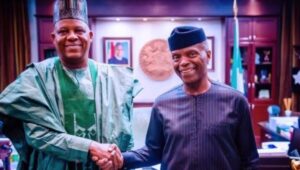
Shettima Vs. Osinbajo
Removing Shettima now would amount to a tactical political miscalculation. Who to replace Shettima with that will give him the political traction with northern voters he desperately needs for re-election in 2027?
If he intends to keep the Muslim-Muslim ticket a host of names have been thrown into the equation; Nuhu Ribadu, Abdullahi Ganduje, Kwankwaso etc.
But anybody he chooses now will be a hard sell to northern voters. The mere fact of replacing Shettima with another figure will reinforce the feeling that Tinubu cannot be trusted to respect political agreements. And this could even rupture the ruling APC.
There are reports too that president Tinubu may change tack and replace Shettima with a northern Christian namely former Speaker Yakubu Dogara, former SGF Boss Mustapha, Senator Simon Lalong etc.
If Tinubu cannot be sure of a huge northern Christian votes tally to tip the scales in his favour this will amount to political suicide to say the least.
As Governor of Lagos state, Tinubu was able to whimsically change three deputies; Kofo Bucknor, Femi Pedro and Adeyemi Ogunleye without fear of political recriminations.
As president he is now faced with three options all of which have potential consequences; he cannot retain Shettima because the gulf between them has become insurmountable; if he drops him and picks another Muslim he risks a rupture in the ruling party and if he decides to go for a northern Christian replacement he will most likely bring the house down.
As he sits presently in limbo under the Tinubu presidency, waiting to see how and where the dice rolls VP Shettima will be hoping for the best under the circumstances.









Eid-el-Fitr: NRC Sets To Run Three Lagos–Ibadan Train Trips Monday
Eid-el-Fitr: NRC sets to run three Lagos–Ibadan train trips Monday. He assured passengers of NRC’s continued commitment to safe, reliable, and efficient rail services.
This was contained in a statement issued on Friday in Lagos by NRC chief public relations officer, Callistus Unyimadu.
He said the additional trip was in response to high passenger turnout during the Eid-el-Fitr travel period.
“The extra trip is aimed at easing passenger movement and providing more travel options for commuters returning after the Eid-el-Fitr celebrations.
“Under the schedule, departures from Lagos (Mobolaji Johnson Station, Ebute Metta) will be at 7.45 a.m., 1.40 p.m., and 4.00 p.m.
“From Ibadan (Obafemi Awolowo Station, Moniya), trains will depart at 8.00 a.m., 10.50 a.m., and 4.30 p.m.,” he said.
Mr Unyimadu assured passengers of NRC’s continued commitment to safe, reliable, and efficient rail services.

NRC Sets To Run Three Lagos–Ibadan Train Trips Monday
He advised travellers to arrive early, comply with ticketing and security procedures, and plan their journeys.
“The corporation appreciates the continued patronage of its services and wishes all passengers a safe and pleasant journey,” he added.
UBA, BII Sign Letter Of Intent To Explore Trade Finance Collaboration Across Africa
United Bank for Africa (UK) Limited (“UBA UK”) and British International Investment plc (“BII”), the UK’s development finance institution and impact investor, announced that they have signed a letter of intent to develop trade finance collaboration opportunities.
The proposed initiative aims to expand access to trade and working capital facilities for businesses operating across Africa.
Access to trade finance remains one of the most significant structural constraints on African trade. Businesses, particularly small and medium-sized enterprises, are frequently unable to secure letters of credit, guarantees, and supply chain finance on commercially viable terms, limiting their capacity to export and import competitively. This trade finance gap is estimated by the African Development Bank to be over USD 80 billion annually.
To help close this gap, UBA UK, the London subsidiary of UBA Group, Africa’s Global Bank, will leverage its deep relationships across the Group’s 20-country African network to originate and structure trade finance transactions. While BII, with a mandate to support productive, sustainable, and inclusive growth across Africa, can support transactions that might otherwise fall outside conventional commercial appetite.
“The signing of this letter with BII represents a landmark moment for UBA UK and for the UBA Group’s global ambitions. As the Group’s hub for Trade Operations, UBA UK is uniquely positioned to connect African businesses with the international financial system. Working alongside BII, we can extend that capability further — mobilising capital where it matters most and helping to close the trade finance gap that holds back so much African potential,” said Lok Mishra, Chief Executive Officer, UBA UK
“British International Investment is committed to catalysing private sector growth across Africa, and trade finance is a critical enabler of that growth. We welcome the opportunity to collaborate with UBA Group, whose pan-African network and deep institutional relationships can help advance our ambition to expand access to trade and working capital finance, particularly in frontier markets,” Chris Chijiuitomi, Managing Director and Head of Africa
The announcement builds on growing momentum around intra-African trade facilitated by the African Continental Free Trade Area (AfCFTA), which entered into force in 2021 and represents one of the world’s most significant trade integration initiatives. Both institutions have identified the operationalisation of AfCFTA as a priority catalyst for a trade finance facility, with UBA UK’s network across major AfCFTA economies offering a basis for supporting businesses navigating the emerging continental market.
This also complements the UK Government’s broader engagement with African economic development, including commitments made at the UK-Africa Investment Summit, and reinforces the City of London’s role as a leading international finance centre for Africa-focused capital mobilisation.
Future cooperation remains subject to further assessment, due diligence and the completion of internal approvals by both parties.
ABOUT UNITED BANK FOR AFRICA (UK) LIMITED
UBA UK is the London-based subsidiary of United Bank for Africa Plc, one of Africa’s leading financial institutions with operations across 20 African countries, the United Kingdom, the United States of America, France, and the United Arab Emirates. UBA UK serves as the Group’s hub for Trade Operations, providing a comprehensive suite of trade finance, treasury, and correspondent banking services to institutional and corporate clients worldwide.
UBA
ABOUT UNITED BANK FOR AFRICA GROUP
United Bank for Africa is one of the largest employers in the financial sector on the African continent, with 25,000 employees group-wide and serving over 45 million customers globally. Operating in twenty African countries, the United Kingdom, the United States of America, France and the United Arab Emirates, UBA provides retail, commercial and institutional banking services, leading financial inclusion and implementing cutting-edge technology.
ABOUT BRITISH INTERNATIONAL INVESTMENT
British International Investment is the UK’s development finance institution and impact investor. The organisation invests in businesses in developing countries to improve people’s lives and help protect the planet. BII’s work targets the underlying causes of poverty and the climate crisis, helping countries break free from aid dependency for good.
Between 2022-2026, at least 30 per cent of BII’s total new commitments by value will be in climate finance. BII is also a founding member of the 2X Challenge which has raised over $33.6 billion to empower women’s economic development.
The company has investments in over 1,600 businesses across 66 countries and total net assets of £9.87 billion. For more information, visit: www.bii.co.uk | watch here. Follow British International Investment on LinkedIn, Bluesky and X.
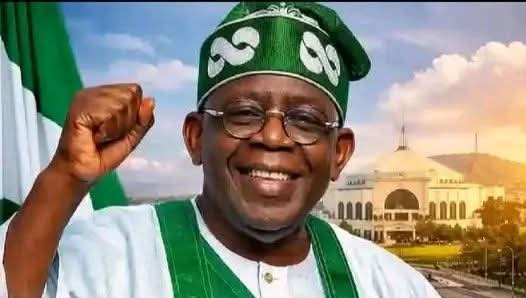
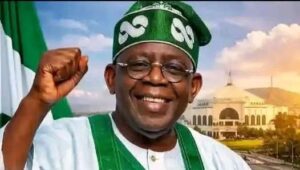
Eid-el-Fitr: President Tinubu Felicitates Muslims, Urges Renewed Unity, Patriotism
Eid-el-Fitr: President Tinubu felicitates Muslims, urges renewed unity, patriotism. Mr Tinubu called on Muslims to reflect on the spiritual lessons of Ramadan.
The president urged them to renew commitment to national unity, peaceful coexistence, and service to humanity as they celebrate the festival across the country on Friday.
This is contained in a statement issued by presidential spokesperson, Bayo Onanuga, on Thursday in Abuja.
Mr Tinubu called on Muslims to reflect on the spiritual lessons of Ramadan, noting that the holy month teaches discipline, sacrifice, compassion, and devotion to God and humanity.
He said: “We have a lot to draw from the noble lessons of Ramadan, especially at a time like this.
“We must continue to abide by the virtues of piety, selflessness, perseverance, kindness and compassion beyond this period.”
The president emphasised the need for Nigerians to remain united across religious and ethnic lines, stressing that national cohesion remains vital for sustainable peace and development.
He urged Muslims to extend acts of kindness and charity to the less privileged, irrespective of religious or ethnic background, in line with the enduring values of Islam.
Mr Tinubu noted that such gestures would strengthen social bonds, promote inclusiveness, and reinforce the spirit of brotherhood that defines the Nigerian society.
The president also called on religious leaders to use the occasion to offer prayers for peace, stability, and economic prosperity across the country.
Tinubu
He expressed optimism that with collective efforts, Nigeria would overcome its challenges and achieve lasting progress for the benefit of all citizens.
Mr Tinubu wished Muslims a joyous celebration, praying that the blessings of Ramadan would bring renewed hope, strength, and guidance to individuals, families, and the nation.
-
 Crime11 months ago
Kogi Assembly Considers Law To Regulate Rent, Establish Control Board: Tenancy Law
-

 News12 months ago
Atiku Reveals Why He Failed To Pick Wike As Running Mate In 2023
-
 Akwa Ibom1 year ago
The Apostolic Church Gets New Territorial Chairman, Exco
-

 Crime1 year ago
Federal High Court Jails 2 For Vandalizing Transformer, Telecom Mast In Kogi
-
 News1 year ago
The Apostolic Church Gets New National President, Executive
-
 Akwa Ibom1 year ago
Umo Eno Commences Payment Of 80,000 Naira Minimum Wage With Arrears
-
 News1 year ago
Senator Natasha Returns To Senate With Husband Amid Seat Dispute
-
 Economy10 months ago
Kiyosaki: Is Tinubu’s Government Afraid Of Ibrahim Traore?