
Economy
Jigawa EFCC Hands Over N387m Recovered Funds To Government

Jigawa EFCC Hands Over N387m Recovered Funds To Government
The Kano Zonal Directorate of the Economic and Financial Crimes Commission, EFCC, on Tuesday, March 17, 2026, handed over the sum of N387,483,488.00 (Three Hundred and Eighty-Seven Million, Four Hundred and Eighty-Three Thousand, Four Hundred and Eighty-Eight Naira), recovered from fraudulent actors to the Jigawa State Government.
The funds were presented to the Director of Treasury Operations of Jigawa State, Muhammad Haruna, in a brief ceremony held at the EFCC Kano Directorate office.
The recovery is the culmination of an investigation initiated following intelligence by the Nigerian Financial Intelligence Unit (NFIU), flagging alleged misappropriation of public funds involving two individuals, Abdullahi Garba and Ayuba Sani.
Acting on the intelligence, operatives of the Commission launched a thorough investigation, during which a total sum of N387,483,488.00 was successfully recovered from the suspects.
Upon conclusion of the investigation, the duo were arraigned in court on charges related to misappropriation of public funds. Subsequently, one of the suspects, Abdullahi Garba, was convicted and sentenced to two years imprisonment after pleading guilty to the charge against him. The second suspect, Ayuba Sani, is currently standing trial.
While presenting the bank draft to the state government representative, the Acting Zonal Director of the Kano Directorate, Assistant Commander of the EFCC, ACE1 Friday S. Ebelo, reiterated the Commission’s unwavering dedication to justice.
“The EFCC remains resolute in its mandate to investigate and ensure the recovery of proceeds of crime. We are committed to the delivery of justice to all victims of corruption, whether they are individuals or government institutions. This handover is a testament to our determination to ensure that funds meant for the development of the people are not diverted for personal use.”
EFCC
Receiving the bank drafts on behalf of the Jigawa State Government, Haruna expressed profound gratitude to the Commission for its diligence, thoroughness and professionalism exhibited throughout the investigation.
“We deeply appreciate the EFCC for its efforts in recovering this substantial amount of money for the people of Jigawa State. This recovery demonstrates the importance of the anti-graft agency and its commitment to safeguarding public funds. The people of Jigawa are the ultimate beneficiaries of this recovery”, he said.





EFCC Arraigns Ex-Convict Adekola Oluokun For Allegedly Laundering N12m
EFCC arraigns ex-convict Adekola Oluokun for allegedly laundering N12m. He pleaded guilty to the charge when it was read to him.
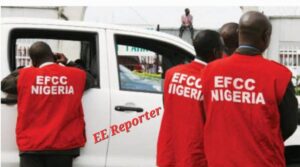
The Economic and Financial Crimes Commission (EFCC), on Monday, arraigned ex-convict Adekola Oluokun for allegedly laundering N12 million.
Mr Oluokun was arraigned on a one-count amended charge of money laundering, contrary to Section 330 of the Criminal Laws of Lagos State, 2011.
He pleaded guilty to the charge when it was read to him.
Following his plea, EFCC counsel Muhammed Bashir asked the court for a date to review the facts of the case and sentencing.
The prosecution also prayed that the defendant be remanded in a correctional centre.
EFCC alleged that the defendant, with others still at large, sometime in 2025 in Lagos, concealed and converted N12 million paid into his account through Point of Sale (POS) agents.
The commission said the sum formed part of N3.9 billion reportedly stolen from accounts in a new-generation bank through unauthorised access and fraudulent activities on its mobile banking platform.
Justice Rahman Oshodi adjourned the case until March 17 for the review of facts and sentencing.
Mr Oshodi also ordered that the defendant be remanded in a correctional centre.
EFCC
Mr Oluokun was earlier convicted on July 23, 2020, by Justice Joyce Abdulmalik of the Federal High Court, Ibadan, Oyo State.
Mr Abdulmalik sentenced him to 20 years’ imprisonment for defrauding a Taiwanese national of $22,300, following prosecution by the EFCC Ibadan Zonal Directorate.
The EFCC Ibadan office had prosecuted him on a six-count amended charge, which included obtaining money by false pretence.
FairMoney Microfinance Bank Appoints Gbenga Shobo As Board Chairman
FairMoney Microfinance Bank appoints Gbenga Shobo as board chairman. He said Mr Shobo’s experience managing complex banking operations would support the bank’s expansion strategy.
FairMoney Microfinance Bank on Monday appointed Gbenga Shobo, former deputy managing director of First Bank of Nigeria Ltd, as chairman of its board.
The bank also announced the appointment of Debo Aderoju as executive director and chief risk officer to strengthen leadership and corporate governance.
FairMoney said the appointments were aimed at strengthening governance frameworks and executive capacity as it expands operations in Nigeria’s growing digital financial services sector.
Commenting, managing director, Henry Obiekea, said the bank had reached a critical stage where strong governance had become essential.
“The bank is at a critical inflection point where strong corporate governance is essential to sustain the growth achieved over the past few years.
“Welcoming Shobo and Aderoju reinforces our commitment to transforming FairMoney into a market-leading financial institution,” Mr Obiekea said.
He said Mr Shobo’s experience managing complex banking operations and technology-driven retail services would support the bank’s expansion strategy.
According to him, Mr Aderoju’s expertise in governance, inclusive finance and risk management will strengthen operational efficiency and regulatory compliance.
Mr Obiekea said Mr Shobo brings more than 35 years of banking experience to the role.
During his tenure at First Bank, Mr Shobo played a key role in driving digital banking growth and supervised business units generating significant revenue.
An alumnus of Obafemi Awolowo University, formerly the University of Ife, Shobo also attended Harvard Business School, Stanford University and INSEAD.
According to Mr Obiekea, Mr Shobo has more than a decade of board-level experience across microfinance, insurance and fintech institutions.
“His appointment will strengthen our governance structure and provide strategic oversight as we expand our footprint in Nigeria’s financial services landscape,” he said.
Mr Obiekea described Mr Aderoju as a banking professional with more than two decades’ experience in credit management, enterprise risk management and inclusive finance.
Before the appointment, Mr Aderoju served as managing director and chief executive officer of Letshego Microfinance Bank Nigeria.

FairMoney Microfinance Bank
He earlier worked at United Bank for Africa before joining First Bank, where he oversaw risk management across several Sub-Saharan African markets.
Mr Obiekea said Mr Aderoju’s appointment remained subject to regulatory approval.
Mr Aderoju also attended leadership programmes at the Gordon Institute of Business Science, University of Pretoria, and the Massachusetts Institute of Technology.
FairMoney Microfinance Bank is a technology-driven institution focused on expanding financial inclusion through digital banking services.
The bank provides loans, savings accounts and payment solutions aimed at improving access to financial services for individuals and businesses across the country.
ASUU President Reveals Why Some Federal Universities Couldn’t Pay Full January Salaries
ASUU president Reveals Why some federal Universities couldn’t pay full January salaries. Christopher Piwuna, president of the Academic Staff Union of Universities (ASUU), has explained why some federal universities were unable to pay their lecturers full salaries for January.
After nearly 16 years of implementation stalemate, the federal government finally signed a renegotiated agreement with ASUU on January 14 to address the incessant strikes in Nigeria’s public tertiary institutions.
The fresh agreement followed intensive renegotiations between a federal government committee and ASUU leadership which was concluded in December 2025.
However, since the beginning of February, there have been reported delays in the payment of lecturers’ salaries across federal universities.
Last week, ASUU members at the University of Lagos (UNILAG) declared an indefinite strike over the non-payment of their full salaries by the university management.
The lecturers later called off the strike after a series of meetings with the management.
As of the time of filing this report, indications suggest that many federal universities have been unable to pay full salaries of lecturers.
A source familiar with developments within the academic community told TheCable that the federal government is yet to release funds to the universities.
According to the source, the ministry of education directed the institutions to pay the full salaries of lecturers from their respective internally generated revenue (IGR).
Piwuna said the situation is largely due to practical difficulties surrounding the implementation of a new salary agreement between the union and the federal government, particularly the delay in passage of the 2026 budget.
According to him, the government has shown a willingness to implement the agreement in full, but the new salary structure cannot be fully effected until the 2026 budget is passed and signed into law.
“Concerning the new agreement, the intention of government is clear; it is to implement it in full. But I want to believe there are practical difficulties at the moment. One is that the 2026 budget has not been passed, let alone becoming law. It is until that is done that the new salary structures will be fully implemented,” the ASUU president told Nigerian Tribune.
He added that payments made in January and February largely stemmed from the efforts of vice chancellors who tried to implement the agreement with available resources.
“In January, some universities were paid in full. When I said ‘in full’ it means that what they paid reflected what we agreed on in the new agreement, while other universities couldn’t meet up with full payment,” he said.
Piwuna added that as of the time of speaking, he was not aware of any university that had paid salaries for February.
“Even for February, I don’t know of any university, as we are speaking, that has paid its workers,” he said.
‘WHY IMPLEMENTATION PROCESS HAS BEEN COMPLICATED’
According to the ASUU president, the implementation process has been complicated by issues relating to special allowances for lecturers in the medical field, with some universities paying the allowance while others are yet to do so.
He said the ministry of education is working with the national salaries, incomes and wages commission to clarify the payment process and ensure lecturers receive what is due to them.
ASUU
Piwuna further said there have been questions from some vice chancellors about whether lecturers on sabbatical should benefit from the new agreement, underscoring that ASUU’s position is that such members are entitled to full payment.
“We do not expect that anybody on sabbatical will be denied any aspect of this agreement,” he said.
He also noted that state universities are yet to begin implementing the agreement with their lecturers, adding that ASUU has written to state governors, who are visitors to their respective universities, urging them to ensure the agreement is implemented to avoid a backlog of arrears.
“We should know that ASUU agreements cover all members across both federal and state-owned universities nationwide. So, we don’t want any university to be left behind in this new agreement,” he said.
Piwuna appealed to lecturers across the public universities to exercise patience over the delay in salary payments, expressing appreciation to vice chancellors who have made efforts to ensure partial implementation of the agreement.
He added that ASUU is hopeful the situation will improve once the 2026 budget is signed into law, which he said is expected later this month.
-
 Crime10 months ago
Kogi Assembly Considers Law To Regulate Rent, Establish Control Board: Tenancy Law
-
 News12 months ago
Atiku Reveals Why He Failed To Pick Wike As Running Mate In 2023
-
 Akwa Ibom1 year ago
The Apostolic Church Gets New Territorial Chairman, Exco
-

 Crime1 year ago
Federal High Court Jails 2 For Vandalizing Transformer, Telecom Mast In Kogi
-
 News1 year ago
The Apostolic Church Gets New National President, Executive
-
 Akwa Ibom1 year ago
Umo Eno Commences Payment Of 80,000 Naira Minimum Wage With Arrears
-
 News1 year ago
Senator Natasha Returns To Senate With Husband Amid Seat Dispute
-
 Economy10 months ago
Kiyosaki: Is Tinubu’s Government Afraid Of Ibrahim Traore?