
News
AVM Adesanya: Bad Governance Fuelling Coups In West Africa

AVM Adesanya: Bad Governance Fuelling Coups In West Africa
AVM Adesanya: Bad governance fuelling coups in West Africa. Former Nigerian Air Force (NAF) chief of logistics, NAF spokesman and one time Nigeria’s defence attache to Russia AVM Olatokunbo Adesanya (rtd) in this interview with TARKAA DAVID, speaks on the increase in coup d’etats in West Africa and its implications
West Africa has witnessed an increased number of coup d’etats in recent years, what could possibly trigger this trend?
Ordinarily, coup d’etats are usually triggered by what is perceived by some as bad governance. Also, it should be borne in mind that sometimes they are triggered by external forces for geopolitical reasons. As we have noticed in recent times, there has been a trend in West Africa for coup d’etats.
It is not impossible that it is as a result of geopolitical interests at play, aside from the generally renowned issues of bad governance. In West Africa, bad governance generally prevails, but as we all agree, democracy still remains the best option. So, with the rising coup d’états in West Africa, I think it is taking us backwards. We have seen it happen already in Burkina Faso, in Mali, and in Niger. We equally saw the recent attempt in Benin Republic, and I think it’s a trend that needs to be checked by all means.
You made mention of some foreign influence. Recently, the president of the United States made some remarks about Nigeria, of coming to intervene, would you rule out foreign influence in Nigeria’s issues as we speak? What is your opinion on Trump’s remark?
Well, it doesn’t threaten our democracy, but it might have some effect on our sovereignty, depending on the way it is looked at. It is not abnormal for a country to be interested in the affairs of another country, if it thinks that the affairs in that country also affects its own interests.
It now behoves on Nigerian leaders and indeed all Nigerians how to handle the issue. Without any doubt, we have the challenge of insecurity in Nigeria, and there’s no denying that. However, I believe that Nigeria is best positioned to handle its internal security challenges, albeit with requisite support from friendly foreign forces, where necessary.
With the spread of coups in West Africa, how can they be prevented? To start with, to prevent coups from happening, democratic leaders have to be very, very sensitive to the needs of the people.
Ordinarily, when there is a change in government, especially if it’s a coup d’etat, and we notice quite an uprising from the general populace in support of the coup d’etas, then it means that truly bad governance was most likely in play. However, if there is generally prevalent good governance, whenever there’s a coup, you will see an uprising by the people against the coup.
So, the primary thing is that democratic leaders must be focused on meeting the needs of the people. That is the primary way to prevent coups from taking place.
Secondly, I would also encourage that those in the military should continue to be tutored in civil-military relations. We know that the military remains subordinate to civil authority. I believe this is being taught, and it should be sustained.
Furthermore, I believe that the needs of the military should be looked at in terms of warfare, equipment as well as professionalism.
Youngsters in Nigeria have been calling for a coup, is Nigeria immune from coups now?
I think the youngsters and even those that are not so young that have been calling for coups in Nigeria are doing so because many of them did not experience military rule in the past. What we enjoy today and what even gives them the impetus to call for coups is because of freedom of speech. Under a military rule, that freedom is certainly not there.
So, I am certainly against those calls for coups in Nigeria. Now, as to the possibility or otherwise of coups taking place in Nigeria, the reality is that no nation can be said to be totally immune from coups. Nevertheless, the possibility of a successful coup d’etat in Nigeria at this point in time is minimal.
You know that we have so far enjoyed over 26 years of unbroken democratic rule. It is the longest that we have been able to achieve as a nation. In the recent past years also, a lot of effort has been made to train the Nigerian military in civil-military relations.
The military I left over two years ago was a military that certainly was not interested in coups or coming to participate in governance in that respect. Rather, the Nigerian military sees itself as being subordinate to and supportive of democratic institutions. In a nutshell, I would say that no nation can be said to be totally immune from coups, but the possibility of a successful coup d’etat in Nigeria is very minimal.
Our security challenge has defied all local solutions. For over a decade, we have been fighting. Do we really need foreign help? But for over a decade now, we have been fighting insurgency and all sorts of insecurity in the country. In your own opinion, what are we not getting right?
Okay, I would like to start by commending President Bola Ahmed Tinubu and his team over the swift intervention in Benin Republic. I actually see it as one of the most successful actions in the sphere of foreign affairs under the current administration. Many would wonder and perceive it as if we left our own issues to go and intervene in the issues of another country.
From the reports available to me, and I believe to the public, the intervention was at the request of the duly recognised government of Benin Republic, in addition to the request by the ECOWAS, and of course, it was successfully executed. What people need to realise is that first, whenever things go wrong, or if things are allowed to go wrong in Benin Republic, then Nigeria’s national security interests become threatened. This is because when you have instability in Benin Republic, it leaves room for miscreants, militants and others to be able to use the place as a launching pad.
It is from there that they can begin to wreak havoc on the interests of Nigeria. There is also the likelihood of influx of internally displaced persons from Benin Republic to Nigeria. Similarly, the cascading adverse effect coming all the way from the Sahel region might start coming through Benin Republic, if the situation were not nipped in the bud.
So it’s a very good thing that the coup was successfully countered with the help of Nigeria. I actually commend our armed forces too for the professional way in which it was done. Now as to why it was successfully done within a short period as compared with what we have been experiencing in Nigeria.
The situation in Nigeria is an asymmetric warfare while what was encountered in the Benin Republic was basically a conventional warfare. In Benin Republic, the Nigerian armed forces were faced with a known enemy that most likely also fought conventionally. On the other hand, within Nigeria, what we have are mostly combatants that do not wear uniform and at the same time employ guerrilla tactics in fighting.
So whenever there is asymmetric warfare, it’s a different ball game altogether. Among other things, it is difficult to identify the enemy and due precaution must to be taken to ensure that collateral damage is minimised.
Again, you know that the collaboration of locals is important with respect to getting the right intelligence and being able to correctly identify the terrorists who, like I said, do not wear uniform and hardly focus on retaining territories. Their main objective is to cause terror to the populace and thereby cause embarrassment to the government of the day, among many others.
AVM Adesanya
There have been allegations of traditional rulers having negotiations, communities negotiating with bandits. What is your opinion on negotiating with bandits and terrorists for peace?
I, without any doubt, totally condemn the idea of negotiating with bandits and paying ransoms. It is never the way to go. This is because when you negotiate with them and end up giving them money, what you are doing is inadvertently funding their nefarious operations thereby enabling them to continue to bring mayhem on peace-loving people of the country.
So, whatsoever efforts we make towards resolving the crisis, it should not be negotiation accompanied by payment of ransom. This is why I’ve always maintained that the prosecution of the counter-insurgency campaign is not something that should be left in the hands of the military alone. It’s an all-of-government approach that is required to solve the problem. That means all stakeholders should come together, employing both the kinetic and non-kinetic measures towards combating the problem.
So, rather than waste resources on paying ransoms, or negotiating with the terrorists, such resources should rather be channeled towards improving governance, eradicating poverty, eradicating illiteracy, minimising unemployment and underemployment, which are some of the root causes of insurgency in the first place.
There is this notion of decreasing power of ECOWAS in the region in the face of widespread coups and threats of sanctions. Is the regional body losing its relevance?
The pullout of some countries from ECOWAS to form the Alliance of Sahel States did not help the image of ECOWAS in anyway. I am however happy that ECOWAS was able to swiftly act regarding the successfully countered coup in Benin Republic.
Otherwise, the Alliance of Sahel States might have gained an additional member to the disadvantage of ECOWAS. ECOWAS must continue to act swiftly and be and be fully supported by member states to maintain true democracy in the region.





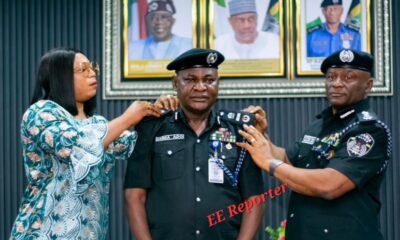




FG Inaugurates PenCom Board, Tasks Members On Protection Of Pension Assets
The Federal Government has inaugurated the Board of the National Pension Commission, reinforcing its commitment to transparency, accountability, and the protection of over ₦28 trillion in pension assets.
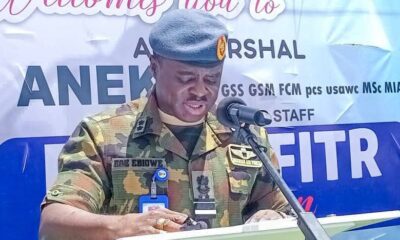
Speaking at the ceremony, the SGF, Senator (Dr.) George Akume, charged members to uphold strong corporate governance while maintaining a clear boundary between oversight and management.

PenCom
The Board, led by Chairman Agbaje Opeyemi Olukayode, pledged to safeguard contributors’ funds and support national development, while the Director-General Omolola Oloworaran reaffirmed commitment to collaboration in delivering secure and timely retirement benefits for Nigerians.
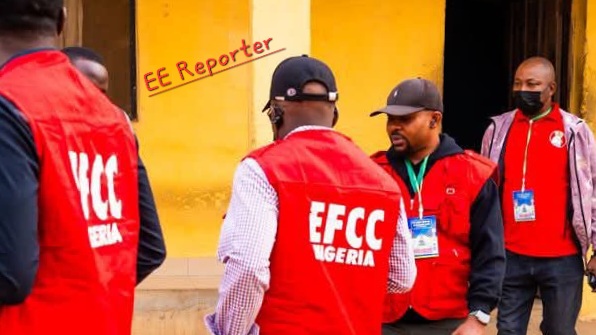
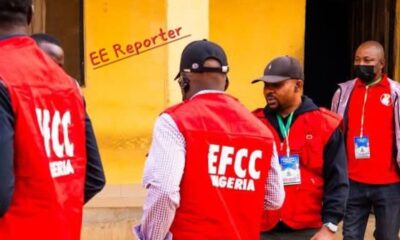
EFCC Officials Mark Properties Linked To Malami In Abuja For Forfeiture: “Keep Off”
“Keep off”. The marking of Malami’s alleged properties took place hours after former Vice-President Atiku Abubakar visited his residence.
The EFCC operatives, alongside armed security personnel, who carried out the exercise on Monday morning, were challenged by the former minister and people around him.
In a video posted on social media, Malami asked a man, who appears to be an EFCC official, to show him the court order authorising them to mark and take over his residence.
The official told the former AGF that the anti-graft agency has the right to mark the property since it is under forfeiture.
Malami responded that the forfeiture order has expired and asked the EFCC official to show him the document authorising the marking.
The inscription, “Restrained order EFCC keep off”, was marked on one of the properties linked to Malami.
In January, a federal high court in Abuja ordered the interim forfeiture of 57 properties suspected to be proceeds of unlawful activities allegedly linked to Malami and two of his sons, Abdulaziz Malami and Abiru Rahman Malami.
The court directed the EFCC to publish the interim forfeiture order in a national daily newspaper, inviting any individual or organisation with an interest in the assets to appear before the court within 14 days and show cause why a final forfeiture order should not be made.
In February, Malami filed an application challenging the interim forfeiture of the properties linked to him.
RELEASE FROM CUSTODY
The former AGF is standing trial on two separate criminal charges.
Last week, Malami was released from custody after a court granted him bail.
On February 27, a federal high court in Abuja granted bail to Malami and his son, Abdulaziz, in the sum of N200 million each over alleged terrorism-related offences.
EFCC
Malami and his son were arraigned on February 3 on a five-count charge bordering on alleged terrorism financing and illegal possession of firearms.
The Department of State Services (DSS) accused the former minister of refusing to prosecute terrorism financiers whose case files were reportedly forwarded to the office of the attorney-general for prosecution while he was in the office.
The EFCC had arraigned Malami, his son and wife, over allegations bordering on money laundering to the tune of N8,713,923,759.49.
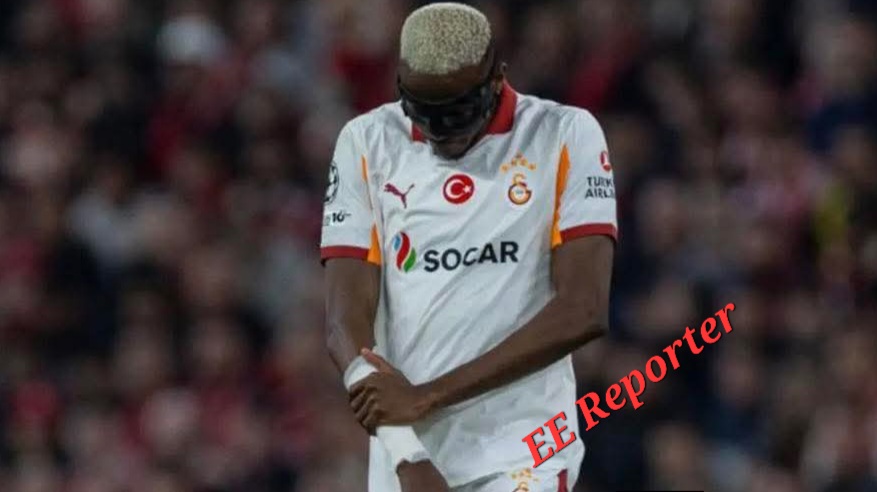
Osimhen Undergoes Successful Surgery Following Injury Against Liverpoo
Victor Osimhen fractured his hand during a challenge with Liverpool defender Ibrahima Konate.
Turkish side Galatasaray, on Monday, announced that Super Eagles forward Victor Olorunfemi has undergone surgery following the hand injury he suffered in the UEFA Champions League round of 16 match against Liverpool last week.
Osimhen only managed to play the first half of the game at Anfield before he was subbed off after fracturing his hand during a challenge with Liverpool defender Ibrahima Konate.
In a statement on Monday, Galatasaray confirmed that the club’s doctor, Yener İnce, successfully operated on the 27-year-old to repair his hand at Maslak Acıbadem Hospital.
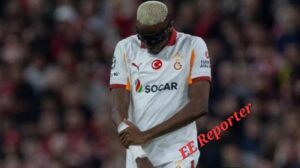
Osimhen
“In the away match we played against Liverpool in the UEFA Champions League Round of 16, our player Victor Osimhen, who was injured and unable to continue the game, underwent a successful operation today at Maslak Acıbadem Hospital performed by our club doctor Op. Dr. Yener İnce,” the Galatasaray said.
The club added that it “extend our wishes for a speedy recovery to our footballer and hope for his return to the field at the earliest.”
Galatasaray would hope that Osimhen recovers in time to help the reigning Turkish champions in their fight with Fenerbahce to retain the league title.
-
 Crime11 months ago
Kogi Assembly Considers Law To Regulate Rent, Establish Control Board: Tenancy Law
-
 News12 months ago
Atiku Reveals Why He Failed To Pick Wike As Running Mate In 2023
-
 Akwa Ibom1 year ago
The Apostolic Church Gets New Territorial Chairman, Exco
-

 Crime1 year ago
Federal High Court Jails 2 For Vandalizing Transformer, Telecom Mast In Kogi
-
 News1 year ago
The Apostolic Church Gets New National President, Executive
-
 Akwa Ibom1 year ago
Umo Eno Commences Payment Of 80,000 Naira Minimum Wage With Arrears
-

 News1 year ago
Senator Natasha Returns To Senate With Husband Amid Seat Dispute
-
 Economy10 months ago
Kiyosaki: Is Tinubu’s Government Afraid Of Ibrahim Traore?