
News
Forest Security Service Seeks Collaboration With EFCC In Anti-corruption Fight


Forest Security Service Seeks Collaboration With EFCC In Anti-corruption Fight
The Nigerian Forest Security Service, NFSS, has sought collaboration with the Economic and Financial Crimes Commission, EFCC, in the fight against corruption, economic and financial crimes in the country.
The request was made on Thursday, April 2, 2026, when NFSS Commander-General, Adewole Joshua Osatimehin, led a delegation of his management team on a courtesy visit to EFCC’s Executive Chairman, Ola Olukoyede at the Commission’s corporate headquarters in Jabi, Abuja.
Speaking during the visit, Osatimehin commended Olukoyede’s leadership for its strides in tackling corruption and especially in bringing highly-placed corrupt individuals to justice.
“We are here today after considering your vision for this organisation. Since you took over, high-profile individuals who thought they were untouchable were brought to book, and Nigeria is feeling the impact. We want to be part of your success story,” he said.
In this regard, he informed his host that the NFSS has a widespread grassroots presence that could support the EFCC in intelligence gathering across the country.
“We have members in all the villages and wards, with village intelligence officers all over the country. If you want to get any information, whether in Zamfara, Sokoto or anywhere, it is just a phone call away. While we trace bandits, Boko Haram insurgents and other criminal elements, the EFCC can monitor their financial flows to ensure their arrest,” he said.
He appealed to the EFCC for capacity building of NFSS personnel, particularly in the area of investigation.
“We have our head of finance and administration, zonal commanders and national officers, and we want them to be trained in your facility and benefit from your vast pool of resource persons so that we can improve our operational capabilities. This partnership will yield the desired results,” he said.
Osatimehin highlighted the importance of forest security, noting that Nigeria’s vast forest reserves require urgent attention.
“Nigeria is blessed with ecological assets, including 1,129 forest reserves, 29 game reserves, 17 national parks and 417 grazing reserves. Out of the country’s 92 million hectares of land mass, about 9.1 million hectares are forested. This shows that a significant portion of Nigeria is forested, and something must be done to secure these areas,” he said.
Olukoyede in his remarks, welcomed the desire of NFSS to collaborate with the EFCC towards the achievement of the mandates of both agencies of the government.
“Everybody must be involved in ensuring security in Nigeria. Even at the private level. Provided they can offer value, we can work together. Anyone who understands what is going on in our forests today knows there is a need for synergy with forest guards,” he said.
The EFCC boss regretted that forests across the country have become safe havens for criminal elements and called for collaborative action of all stakeholders.
“Our forests are virtually taken over by bandits and illegal miners, and the latter falls within our mandate. We arrest illegal miners in large numbers, and many of the heinous crimes committed by bandits are planned and executed from the forests. They perpetrate their crimes and retreat back to the forests. This is an area where the government and citizens must rise collectively to address the menace,” he said.

Forest Security Service
He assured the delegation of the Commission’s willingness to partner with organizations whose mandates align with that of the EFCC.
“We are willing to collaborate and partner with any organisation, whether private or public, provided their mandates align with ours. We are patriotic in our work, and we appreciate what you are doing. Together, we can achieve more,” he said.
He granted NFSS’s request for capacity building by the EFCC in the area of investigation.











News
NAF, Oyo Deepen Strategic Partnership To Advance Aviation Capability, Security And National Development
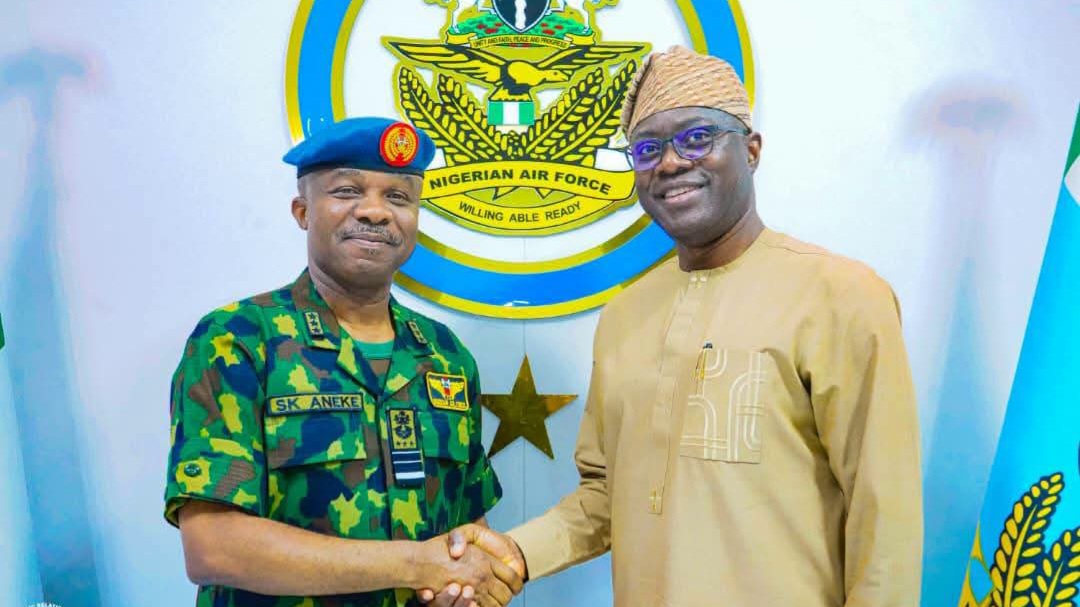
NAF, Oyo Deepen Strategic Partnership To Advance Aviation Capability, Security And National Development
The Nigerian Air Force (NAF) and the Oyo State Government have taken significant steps towards strengthening institutional collaboration following a visit by the Executive Governor of Oyo State, His Excellency Engr Seyi Makinde, to the Chief of the Air Staff (CAS), Air Marshal SK Aneke, at Headquarters Nigerian Air Force, Abuja, on Friday, 24 July 2026.
Eereporter.com
Discussions focused on a proposed Memorandum of Understanding (MoU) that will facilitate strategic cooperation in the operation and maintenance of the Oyo State Government’s newly acquired Diamond DA-42 aircraft, reinforcing a shared commitment to enhancing aviation capability, security and sustainable development.
Governor Makinde expressed profound appreciation to the Nigerian Air Force for its unwavering support to Oyo State, particularly its vital role during the recent rescue operation involving abducted students in Oriire Local Government Area.
He commended the professionalism and dedication of NAF personnel, noting that the Service’s Intelligence, Surveillance and Reconnaissance (ISR) personnel operated tirelessly, day and night, to provide critical situational awareness that significantly supported the operation.
The Governor further observed that the intelligence and operational insights shared by the Nigerian Air Force have also provided valuable perspectives that will help shape the State’s technology-driven security architecture and future security initiatives.
He also appreciated the Service for supporting the accommodation of the State’s aircraft and expressed the desire to expand collaboration in aviation operations and post-service housing initiatives for the benefit of both institutions.
In his remarks, the Chief of the Air Staff expressed appreciation for the confidence reposed in the Nigerian Air Force, describing the proposed partnership as a reflection of the Service’s professionalism, operational excellence and enduring relationship with the people of Oyo State. Air Marshal Aneke reaffirmed the NAF’s commitment to supporting the State Government in areas of mutual interest, assuring that the necessary frameworks would be explored to facilitate a mutually beneficial collaboration.

NAF, Oyo
He further commended Governor Makinde’s visionary leadership and reaffirmed the Nigerian Air Force’s resolve to continue fostering strategic partnerships that strengthen national security, promote innovation, enhance personnel welfare and accelerate socio-economic development.
Eereporter.com
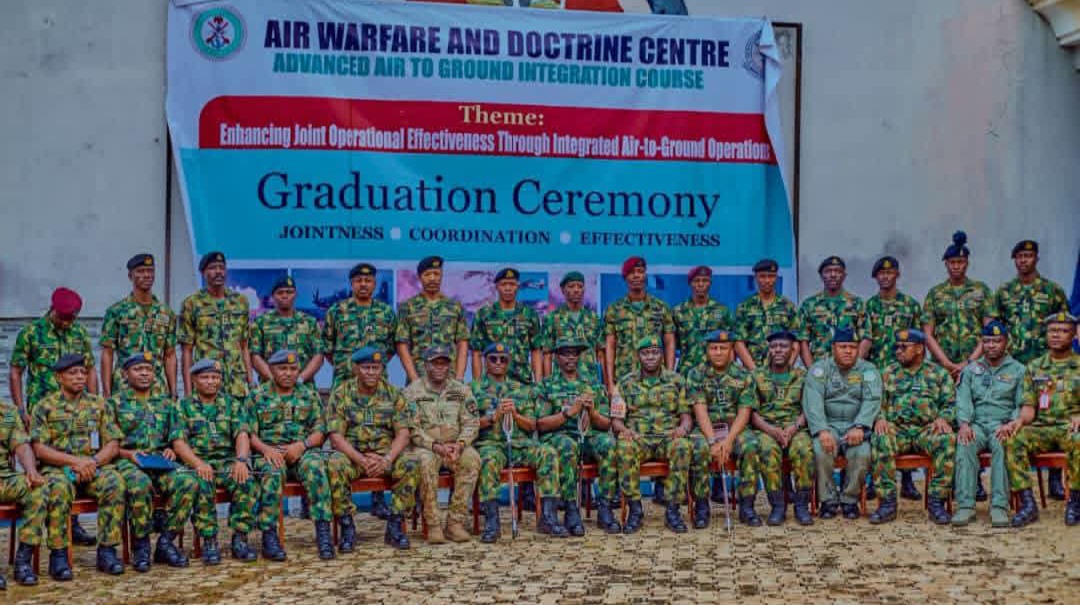
CDS Charges Air-To-Ground Integration Graduands To Strengthen Joint Operational Capability
The Chief of Defence Staff (CDS), General Olufemi Oluyede, has charged newly qualified Joint Terminal Attack Controllers (JTACs) and Joint Fire Observers (JFOs) to apply their specialised skills in strengthening joint military operations and enhancing operational effectiveness across the Armed Forces of Nigeria.
Eereporter.com
Represented by the Director Liaison, Defence Headquarters, Air Vice Marshal Garba Bello, the CDS gave the charge during the graduation ceremony of the Advanced Air-to-Ground Integration Course 4/2026 held at the Nigerian Air Force Base, Makurdi.
He emphasised that effective air-ground integration remains indispensable in today’s complex security environment, as it enhances mission success while reducing the risks of friendly fire and collateral damage.
He also commended the successful evolution of the programme into a fully indigenous training capability delivered by Nigerian instructors, describing it as a major milestone in building sustainable national capacity for joint operations in line with the Chief of the Air Staff’s commitment to strengthening jointness, mission-oriented training and operational excellence.
A total of 53 personnel comprising 16 JTACs and 37 Joint Fire Observers (JFOs) drawn from the Nigerian Army, Nigerian Navy and Nigerian Air Force successfully completed the intensive 16-week programme.
Through rigorous classroom instruction, simulation exercises and practical field training culminating in live Close Air Support missions using A-29 Super Tucano aircraft, the participants acquired the expertise required to coordinate close air support, facilitate effective joint fires integration, and provide accurate targeting information that enhances commanders’ decision-making and the effective employment of joint fires.
The enhanced capability is expected to improve the precision, responsiveness and effectiveness of joint operations against terrorism, insurgency, banditry and other emerging security threats across the country.
Earlier, the Director General, Air Power Centre of Excellence, Air Vice Marshal Patrick Obeya, described the graduation as another significant milestone in institutionalising doctrine-driven air-to-ground integration and developing a specialised cadre capable of strengthening the vital link between air power and surface forces.
Also speaking, the Commandant, Air Warfare and Doctrine Centre (AWDC), Air Vice Marshal Garba Ibrahim Jibia, noted that the graduates are now equipped with the knowledge, procedures and interoperability required to coordinate joint fires in accordance with established operational doctrine.
CDS Charges Air-To-Ground Integration Graduands
The ceremony featured a live air-to-ground targeting demonstration, a video presentation of field exercises, and the presentation of awards and certificates to outstanding graduands, reinforcing the Armed Forces of Nigeria’s commitment to developing a highly professional, mission-ready and interoperable force capable of addressing contemporary security challenges.
Eereporter.com

Arsenal Moves For Vinicius Jr As Real Madrid Push For Diomand
Arsenal are exploring a potential deal for Real Madrid winger Vinicius Junior, while the Spanish giants are reportedly advancing their efforts to sign RB Leipzig forward Yan Diomande.
Eereporter.com
Sky Sports News on Saturday reported that there has been no club-to-club contact between Arsenal and Real Madrid over Vinicius, but the Premier League club’s interest is genuine.
The Brazilian is one of several forwards Arsenal are exploring, with Julian Alvarez, Diomande and Bradley Barcola also among their options.
Vinicius, 26, has entered the final year of his contract with Real Madrid. If an agreement cannot be reached on a new deal, the Spanish club could be open to selling him rather than risk losing the Brazil international for free next summer.
The situation has also been linked to Real Madrid’s interest in Diomande.
Sky Sports, Talk Sports and other reports said the Spanish club had an £85.4m bid rejected by RB Leipzig for the 19-year-old Ivorian winger, while Liverpool and Arsenal have also shown interest.
A report carried by Yahoo Sports said the developments could provide a boost to Arsenal’s hopes of signing Vinicius, with the Brazilian potentially open to a move if Real Madrid complete a deal for Diomande as his replacement.
Real Madrid’s pursuit of Diomande has reportedly intensified, with talkSPORT reporting that the club is advancing its efforts to sign the winger after its initial bid was rejected.
The report said Diomande had initially preferred a move to Paris Saint-Germain, but the lack of a completed agreement between PSG and Leipzig had left room for Madrid to pursue the deal.
Sky Sports’ Peter Smith described a potential move for Vinicius as a “jaw-dropping addition” for Arsenal.
“It’s well known Arsenal are aiming to strengthen their left-wing options this summer – but a deal for Brazil ace Vinicius Junior would be a jaw-dropping addition,” Smith said.
Vinicius was runner-up in the 2024 Ballon d’Or voting and is regarded as one of Real Madrid’s leading attacking players.
He has also been named one of the club’s captains for the new season, according to Brazilian outlet ge, which reported that he would wear the armband in the absence of Federico Valverde.
The report also noted that Vinicius’ relationship with new Real Madrid manager Jose Mourinho had been in focus.
“However, it is understood the player and head coach have been in touch since an incident last season which saw Vinicius Jr abused by Mourinho’s Benfica midfielder Gianluca Prestianni and that the pair were ready to start this new campaign together with a clean slate.
“But with Arsenal’s interest being reported, there is now the possibility Vinicius Jnr will be kicking off the 2026/27 season in the Premier League,” the report said.
Arsenal have been looking to strengthen their left-wing options this summer.
The club sold Leandro Trossard to Besiktas for £17m and signed Christos Tzolis from Club Brugge for £34m, while Gabriel Martinelli scored one Premier League goal last season.

Arsenal Moves For Vinicius Jr
Arsenal’s interest in Vinicius remains exploratory, with no club-to-club contact reported, while Diomande is being pursued by Real Madrid and has also attracted interest from Arsenal and Liverpool.
A move for Diomande could therefore have implications for the transfer market around Vinicius, although no deal has been agreed for either player.
Eereporter.com
-

 Crime1 year ago
Kogi Assembly Considers Law To Regulate Rent, Establish Control Board: Tenancy Law
-

 News1 year ago
Atiku Reveals Why He Failed To Pick Wike As Running Mate In 2023
-

 Akwa Ibom2 years ago
The Apostolic Church Gets New Territorial Chairman, Exco
-

 Crime1 year ago
Federal High Court Jails 2 For Vandalizing Transformer, Telecom Mast In Kogi
-

 News1 year ago
The Apostolic Church Gets New National President, Executive
-

 Akwa Ibom2 years ago
Umo Eno Commences Payment Of 80,000 Naira Minimum Wage With Arrears
-

 News1 year ago
Senator Natasha Returns To Senate With Husband Amid Seat Dispute
-

 Economy1 year ago
Kiyosaki: Is Tinubu’s Government Afraid Of Ibrahim Traore?