
News
Senate President Akpabio Declares Three Senate Seats Vacant, Orders By-Elections

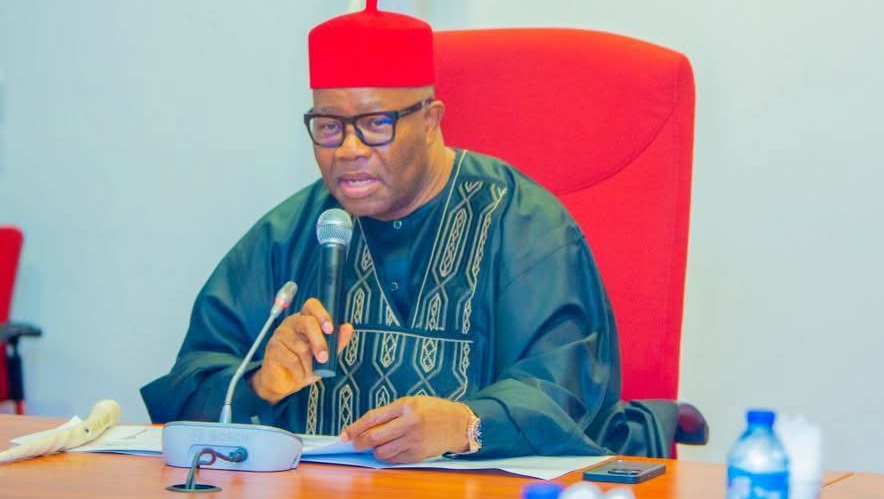
Senate President Akpabio Declares Three Senate Seats Vacant, Orders By-Elections
Three senate seats vacant. The Senate president directed the INEC to conduct by-elections within the stipulated constitutional timeframe.
Mr Akpabio made the announcement during Tuesday’s plenary, describing the development as a tragic loss to the legislature.
“These unfortunate events necessitate midterm elections by the Independent National Electoral Commission (INEC) to fill the affected seats,” he said.
He cited provisions of the Constitution of the Federal Republic of Nigeria 1999, as amended, in declaring the vacancies.
Mr Akpabio said, “Enugu State—Enugu North Senatorial District is hereby declared vacant. Nasarawa State—Nasarawa North Senatorial District is hereby declared vacant. Rivers—Rivers South East Senatorial District is hereby declared vacant.”
Akpabio
The Senate president directed the INEC to conduct by-elections within the stipulated constitutional timeframe.
“The timeframe is approximately 30 days from the date of this declaration. May the souls of our departed colleagues rest in perfect peace,” he prayed.
Meanwhile, the Senate adjourned plenary until April 21 for the Easter break.








News
Nigerian Navy Uncovers 31 Dug Out Pits, Recovers 62,050 litres of Suspected Stolen Petroleum Products in Rivers
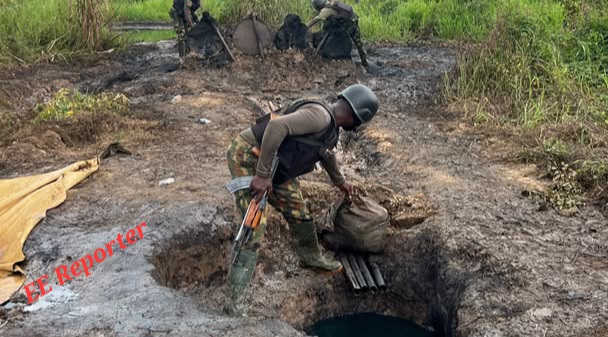
Nigerian Navy Uncovers 31 Dug Out Pits, Recovers 62,050 litres of Suspected Stolen Petroleum Products in Rivers
The Nigerian Navy has uncovered two suspected illegal refining sites containing approximately 62,050 litres of petroleum products in Ogbogolo community, Ahoada West Local Government Area of Rivers State, during an anti-crude oil theft operation on 8 September 2026.
Eereporter.com
The operation, conducted by personnel of Nigerian Navy Ship SOROH, a unit under Operation DELTA SENTINEL, led to the discovery of 31 dugout pits containing about 58,000 litres of suspected stolen crude oil and 4,050 litres of suspected illegally refined Automotive Gas Oil (AGO), commonly known as diesel. The team also recovered six sacks and one keg containing additional quantities of suspected illegally refined AGO.
The sites, located within the Orashi Forest and the wider Ogbogolo area, were handled in accordance with extant regulations. No arrest was made, as the suspects fled upon sighting the naval team.
Nigerian Navy
Operation DELTA SENTINEL, since inception, has led to numerous busts, reinforcing the Nigerian Navy’s commitment to eradicate illegal refining activities in the Niger Delta while denying perpetrators access to the facilities used to store and process petroleum products, thus protecting Nigeria’s oil resources and economic interests.
Signed
AA FOLORUNSHO
Captain (Nigerian Navy) Director Naval Information
Eereporter.com
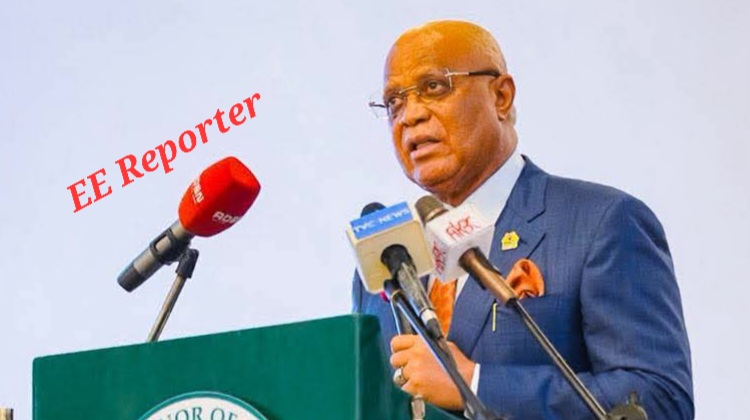
Governor Eno Directs MDAs, Contractors to Fast-Track Transport Projects for 2026 Delivery
Akwa Ibom State Governor, Pastor Umo Eno, Ph.D., has directed relevant Ministries, Departments and Agencies (MDAs) and contractors to accelerate work on ongoing transportation projects across the state to ensure their completion and commissioning before the end of 2026.
Eereporter.com
Governor Eno gave the directive on Thursday, October 8, 2026, during a comprehensive briefing on the progress of ongoing transport infrastructure and equipment projects by the responsible MDAs and contractors.
The governor stressed that the projects were designed to improve transportation services, enhance connectivity and provide residents with efficient and affordable mobility.
He expressed concern over delays in project execution, insisting that all relevant agencies and contractors must intensify their efforts to meet the stipulated deadlines and deliver the projects for public use.
ORON MARITIME PROJECT NEARS COMPLETION
Speaking on the Oron Maritime Infrastructure and Ferry Project, Governor Eno highlighted its potential to boost economic activities, promote tourism, strengthen maritime security and improve transportation across the state’s waterways.
He directed the relevant agencies and contractors to take all necessary measures to ensure the timely completion of the project, proper commissioning and smooth commencement of operations.
The Oron project is reportedly 85 per cent complete and comprises a terminal building, passenger jetty, cargo jetty, Joint Task Force (JTF) jetty, floating bar, warehouses, dry storage facilities, fish processing and drying sections, solar-powered cold rooms for fishmongers, and a recreational area.
When completed, the facilities are expected to facilitate passenger and cargo movement, improve fish preservation and processing, strengthen maritime security and support tourism development.
FERRIES, CNG BUSES ALSO UNDER REVIEW
Other projects reviewed during the briefing included the status of two ferries ordered by the state government, CNG buses and associated terminal infrastructure, alongside other transportation initiatives.
The governor charged the responsible MDAs and contractors to sustain the pace of work and ensure that the projects deliver their intended benefits to the people of Akwa Ibom State.
He further emphasised the importance of effective coordination, regular monitoring and prompt resolution of implementation challenges to achieve the year-end delivery target.
Umo Eno
Governor Eno reiterated his administration’s commitment to improving transportation infrastructure and expanding mobility options for residents through the timely delivery of ongoing projects.
Present at the briefing were the Deputy Governor, Senator Akon Eyakenyi; Secretary to the State Government, Prince Enobong Uwah; Executive Assistant/Chief Delivery Advisor, Mr Aniefiok Johnson; Commissioner for Transport, Dr Anthony Luke; members of the State Executive Council; and other government officials.
Eereporter.com
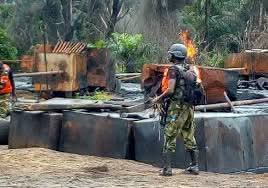
Navy Uncovers 25,000 Litres of Suspected Crude Oil in Delta
The Nigerian Navy has uncovered approximately 25,000 litres of substance suspected to be crude oil in a dugout reservoir in the Oteghele general area of Delta State, extending its recent operational gains against suspected crude oil theft in the area.
Eereporter.com
The discovery was made by NNS DELTA on 8 October 2026, following credible intelligence. The reservoir and its contents were handled in accordance with established procedures.
The latest recovery brings the quantity of suspected crude oil uncovered by NNS DELTA in Oteghele to 65,000 litres within two consecutive days, following the discovery of approximately 40,000 litres on 7 October. The successive operations highlight the importance of maintaining pressure on locations used for the suspected storage of illicit petroleum resources.
Oil
Through these interventions, the Nigerian Navy is reinforcing its resolve to deny criminal operators the opportunity to exploit petroleum resources unlawfully and to sustain operations that protect Nigeria’s critical economic assets.
Signed AA FOLORUNSHO Captain (Nigerian Navy) Director Naval Information
Eereporter.com
-
 Crime1 year ago
Kogi Assembly Considers Law To Regulate Rent, Establish Control Board: Tenancy Law
-

 News2 years ago
Atiku Reveals Why He Failed To Pick Wike As Running Mate In 2023
-
 Akwa Ibom2 years ago
The Apostolic Church Gets New Territorial Chairman, Exco
-

 Crime2 years ago
Federal High Court Jails 2 For Vandalizing Transformer, Telecom Mast In Kogi
-
 News2 years ago
The Apostolic Church Gets New National President, Executive
-
 Akwa Ibom2 years ago
Umo Eno Commences Payment Of 80,000 Naira Minimum Wage With Arrears
-

 News2 years ago
Senator Natasha Returns To Senate With Husband Amid Seat Dispute
-

 Economy1 year ago
Kiyosaki: Is Tinubu’s Government Afraid Of Ibrahim Traore?