
Economy
ASUU President Reveals Why Some Federal Universities Couldn’t Pay Full January Salaries


ASUU President Reveals Why Some Federal Universities Couldn’t Pay Full January Salaries
ASUU president Reveals Why some federal Universities couldn’t pay full January salaries. Christopher Piwuna, president of the Academic Staff Union of Universities (ASUU), has explained why some federal universities were unable to pay their lecturers full salaries for January.
After nearly 16 years of implementation stalemate, the federal government finally signed a renegotiated agreement with ASUU on January 14 to address the incessant strikes in Nigeria’s public tertiary institutions.
The fresh agreement followed intensive renegotiations between a federal government committee and ASUU leadership which was concluded in December 2025.
However, since the beginning of February, there have been reported delays in the payment of lecturers’ salaries across federal universities.
Last week, ASUU members at the University of Lagos (UNILAG) declared an indefinite strike over the non-payment of their full salaries by the university management.
The lecturers later called off the strike after a series of meetings with the management.
As of the time of filing this report, indications suggest that many federal universities have been unable to pay full salaries of lecturers.
A source familiar with developments within the academic community told TheCable that the federal government is yet to release funds to the universities.
According to the source, the ministry of education directed the institutions to pay the full salaries of lecturers from their respective internally generated revenue (IGR).
Piwuna said the situation is largely due to practical difficulties surrounding the implementation of a new salary agreement between the union and the federal government, particularly the delay in passage of the 2026 budget.
According to him, the government has shown a willingness to implement the agreement in full, but the new salary structure cannot be fully effected until the 2026 budget is passed and signed into law.
“Concerning the new agreement, the intention of government is clear; it is to implement it in full. But I want to believe there are practical difficulties at the moment. One is that the 2026 budget has not been passed, let alone becoming law. It is until that is done that the new salary structures will be fully implemented,” the ASUU president told Nigerian Tribune.
He added that payments made in January and February largely stemmed from the efforts of vice chancellors who tried to implement the agreement with available resources.
“In January, some universities were paid in full. When I said ‘in full’ it means that what they paid reflected what we agreed on in the new agreement, while other universities couldn’t meet up with full payment,” he said.
Piwuna added that as of the time of speaking, he was not aware of any university that had paid salaries for February.
“Even for February, I don’t know of any university, as we are speaking, that has paid its workers,” he said.
‘WHY IMPLEMENTATION PROCESS HAS BEEN COMPLICATED’
According to the ASUU president, the implementation process has been complicated by issues relating to special allowances for lecturers in the medical field, with some universities paying the allowance while others are yet to do so.
He said the ministry of education is working with the national salaries, incomes and wages commission to clarify the payment process and ensure lecturers receive what is due to them.

ASUU
Piwuna further said there have been questions from some vice chancellors about whether lecturers on sabbatical should benefit from the new agreement, underscoring that ASUU’s position is that such members are entitled to full payment.
“We do not expect that anybody on sabbatical will be denied any aspect of this agreement,” he said.
He also noted that state universities are yet to begin implementing the agreement with their lecturers, adding that ASUU has written to state governors, who are visitors to their respective universities, urging them to ensure the agreement is implemented to avoid a backlog of arrears.
“We should know that ASUU agreements cover all members across both federal and state-owned universities nationwide. So, we don’t want any university to be left behind in this new agreement,” he said.
Piwuna appealed to lecturers across the public universities to exercise patience over the delay in salary payments, expressing appreciation to vice chancellors who have made efforts to ensure partial implementation of the agreement.
He added that ASUU is hopeful the situation will improve once the 2026 budget is signed into law, which he said is expected later this month.







Economy
Umahi Receives New NLNG CEO, Announces President’s Approval For Dualisation Of Road Linking Bodo-Bonny To East-West Road
Umahi Receives New NLNG CEO, Announces President’s Approval For Dualisation Of Road Linking Bodo-Bonny To East-West Road
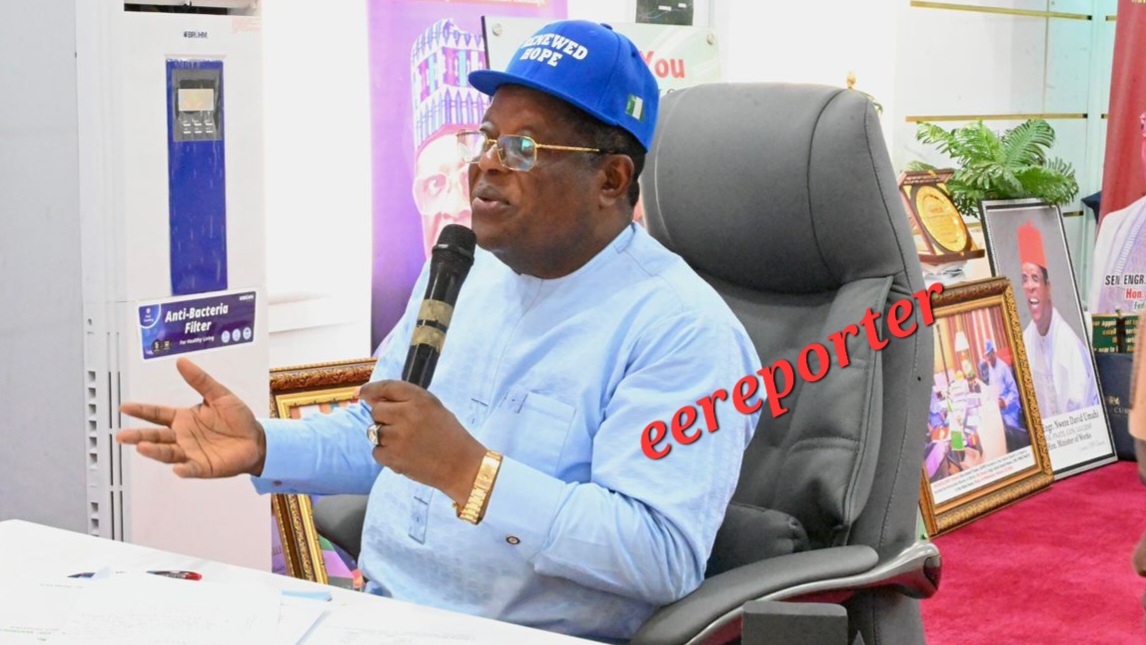
The Minister of Works, Senator Engr. David Umahi, CON, has received the new Managing Director and Chief Executive Officer of Nigeria Liquefied Natural Gas, Adeleye Falade, at the Ministry’s headquarters in Abuja, using the occasion to announce fresh approval for a major road project in Rivers State.
The meeting, held on Wednesday, focused on the completed Bodo-Bonny Road and the next phase of development that will link it to the East-West Road, an important route for movement of people and goods in the Niger Delta.
Speaking during the visit, the Minister revealed that the President, HE Senator Bola Ahmed Tinubu, CON has approved the dualisation of the 8.9-kilometre road connecting Bodo-Bonny to the East-West Road. The project will be constructed with concrete and will include two flyovers, solar-powered streetlights, and modern monitoring systems.
Eereporter.com
“I have listed that project for the president, he will tell me when he is ready for the commissioning and I will let you know and graciously he has also approved the 8.9km dualized and this time on concrete with two flyovers. We are working with Julius Berger since they are on site, it is more economical for us for them to continue. With the information I’m having from PPP I think the cost is about 150billion because it is a very terrible terrain, two flyovers and solar powered light, tree planting and also some rest house where we will stay and monitor the CCTV.”
Umahi explained that part of the funds saved from the Bodo-Bonny Road project has already been redirected to improve the road with solar lights and tree planting.
“We made some savings from the Bodo-Bonny and we directed them to use this savings to put solar light and then plant trees within that axis. So, I want to assure you that we work very closely with you and we are not going to be on that project when awarded for more then twelve months and the price will not be reviewed. So make it very clear in our agreement with you and us and them.”
The Minister said the Tinubu administration is focused on building durable roads that will last for decades, while also improving safety and boosting economic activities.
“I want to commend you very highly and I say that the president infrastructure revolution in Nigeria is quite unprecedented. There is no part of this country that you don’t see solid work going on and we are not talking about just road construction, he is building a road that will last between 50-100years with minimal maintenance and that is what he stands for.
For the first time you see road is built, it has solar light. So that people can travel at night and it will increase commercial activity and also safety on the road. He has also directed to start mapping out our to put CCTV on our roads and have viewing points so that response them at every point in time will not be more than 10mins.”
Earlier, Abdul Humaru introduced the NLNG team, saying: “We are here to introduce our new managing director and CEO and for a courtesy visit as well.”
In his remarks, the NLNG boss, Adeleye Falade, thanked the Federal Government for its support, especially on the Bodo-Bonny Road, which he said is already making life easier for residents and businesses.
“Just like Abdul said it is a courtesy visit but it is more than courtesy, we want to take this privilege to express gratitude particularly on Bodo Bonny road.
I want to thank you for the support. The road as we have communicated is completed now, we are actually waiting for when you will give us a date for official commissioning but we know people are already using it. The road changed a lot of things about the activities on the Island.
I went on the road myself from my office in Port Harcourt. It took me one and a half hours from my office to Bonny that is something that will ordinarily take us four hours.”
Umahi
He also expressed readiness for continued collaboration on the new road project.
“We are grateful for the support. We are also grateful for the consideration of that 8.9km that leads into the East west road that enables us to maximize that particular road. We are still waiting for advice, who is going to handle that going forward. We are ready to provide support as well. So, today we have come to show gratitude for the support that we have gotten from you.”
Francis Nwaze, FIPMD
Senior Special Assistant to the Honourable Minister of Works (Media)
April 30, 2026
NNPC Records Major Breakthrough With Successful River Niger Crossing On OB3 Gas Pipeline
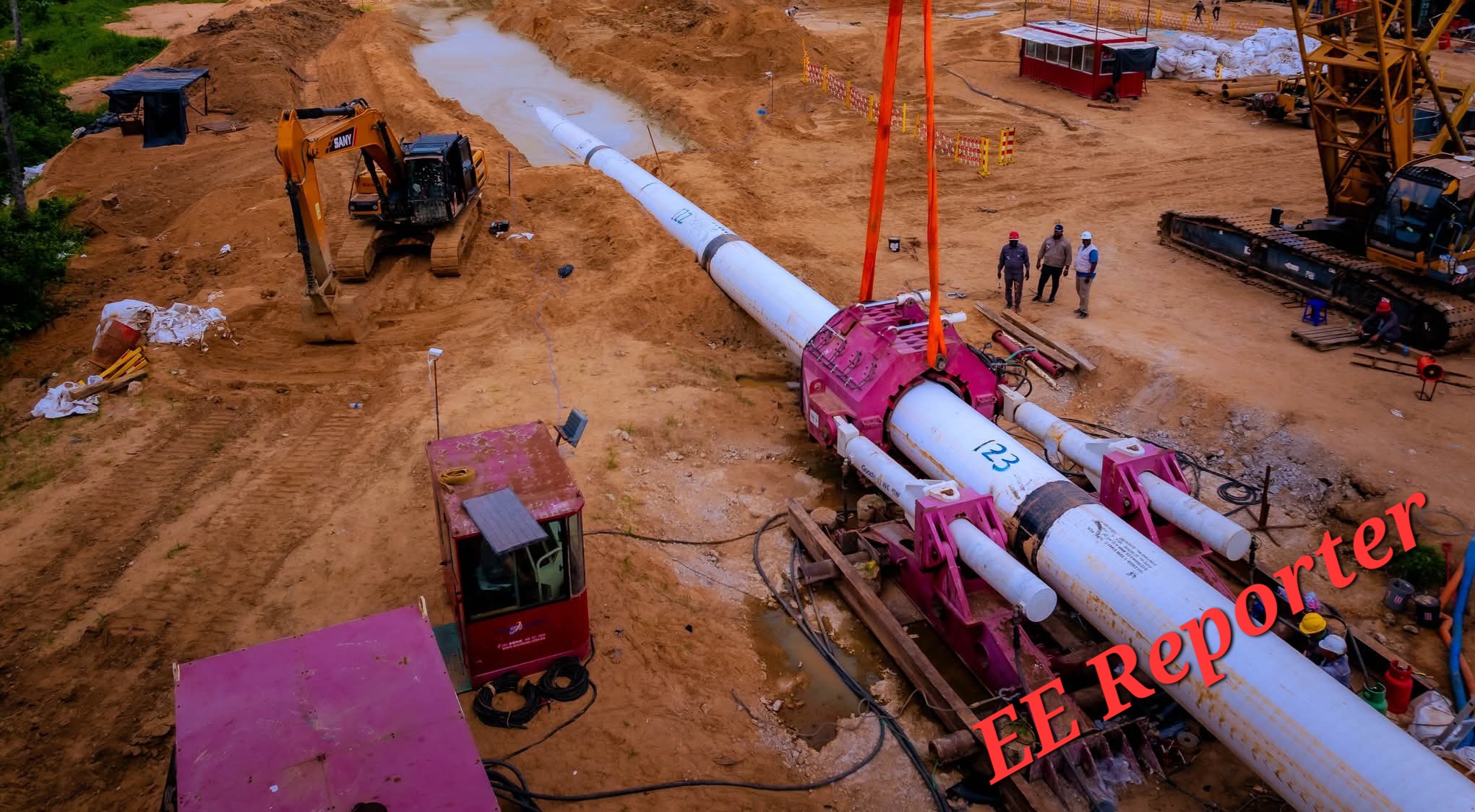
The NNPC Gas Infrastructure Company (NGIC), a wholly owned subsidiary of NNPC Limited, has successfully completed the River Niger Crossing of the 130-kilometre Obiafu-Obrikom-Oben (OB3) Gas Pipeline, marking a major milestone in the expansion of Nigeria’s national gas transmission network.
The successful crossing unlocks the full potential of the OB3 Pipeline, a strategic infrastructure designed to transport up to 2 billion standard cubic feet of gas per day, significantly strengthening energy availability, enhancing supply reliability, and accelerating national economic development.
Executed approximately two kilometres beneath the River Niger riverbed, the technically complex crossing was delivered by the NNPC project team working with PCE Nig. Limited, using advanced horizontal directional drilling (HDD) technology.
Eereporter.com
Commending the achievement, the Group Chief Executive Officer of NNPC Limited, Engr. Bashir Bayo Ojulari, described the milestone as a testament to disciplined execution and technical excellence.
According to him, “The completion of the OB3 River Niger Crossing is a defining milestone for Nigeria’s gas infrastructure and a clear demonstration of what disciplined execution and sustained commitment to excellence can deliver. By successfully traversing one of the most technically challenging sections of the project, we have unlocked a critical link that will enhance gas supply reliability, deepen domestic utilisation, and support power generation and industrial growth across the country.”
Engr. Ojulari noted that the achievement builds on NNPC Limited’s growing engineering and execution capability, drawing from the successful AKK River Niger Crossing in June 2025, to deliver an even more complex crossing in the Niger Delta environment.
“This achievement is not incidental. It is the result of deliberately leveraging and upscaling our AKK engineering and execution excellence through rigorous project governance, innovative engineering solutions, adaptive problem-solving, and the unwavering commitment of our teams and PCE Nig. Limited.
The OB3 Pipeline is central to our ambition of building an integrated and resilient gas network that underpins Nigeria’s energy security and economic development. I commend everyone involved for their doggedness and for staying the course to deliver this strategic national asset.”
The GCEO further acknowledged the critical support of key stakeholders, stating: “We sincerely appreciate the continued support of the Federal Government under the leadership of His Excellency, President Bola Ahmed Tinubu, GCFR, whose Gas-to-Prosperity agenda and commitment to a conducive business environment have been instrumental in making this achievement possible.
NNPC Limited could also not have achieved this feat without the trust and guidance of its Board of Directors, under the leadership of our Chairman, Engr. Ahmadu Musa Kida.”
Reaffirming NNPC Limited’s national mandate, Engr. Ojulari added:
“At NNPC Limited, we remain fully committed to translating Nigeria’s oil and gas resources into a better standard of living for all citizens.
We will continue to collaborate with our partners to deliver projects that expand energy availability, stimulate industrialisation, and improve the overall wellbeing of Nigerians.”
Eereporter.com
He expressed his sincere appreciation to the host community for its consistent support towards the project; the management and staff of NGIC for their doggedness in achieving the milestone; and PCE Nig. Limited for its professionalism, noting that the contractor’s innovative approach and disciplined workforce were pivotal to the project’s success.
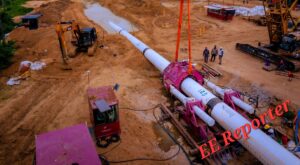
Oil and Gas Pipeline
The GCEO further highlighted the strategic significance of the milestone against the backdrop of the Federal Government’s oil and gas production growth targets of 3 million barrels of crude oil per day and 12 billion standard cubic feet of gas per day by 2030. The successful River Niger Crossing ensures that Nigeria’s gas-producing regions are now physically interconnected with the rest of the country.
The OB3 Pipeline, with a capacity of 2 billion standard cubic feet per day, serves as a backbone gas infrastructure linking the Eastern gas network to the Western network and extending connectivity to the Northern corridor through the AKK Pipeline.
In the near term, the successful crossing is expected to unlock over 500 million standard cubic feet of incremental gas supply for the domestic market, supporting power generation, industrial growth, and gas supply to the West African market.
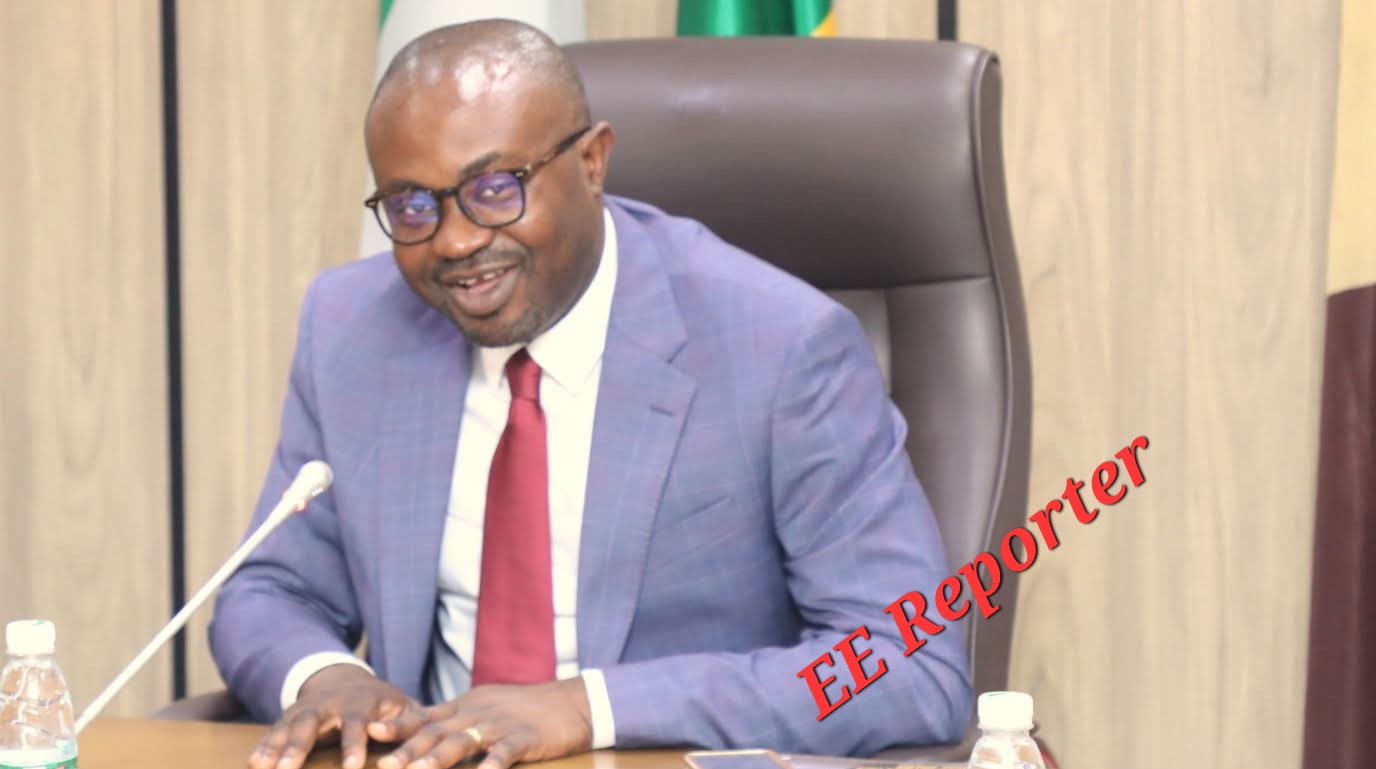
FG Declares Friday, 1st May As Public Holiday To Mark 2026 Worker’s Day Celebration
The Federal Government has declared Friday, 1st May 2026, a public holiday to celebrate this year’s International Workers Day.
The Honourable Minister of Interior, Dr. Olubunmi Tunji-Ojo, announced this on behalf of the Federal Government. He congratulated workers across the country on this year’s celebration.
The Minister commended Nigerian workers for their hard work and dedication to national development. He noted that their efforts are essential for the nation’s growth and prosperity.
Eereporter.com
He encouraged workers to embrace patriotism, productivity, and dedication to their duties. These qualities are crucial for sustainable development.
The Federal Government of Nigeria is committed to supporting the welfare and security of all workers and creating a favorable environment for economic growth.
Olubunmi Tunji-Ojo
While wishing workers a happy celebration, the Minister urged all Nigerians to remain peaceful and law-abiding. He encouraged everyone to use this occasion to reflect on the importance of unity and hard work in building the nation.
E-Signed
Dr. Magdalene Ajani
Permanent Secretary
29th April 2026
-
 Crime12 months ago
Kogi Assembly Considers Law To Regulate Rent, Establish Control Board: Tenancy Law
-

 News1 year ago
Atiku Reveals Why He Failed To Pick Wike As Running Mate In 2023
-
 Akwa Ibom1 year ago
The Apostolic Church Gets New Territorial Chairman, Exco
-

 Crime1 year ago
Federal High Court Jails 2 For Vandalizing Transformer, Telecom Mast In Kogi
-
 News1 year ago
The Apostolic Church Gets New National President, Executive
-
 Akwa Ibom1 year ago
Umo Eno Commences Payment Of 80,000 Naira Minimum Wage With Arrears
-

 News1 year ago
Senator Natasha Returns To Senate With Husband Amid Seat Dispute
-
 Economy12 months ago
Kiyosaki: Is Tinubu’s Government Afraid Of Ibrahim Traore?