
News
Why ADC Rejects Revised INEC Timetable


Why ADC Rejects Revised INEC Timetable
Why ADC rejects revised INEC timetable — says it contains boobytraps designed to exclude opposition from contesting in 2027.
The African Democratic Congress (ADC) has rejected the Independent National Electoral Commission’s updated 2026–2027 electoral timetable, saying it contains boobytraps that could aid President Tinubu’s plot to be returned unopposed in 2027.
Specifically, the party has flagged the new compliance requirements under Sections 77 and 82 of the Electoral Act 2026, which unfairly burden opposition parties while giving undue advantage to the ruling party.
In a statement signed by its National Publicity Secretary, Mallam Bolaji Abdullahi, the party said the requirement for political parties to submit a comprehensive digital membership register by April 2, 2026 ahead of primaries scheduled between 23 April and 30 May 2026 creates a near impossible hurdle that could exclude other parties from fielding candidates.
The ADC contended that with this requirement, among others contained in the obnoxious Electoral Act 2026, the so-called reform has effectively become an instrument of exclusion to clear the field for President Tinubu.
The full statement read:
The African Democratic Congress (ADC) rejects the updated 2026–2027 electoral timetable released by the Independent National Electoral Commission (INEC). What has been presented as a routine administrative schedule of the upcoming general elections, is in fact, a political instrument carefully structured to narrow democratic space and strengthen the hand of the incumbent administration ahead of the 2027 general elections.
According to the timetable, party primaries are to be conducted between 23 April and 30 May 2026, just 55 to 92 days from today. However; what is more significant is that pursuant to Section 77(4) of the Electoral Act 2026, political parties are required to submit their digital membership registers to INEC not later than 2 April 2026.
That is only 34 days away. Section 77(7) further provides that any party that fails to submit its membership register within the stipulated time “shall not be eligible to field a candidate for that election.” These are not house-keeping rules. They are deliberately constructed barriers to exclude opposition from partaking in the coming election.
It is significant to note also that Section 77(2) of the Electoral Act 2026 prescribes that the digital register of members must contain their name, sex, date of birth, address, state, local government, ward, polling unit, National Identification Number (NIN), and photograph in both hard and soft copies, while Section 77(6) prohibits the use of any pre-existing register other than the one that contains the specific information above. According to this law, failure to meet these requirements would result in disqualification.
What makes this requirement of digital membership particularly insidious is that the ruling party had commenced the process of this registration since February 2025, long before it became a requirement of the law. This is not a product of foresight, but insider knowledge.
They knew what was coming. They therefore had one whole year to carry out an exercise that they expect other political parties to execute in one month, during which they must collect, process and collate vast digital data and transmit same to INEC by the deadline under the threat of total exclusion. This is more or less a practical impossibility.
Democratic competition is based on a level-playing field that does not give any advantage to the contestants. A system where one party takes advantage of incumbency to give itself a one-year head-start on a requirement that other parties only became aware of when it is almost too late is a rigged and corrupt system.
ADC
The ADC has joined other opposition political parties to reject the corrupted Electoral Act 2026. This INEC time-table, which based on the said law therefore stands equally rejected for the same reason that, put together, they appear designed to serve President Tinubu’s automatic self-succession project.
Let it be clear: ADC will not do anything that will appear to confer legitimacy on a fraudulent system. We are reviewing our options, and will make this known in the coming days.
We call on civil society, democratic stakeholders, and patriotic Nigerians across party lines to scrutinize this timetable and join us in demanding fairness, because no democracy can endure if the rules that govern it are written to suit pre-determined outcomes.
Signed,
Mallam Bolaji Abdullahi
National Publicity Secretary
African Democratic Congress (ADC)











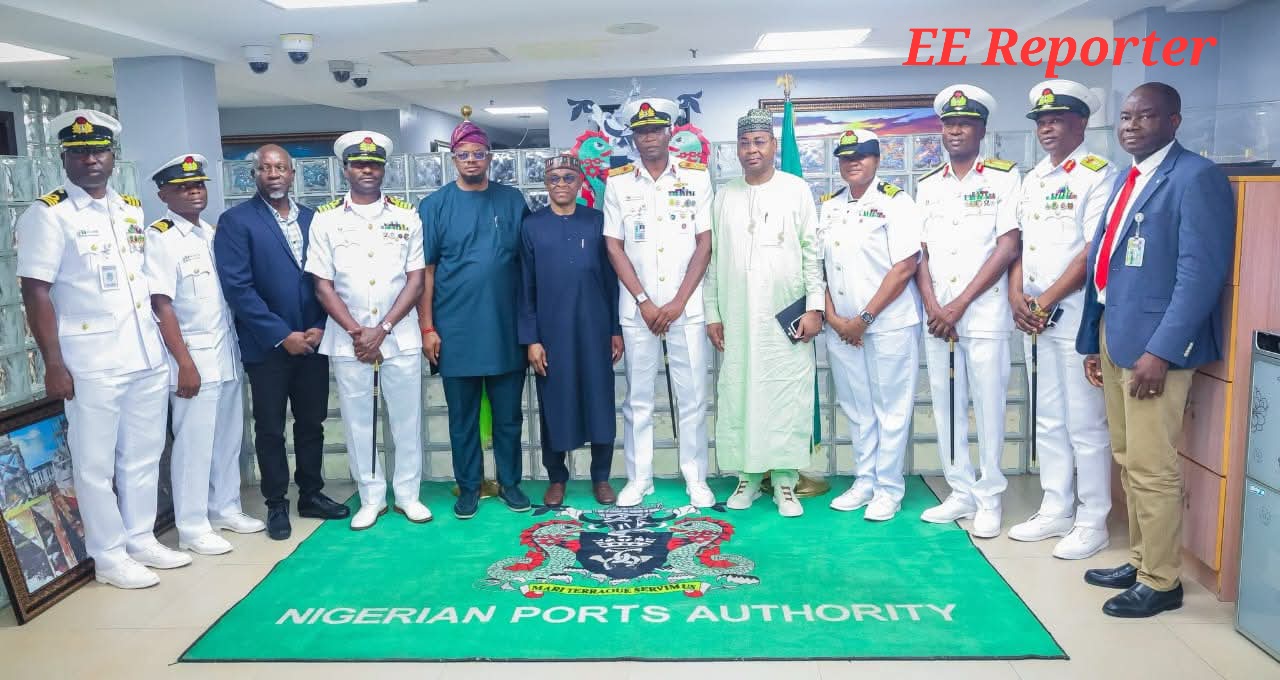
FOC Western NAVAL Command Reaffirms Partnership With Nigerian Ports Authority
The Flag Officer Commanding (FOC), Western Naval Command, Rear Admiral Abubakar Abdullahi Mustapha, has reaffirmed the Nigerian Navy’s commitment to strengthening its partnership with the Nigerian Ports Authority (NPA) to enhance port security and support efficient maritime trade.
Eereporter.com
Rear Admiral Mustapha stated this during a courtesy visit to the Managing Director of the NPA, Dr Abubakar Dantsoho, at the Authority’s Headquarters in Marina, Lagos, on Tuesday, 28 July 2026.
The FOC explained that the visit was aimed at consolidating the longstanding collaboration between the Nigerian Navy and the NPA in promoting a secure maritime environment and efficient port operations. He conveyed the appreciation of the Chief of the Naval Staff, Vice Admiral Idi Abbas, for the Authority’s strategic role in advancing the nation’s Blue Economy and economic development.
He highlighted the Nigerian Navy’s sustained efforts in enhancing maritime security through surveillance capabilities and operational deployments, assuring the NPA of the Western Naval Command’s continued support in safeguarding Nigeria’s maritime domain.
Responding, Dr Dantsoho commended the Nigerian Navy for its vital role in securing the nation’s waterways and facilitating port operations. He called for sustained collaboration and increased operational support to further strengthen port security and improve trade facilitation.
Western NAVAL Command
The visit concluded with an exchange of souvenirs and a group photograph, reaffirming the shared commitment of both organisations to enhancing maritime security, efficient port operations and national economic prosperity.
Eereporter.com

EFCC Hands Over Recovery N42 Million To Businessman
The Ag Zonal Director, Benin Zonal Directorate, Deputy Commander of the EFCC, Sa’ad Hanafi Sa’ad on Wednesday July 29, 2026 handed over a bank draft of N42 million to Ebesunun Mathew Edonojie, being the sum recovered by operatives of the Commission from fraudsters that defrauded him.
Eereporter.com
Edonojie, a businessman dealing in cement had in 2022 petitioned the Commission that one Ogiemwonyi Godwin defrauded him of N175,392, 000. The petitioner stated that he transferred the sum of N350,784, 000 to Godwin for the supply of 116 trucks of cement but that he was supplied with 58 trucks leaving a balance of 58 trucks which amounted to N175,392,000.
During investigation, operatives discovered that Godwin transferred N280 million to Dangote Cement Company but diverted the balance of N70 million for his personal use and supplied 58 trucks leaving a balance of 58 trucks of cement.
The suspect became inaccessible and unreachable but through the consistent effort of operatives of the Commission, the Commission recovered N116,000,000 which was previously handed over to Edonojie before recovery of additional N42,000, 000
Receiving the draft, Edonojie expressed deep gratitude to the Executive Chairman, Ola Olukoyede, the Ag Zonal Director, Sa’ad Hanafi Sa’ad and the entire staff of EFCC at the Directorate for the wonderful work. Edonojie said he lost hope completely about ever recovering the money as the suspect became inaccessible. “I lost hope completely. I did not even believe that I could recover the money as the man (suspect) was nowhere to be found.
I am more than grateful to the EFCC, the Chairman, the Zonal Director and the entire EFCC, for the good work they are doing. It is only God that can reward you all. EFCC has become my saving grace and I am going to tell everybody how the EFCC saved me. I could not sleep because I borrowed the money. EFCC has wiped away my tears.” he said.

EFCC
Presenting the draft, the Ag Zonal Director, assured that the Commission will continue to discharge its duties professionally to ensure justice for all.
“We will continue to discharge our duties professionally and responsibly by ensuring that fraudulent people do not get away with their crime and that innocent people do not suffer unjustly.”
Eereporter.com

EFCC Disclaim, Says “Hamza Musa Mai Bulawus Not Wanted”
The Economic and Financial Crimes Commission, EFCC, wishes to disclaim a WANTED publication made by a certain Abdullahi Saidu Shugaba on his Facebook account: Zamfara State Media Forum, that Hamza Musa Mai Bulawus was declared WANTED by the Commission.
Eereporter.com
The Commission has no case with Bulawus and he is not on its WANTED List. Any publication to the contrary is fictitious and contrived. The public is enjoined to ignore it.

EFCC
Dele Oyewale
Head, Media & Publicity
July 29, 2026
Eereporter.com
-

 Crime1 year ago
Kogi Assembly Considers Law To Regulate Rent, Establish Control Board: Tenancy Law
-

 News1 year ago
Atiku Reveals Why He Failed To Pick Wike As Running Mate In 2023
-

 Akwa Ibom2 years ago
The Apostolic Church Gets New Territorial Chairman, Exco
-

 Crime1 year ago
Federal High Court Jails 2 For Vandalizing Transformer, Telecom Mast In Kogi
-

 News1 year ago
The Apostolic Church Gets New National President, Executive
-
 Akwa Ibom2 years ago
Umo Eno Commences Payment Of 80,000 Naira Minimum Wage With Arrears
-

 News1 year ago
Senator Natasha Returns To Senate With Husband Amid Seat Dispute
-

 Economy1 year ago
Kiyosaki: Is Tinubu’s Government Afraid Of Ibrahim Traore?