International
Nigeria, US Defence Partnership Advances As NAF Earns Praise For AH-1Z Preparedness

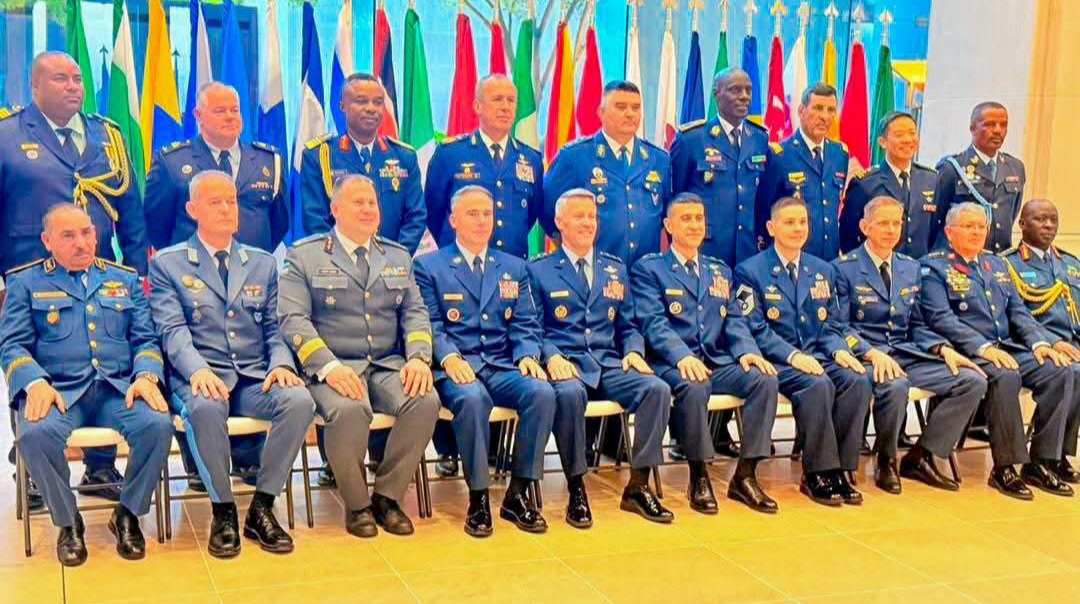
Nigeria, US defence partnership advances as NAF earns praise for AH-1Z preparedness. The United States Government has commended the Nigerian Air Force (NAF) for its high level of preparedness ahead of the delivery of the AH-1Z helicopters to Nigeria, including the readiness of designated NAF facilities where the aircraft will be domiciled.
The commendation was conveyed during a three-day high-level engagement between the US Government delegation from PMA-276, led by Robert Galan, and senior NAF stakeholders at Headquarters Nigerian Air Force, Abuja.
The meeting focused on the comprehensive Programme and Support Plan designed to ensure seamless integration, sustainment, and operational effectiveness of the incoming fleet.
The Chief of the Air Staff, Air Marshal Sunday Kelvin Aneke, was represented at the engagement by the Chief of Policy and Plans, Air Vice Marshal Abubakar Abdullahi, who reaffirmed the Service’s unwavering commitment to aligning all operational, technical, and logistical requirements to guarantee immediate operational readiness upon delivery of the aircraft.

NAF
The engagement underscores the steady advancement of Nigeria–United States defence cooperation, anchored on mutual trust, shared security objectives, and institutional professionalism.
The commendation reflects international recognition of the Nigerian Air Force’s meticulous planning, strategic foresight, and disciplined modernization drive under the leadership of the Chief of the Air Staff.
Beyond fleet acquisition, this collaboration strengthens Nigeria’s airpower capability, reinforces national security architecture, and contributes meaningfully to broader national stability and sustainable development.
Economy
Weak Gender Law Enforcement Limiting Nigeria’s Economic Growth, Says World Bank
Weak gender law enforcement limiting Nigeria’s economic growth, says World Bank. The World Bank says Nigeria’s weak enforcement of gender equality laws and lack of parenthood support policies are constraining women’s participation in the workforce and limiting the country’s economic growth.
In its Women, Business and the Law 2026 report on Wednesday, the bank said Nigeria scores 50 out of 100 on gender equality laws but just 21.7 out of 100 on the systems required to implement them, including funding, services and institutional support.
The report also gave Nigeria a 0 out of 100 score on parenthood policies, citing the absence of federally mandated paid maternity leave of at least 14 weeks, paid paternity leave, and protections against dismissal of pregnant workers.
The World Bank warned that gaps between legislation and enforcement are creating “huge opportunity gaps” that undermine productivity in developing economies.
Indermit Gill, chief economist and senior vice-president for development economics at the World Bank Group, said there is a wide gap between laws on paper and their real-world application.
“On paper, most countries are doing reasonably well: the average country scores 67 out of 100 on the adequacy of laws to enable economic equality between women and men,” Gill said.
“But when it comes to enforcing the laws, the average score drops to 53. And when the systems needed to implement those rights are assessed, the adequacy score is just 47. These numbers reflect huge opportunity gaps.”
The report noted that globally, only 4 percent of women live in economies with near-full legal equality.
In Nigeria, the Bretton Woods institution said the absence of structured childcare systems, paid parental leave, and enforceable equal pay provisions weakens female labour force retention and limits the country’s ability to harness its demographic potential.
“The country currently lacks federal laws mandating at least 14 weeks of paid maternity leave, paid paternity leave, or explicit prohibitions against the dismissal of pregnant workers. Across all Nigerian states, there are virtually no explicit provisions ensuring access to affordable and quality childcare,” the report reads.
“Less than half of the 190 economies globally provide financial support for families, and Nigeria lacks the critical tax support or government-administered mechanisms to keep mothers in the workforce.”
It also noted that across Nigerian states, there are virtually no explicit provisions guaranteeing access to affordable and quality childcare.
The report added that Nigeria lacks tax incentives or government-administered financial support systems aimed at helping families balance work and caregiving responsibilities.
WORLD BANK SAYS LABOUR RESTRICTIONS, PAY GAP PERSIST
The report said sections 55, 56 and 57 of the Nigerian Labour Act still restrict women from working in certain industrial jobs or at night.
“The lack of legal mandates for equal remuneration for work of equal value contributes to a global reality highlighted in the report: women earn, on average, just 77 cents for every dollar paid to men,” the report added.
On safety, the report said although Nigeria passed the violence against persons (Prohibition) Act, supportive frameworks remain underfunded.
“Globally, enforcement of safety laws fails 80% of the time, leaving women disproportionately vulnerable and less able to work consistently,” World Bank said.
The report also noted disparities across Nigerian states.
“States like Lagos and Oyo lead the country in legal gender equality, with Lagos operating specialized family courts and comprehensive services for survivors of gender-based violence,” it said.
“Conversely, states like Bauchi and Kano operating heavily under varying customary or religious laws show urgent gaps, with some northern states scoring as low as 25.0 out of 100 on legal frameworks limiting women’s marital and inheritance rights.”
Speaking on the performance, Shirley Ewang, advocacy lead at Gatefield, said Nigeria’s legal progress is being undermined by weak institutional backing.

World Bank
“The data is clear: our legal progress is being severely undermined by a lack of institutional backing, reflected in our 0 out of 100 score on the Parenthood indicator,” she said.
Ewang called for concrete reforms, including a minimum fully paid 16-week maternity leave, 14-day paid paternity leave, and investment in childcare infrastructure.
“Until these support systems are in place, empowering Nigerian women remains an illusion, and economic growth will be constrained,” she added.
Tea Trumbic, manager of the Women, Business and the Law project, warned of demographic urgency, noting that 1.2 billion young people, half of them girls, will enter the global workforce over the next decade.
The World Bank said closing Nigeria’s supportive framework gap is critical to unlocking women’s economic participation and avoiding long-term growth constraints.
International
ADC To Reports Edo Attacks To ECOWAS Court Of Human Rights, Says “APC Proving To Be Terrorist Organisation”
ADC to reports Edo attacks to ECOWAS court of human rights, says “APC proving to be terrorist organisation”. The African Democratic Congress (ADC) has strongly condemned what it described as a gun attack and assassination attempt in Edo State targeting former governor John Oyegun, party leader Peter Obi, and Olumide Akpata, declaring that the ruling party is proving to be a terrorist organisation.
In a statement by National Publicity Secretary Mallam Bolaji Abdullahi, the ADC said the incident in Edo reflects a troubling pattern of political intimidation against the opposition. The party also accused Edo State Governor Monday Okpebholo of making inflammatory claims and threats that have heightened tensions and could lead to a further breakdown of law and order.
The full statement read:
The African Democratic Congress (ADC) condemns, in the strongest possible terms, yesterday’s disturbing gun attack and assassination attempt in Edo State targeting Chief John Oyegun, former Governor of Edo State and Chairman of the ADC Policy and Manifesto Committee; Mr. Peter Obi, a national leader of our party; and Mr. Olumide Akpata, the Labour Party candidate for Edo State who recently joined the ADC.
This was not an isolated incident. It bears the unmistakable marks of a dangerous and escalating pattern of political intimidation and terror against our party across the country. The resort to gunfire against lawful political actors represents an act of terrorism against the opposition, which has no place in a constitutional democracy.
We are particularly alarmed by the pattern of inflammatory rhetoric and threats that have preceded these events, including the outrageous claim by the State Governor, Monday Okpebholo, who had earlier issued a threat that he would not guarantee the safety of Mr. Peter Obi should he visit Edo State. The Governor has since gone ahead to make further ridiculous and irresponsible claims that the ADC is sponsoring cultism in Edo State and has threatened to start demolishing properties of the opposition in the State.
Let it be said plainly: Nigeria is not a private estate. Edo State is not the personal property of any party or any governor. No elected official has the constitutional authority to threaten, harass, or endanger law-abiding political actors for exercising their democratic rights. Our members and supporters across Edo State and Nigeria have the constitutional rights to freedom of speech, freedom of assembly, and lawful self-defence.
The Federal Government and the Edo State Government are free to continue on their present course. But let there be no misunderstanding: if any harm comes to our leaders, members, or supporters as a result of this escalating climate of official hostility, intimidation, or incitement, the responsibility for whatever consequences follow will rest squarely with those who choose the path of provocation over the path of peace.

ADC
We are compiling all cases of acts of terrorism by the ruling APC against our party. We shall soon be making our reports available to all diplomatic missions as well as the ECOWAS Court of Human Rights.
Let no one be left in doubt: regardless of the level of intimidation, ADC will not bow to terror and will take all lawful means to protect its members and facilities across the country. We urge all our members to remain vigilant and to go about their lawful activities without fear.
Signed: Mallam Bolaji Abdullahi National Publicity Secretary African Democratic Congress (ADC)
International
West Africa Must Collaborate Internally To Unlock AfCFTA Gains, Says Natasha Akpoti
West Africa must collaborate internally to unlock AfCFTA gains, says Natasha Akpoti. Natasha Akpoti-Uduaghan, senator representing Kogi central, has called for deeper collaboration among member states of the Economic Community of West African States (ECOWAS) to strengthen regional integration and expand intra-community trade.
The senator spoke in Abuja as regional lawmakers and stakeholders gathered for the ECOWAS’ first extraordinary session and the first 2026 parliamentary seminar.
The seminar, themed “Deepening regional integration through the African Continental Free Trade Area (AfCFTA): Opportunities and challenges for expanding intra-community trade within the ECOWAS region”, focused on unlocking economic opportunities under the AfCFTA framework.
Akpoti-Uduaghan said meaningful regional integration must be anchored on shared research, industrial integration, market linkages, and product development.
“In areas of industrial integration, research, market linkages, and product development, it will enhance and expand trade and commerce within the West African region,” she said.
She expressed concern over the region’s growing tendency to pursue partnerships outside the West Africa region while neglecting joint initiatives within member states.
“In my own perspective, I believe that West Africans lack cohesive collaboration amongst ourselves,” she said.
“And it’s very simple. Let’s ask how much research and innovation have been conducted amongst ourselves? How much technology developed in our countries have we willingly shared amongst ourselves?”
The lawmaker warned that without a strong foundation of internal cooperation, trade ambitions under AfCFTA could face trust deficits.
“If we have failed in this foundation, then how can we trust the products that we have produced in our countries to be willingly patronised amongst ourselves?” she asked.
Citing a publication on collaboration between Ghana and Germany on vaccine development, Akpoti-Uduaghan questioned why similar partnerships were not prioritised within West Africa.
“I saw a publication regarding collaboration between Ghana and Germany on vaccine development,” she said.
“It is a good deed, but wouldn’t it be better if Ghana’s ministry of health partnered with Nigeria’s ministry of health on such innovations? I think we need to look deeply into that.”
While acknowledging the importance of global partnerships, the lawmaker said intra-regional cooperation should take precedence.
“It is okay if we promote innovations with America, with the United Kingdom, and with France,” she said.
“But primarily, as a region, we should not neglect ourselves because we share heritage; we share problems.
“Our DNA is not far from one another. Would it not be better to focus on health, agriculture, science, and technology, and all the vast industries among ourselves first?”
Akpoti-Uduaghan advocated open research systems, inter-university partnerships, and improved access to innovation across the region.
“Let us foster relationships between our universities. Let us not hoard the products of our research,” she said.
“Let us have open research platforms, our technology hubs, and innovation hubs responding and relating better.
“As an individual, I should be able to log into a portal in Mali, Gambia, and Liberia and find out what innovations have been promoted.”

Senator Natasha
She urged parliamentarians to facilitate stronger communication between ministries across ECOWAS states to encourage transparency and trust.
“As parliamentarians, let us task our ministries to reach out to their counterparts across the region and trust that they will openly share the products of their research. That is the foundation we must not neglect,” she said.
The senator also highlighted emerging opportunities in the blue economy, referencing discussions by the World Bank on maritime and water-based economic development.
“In recent times, we have seen the World Bank emphasise the blue economy in relation to our waters,” she added.
“Wouldn’t it be good for West African countries and companies to jointly develop and maximise these opportunities? This would greatly jump-start trade volumes for the benefit of ECOWAS states.”
African Continental Free Trade Area (AFCFTA)
Economic Community of West African States (ECOWAS)
Natasha Akpoti-Uduaghan
-
Crime10 months agoKogi Assembly Considers Law To Regulate Rent, Establish Control Board: Tenancy Law
-

News11 months agoAtiku Reveals Why He Failed To Pick Wike As Running Mate In 2023
-

Akwa Ibom1 year agoThe Apostolic Church Gets New Territorial Chairman, Exco
-

Crime1 year agoFederal High Court Jails 2 For Vandalizing Transformer, Telecom Mast In Kogi
-
News1 year agoThe Apostolic Church Gets New National President, Executive
-
Akwa Ibom1 year agoUmo Eno Commences Payment Of 80,000 Naira Minimum Wage With Arrears
-

News12 months agoSenator Natasha Returns To Senate With Husband Amid Seat Dispute
-

Economy9 months agoKiyosaki: Is Tinubu’s Government Afraid Of Ibrahim Traore?