
News
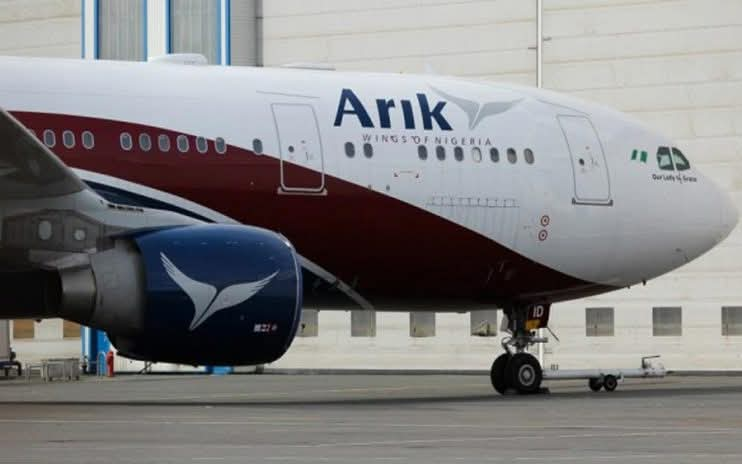
How Arik Air Pilot, Cabin Crew Saved 80 Passengers In Recent Mishap

How Arik Air Pilot, Cabin Crew Saved 80 Passengers In Recent Mishap
How Arik Air pilot, cabin crew saved 80 passengers in recent mishap. facebook sharing buttontwitter sharing buttonemail sharing buttonsharethis sharing buttonwhatsapp sharing button
On February 11, about 80 passengers reportedly survived what could have been a deadly plane crash on Nigerian soil, following an engine fault on an aircraft operated by Arik Air.
The aviation firm said its Boeing 737-700 aircraft operating a Lagos-Port Harcourt flight on Wednesday diverted to Benin airport after the crew “heard a loud bang from the left engine”.
The flight W3-740, with registration number 5N-MJF, was said to be descending into Port Harcourt International Airport, Omagwa, when the incident occurred.
The Nigerian Safety Investigation Bureau (NSIB), currently investigating the incident, said preliminary observations indicated significant damage to the affected engine.
Advertisement
Following the “in-flight engine anomaly” — as described by the NSIB — the crew was said to have conducted a precautionary engine shutdown “in line with established safety procedures, and diverted to Benin airport.
“There were no injuries to passengers and crew as all 80 passengers on board were safely disembarked,” Arik Air had said in a public communication.
‘THE LONGEST 14 MINUTES OF MY LIFE’
Advertisement
The trip began like any other: a smooth climb, normal cabin sounds, and the quiet comfort of believing everything was routine, a source who was on the flight told TheCable.
“We were ascending steadily, and for a while, nothing felt out of place. Until it happened,” the source said.
What followed, she said, was a sudden, terrifying bang and the aircraft instantly began to “vibrate violently, threateningly”.
“I turned toward the window, and what I saw froze me. Panic erupted,” the source said.
Advertisement
“The cabin filled with confusion, voices trembling, and cries of “Jesus!” echoing everywhere. In that moment, fear became a physical thing. Heavy and suffocating.
“I remember asking myself quietly: “Is this how I will depart this earth?”
Bracing for “the worst” amidst the chaos, she said a “tall dark lady — calm, composed, likely the lead cabin crew — emerged after consulting with the cockpit and spoke to the passengers”.
The cabin crew member was said to be “human and reassuring” in her speech, which the passenger said carried control — “something stronger than words”.
Advertisement
“She told us we were safe [and] explained that the crew was handling the situation professionally and that we would be landing at an alternate airport in about 14 minutes,” the source said.
“It sounded short, but I can tell you honestly — it was the longest 14 minutes of my life.
Advertisement
“Yet, minute by minute, something changed. The fear began to loosen its grip.
“Not because the situation was pleasant… but because the crew was extraordinary.”
Advertisement
She said the Arik flight crew remained composed, attentive, and courageous “throughout what felt like an ugly episode”.
According to the source, the passengers were guided “with procedure and empathy”.
Advertisement
In the account of another passenger, the incident was described as a “loud explosion” that triggered “panic and screams” in-flight.
“Some people were praying and calling on the name of Jesus. I noticed a lot of concern around those sitting by the window,” he said.
“But the Captain assured us, and the calmness of the cabin crew members was a bit reassuring, though the tension remained. We are so grateful to God that we landed safely and there [were] no casualties nor any injury.”
‘SAFE LANDING DUE TO PILOT’S EXPERIENCE, CALM JUDGEMENT’
While this outcome has been described as a “miracle” in some quarters, industry bigwigs attributed it to the captain’s competence.
Rather than luck or the intervention of some metaphysical forces, Alex Nwuba, president of the Aircraft Owners and Pilots Association of Nigeria (AOPAN), linked the safe landing to the pilot’s experience on the Boeing 737, his background with Aero Contractors and Mobil Aviation, and years of recurrent training.
“He didn’t rely on luck; he relied on training, procedures, and calm judgment,” Nwuba said.
Speaking to TheCable, Ebenezer Soji Amusan, an aviation expert, said the pilot in command handled the situation professionally and deserves credit for a job well done.
He also attributed the outcome to the captain’s competence.
“We should be proud of him as a Nigerian pilot,” he said.
Amusan, however, said such incidents happen in airline operations globally, noting that pilots worldwide are trained to handle them whenever they occur.
Arik
“That is why their training is known to be very rigorous and they must obtain international accreditation before flying an aircraft. It’s not a local or national affair. It’s international,” the author said.
ENGINE UNCONTAINED FAILURE AND CAUSES
The incident, which has since been described mainly as a “loud bang or explosion” and an “in-flight engine anomaly”, is known as an engine uncontained failure (EUF) in the aviation industry.
The EUF happens when internal engine parts disintegrate and exit the engine casing at high speed.
While EUFs are rare, experts said such incidents are not new and occur in the aviation industry globally.
Providing a historical context, Akin Olateru, ex-director-general of the NSIB, said past engine uncontained failures recorded in the industry were “due to fatigue failure of the blades”.
“Sometimes it could be improper maintenance by the engineer. Another thing that could have happened is due to human error. A lot happens under human error,” he said.
WHY ARIK MISHAP WASN’T FATAL
Available literature suggests that EUFs can be deadly because engine debris can exit at high speeds in other directions.
This, according to SKYbrary, an electronic repository of aviation safety knowledge, could pose potential danger to the pressurised aircraft structure, adjacent engines, the integrity of the flight control system and, possibly, “directly to the aircraft occupants”.
Olateru said one good thing about the Arik mishap was that there was no fuselage penetration.
“If there were to be a fuselage penetration, that would have led to depressurisation. And definitely, that would probably have led to fatality,” the aviation professional said.
“So, the pilot did a very good job. The moment they noticed this occurrence, they went straight to the next airport, which was Benin.”
A GLANCE AT GLOBAL OCCURRENCES AND NSIB’S TASK
Although EUFs have been adjudged a rare phenomenon in aviation, multiple global media reports show that engine problems are not uncommon with the Boeing 737 aircraft.
In April 2018, the left engine of Southwest Airlines flight 1380 exploded, hurling pieces of the cowling in all directions. A fragment reportedly hit a window, causing an explosive decompression that partially sucked a passenger out of the plane. The passenger later died from injuries.
In 2025, a jet owned by the same airline suffered an engine failure and safely diverted to a nearby airport.
ABC News, on April 19, 2025, reported that a Southwest Airlines flight heading to Cabo San Lucas from Houston, Texas, was forced to return and make an emergency landing due to an engine issue.
In addition, the cowling — the protective covering of a plane engine — on a Southwest Airlines aircraft fell off during takeoff in April 2024, and struck the plane’s wing flap.
Although the reported cases were linked mostly to the same airline, the incidents occurred on the Boeing 737 aircraft family.
Yet, Olateru insists that the incidents are not particular or restricted to the 737 aircraft, emphasising that “We’ve had a history of the same problem with other aircraft”.
“I don’t think anybody should worry about 737. The aircraft is safe,” the expert said.
However, he advised the NSIB to ensure that there are no larger issues with the aircraft worldwide that could pose a threat to airlines.
“Is there anything that could affect all 737 engines that has the same issue? Something that is a threat to all operators around the world,” the former NSIB chief said.
“So that’s one thing I expect NSIB to look at, because that’s the whole essence of accident investigation, to prevent a reoccurrence.
“So, you need to look and be sure that there is no larger issue in this occurrence. There is nothing that could affect the operation of the 737 engine.”
As Nigerians await the report of the NSID, Olateru re-echoed the position of many stakeholders who believe the Arik Air pilot and cabin crew should be honoured.
“I give it to the crew on the flight. They didn’t panic,” he said, explaining that dealing with emergencies requires “being solid and in control”.
“They took the right decision [and] diverted the airplane to the nearest airport.”








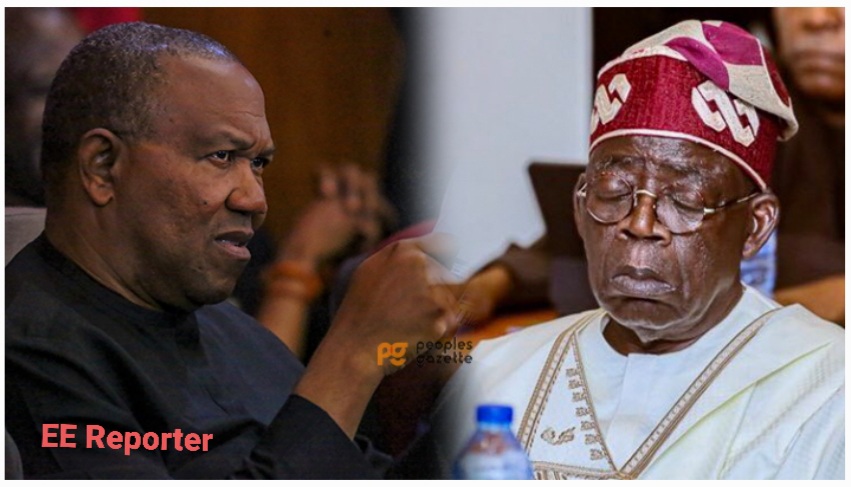
Obi Urges Tinubu To Step Aside, Says “Nigeria Needs New Leadership”
The presidential candidate of the Nigeria Democratic Congress, Peter Obi, has urged President Bola Tinubu to step aside ahead of the 2027 general election, arguing that Nigeria needs a leader with the energy and capacity to confront its worsening economic and security challenges.
Eereporter.com
Obi made the remarks during an interview on Channels Television’s Sunday Politics, where he said the President’s performance in office had fallen short of what the country requires.
Drawing a distinction between Tinubu’s tenure as Lagos State governor and his current administration, Obi said, “The Bola Tinubu that was governor is not the one that is president today. He’s tired. He should be allowed to retire in peace and then go home.”
The former Anambra State governor maintained that Nigeria was moving in the wrong direction under the current administration.
“As it is right now, Bola Tinubu is leading us nowhere. We will turn it so he can see it. That’s why maybe I’m calling for his retirement. The man should just step aside. Yes, he doesn’t have the capacity to do the job,” he said.
Obi also expressed concern over what he described as Nigeria’s worsening poverty, hunger and insecurity, saying public discourse should focus on the country’s pressing challenges rather than politics.
Citing recent poverty projections, he said, “The World Bank has just said that 79 per cent of Nigerians are going to face poverty. In a country of 230 million people, that’s over 180 million. That should be the issue we should be discussing.”
He added that issues such as education, healthcare and public spending deserved greater attention.
“They should be talking about the issue of out-of-school children, talking about the issue of health, and all these monies that are missing here and there that would have been invested properly. Nobody is discussing it,” Obi said.
On food insecurity, the former governor argued that the 2027 election should centre on improving the lives of ordinary Nigerians.
“This election in 2027 should be about issues that affect ordinary Nigerians. The World Food Programme has just said 35 million Nigerians are going to face hunger. Nigerians are being kidnapped. Let’s talk about Nigeria,” he said.
Responding to comments by United States President Donald Trump commending Tinubu’s efforts to tackle insecurity, Obi acknowledged the recognition but insisted more needed to be done.
“Thank you to Donald Trump. Thank you to President Trump. But we need to do more, far more than what we are doing,” he said.
Obi added, “I’ve heard people, and Donald Trump is now confirming it, say he has done his best. But with the crisis we are facing, his best is not enough. We need to do more.”
“On Wednesday, 40 people were abducted in Zamfara, and the entire community, everybody is packing to run away. On Thursday, 50 were abducted. So we’re in a crisis situation that requires another capacity,” he said.
Obi argued that lasting security could only be achieved by addressing poverty and expanding access to education.
“You can’t create mass poverty and think you can deal with insecurity. The more you put people out of poverty, the more you reduce criminality. You need to invest massively in education,” he said.
He said that if elected president, he would personally take responsibility for protecting Nigerians.
“Whatever it takes to secure any Nigerian, I will do that,” Obi said, adding, “If your people are dying, you should be ready to die. You’re the president. You’re the number one person.”
Speaking on his 2027 ambition, Obi reiterated that his interest was not driven by a desire for political office but by his vision for the country.
“I’m not desperate to be Nigerian president. I’m desperate to see Nigeria work,” he said.
He added that he would support any leader capable of delivering good governance.
“If it’s working, I’ll support whatever makes it work,” Obi said.
Reflecting on Nigeria’s current state, Obi lamented what he described as a steady decline in living conditions.

Peter Obi, Tinubu
“Every year we’re headed south, where more and more people have been impoverished, more and more children are out of school. Things are going in the wrong direction,” he said.
He said his goal remained to build “a Nigeria that is united and peaceful” and where every citizen has equal opportunities irrespective of ethnic or religious background.
Eereporter.com
News
NAF Completes Acceptance Of First M-346 Fighter Attack Aircraft, Boots Airpower And National Security

NAF Completes Acceptance Of First M-346 Fighter Attack Aircraft, Boots Airpower And National Security
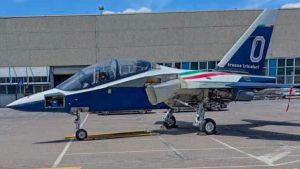
The Nigerian Air Force (NAF) has recorded another major milestone in its ongoing fleet modernisation programme with the successful completion of the Factory Acceptance Test (FAT) for the first batch of three M-346 Fighter Attack (FA) aircraft at the Leonardo Aircraft Division facility in Venegono, Italy.
Eereporter.com
Conducted by a joint delegation comprising representatives of the NAF and the Ministry of Defence (MOD), the exercise successfully concluded all contractual acceptance requirements ahead of the aircraft’s delivery to Nigeria. The achievement reinforces the Chief of the Air Staff’s command philosophy of building a highly motivated, professional and mission-ready force capable of delivering decisive airpower effects in synergy with surface forces.
The successful acceptance confirms that the three aircraft have met all required contractual, technical and airworthiness standards for delivery. Beyond the acceptance process, the delegation also engaged with Leonardo Aircraft Division on pilot and maintenance training, logistics support and long-term fleet sustainment, while inspecting advanced simulation and ground-based training systems that will strengthen indigenous training capacity, enhance operational readiness and ensure the effective employment of the M-346 fleet. Commenting on the milestone, the Chief of the Air Staff, Air Marshal Sunday Kelvin Aneke, stated that the M-346’s unique blend of advanced pilot training and frontline combat capability will significantly enhance the NAF’s ability to generate combat-ready aircrew while expanding its capacity to conduct precision strike, close air support, air interdiction and other air combat missions in response to Nigeria’s evolving security environment.
The milestone further underscores the Federal Government’s commitment, under the leadership of President and Commander-in-Chief of the Armed Forces, President Bola Ahmed Tinubu, GCFR, to strengthening the operational capabilities of the Armed Forces through the acquisition of modern, technologically advanced and mission-ready platforms.
Airpower
As the Nigerian Air Force continues to modernise its fleet, it remains steadfast in its commitment to safeguarding Nigeria’s territorial integrity, supporting joint military operations and protecting the lives and property of all Nigerians through responsive, professional and decisive airpower.
Eereporter.com

ADC Tells Tinubu: Security Demands Action Not Statements
The African Democratic Congress (ADC) has accused President Bola Tinubu of creating the impression that some victims of insecurity matter more than others, urging him to provide updates and timelines for the rescue of 176 residents abducted from Woro community in Kaiama, Kwara State, who have remained in captivity since February 3, 2026.
Eereporter.com
In a statement signed by its National Publicity Secretary, Mallam Bolaji Abdullahi, the party said the President’s celebration of the recent rescue of abductees in Oyo State had prompted questions about the fate of victims still being held in Kaiama, Borno and other parts of the country. The ADC also cited the recent abduction of 40 residents in Zamfara, fresh attacks in Benue and the kidnapping of Kebbi High Court Judge, Justice Faruku Hassan Bunza, as evidence that insecurity remains widespread despite presidential assurances. It argued that repeated promises that insecurity would soon end were no longer convincing, describing Tinubu as “a professional statement-maker” on security issues, and urged him to demonstrate through action that every Nigerian life carries equal value.
The full statement read:
The African Democratic Congress (ADC) is concerned by what is becoming an unmistakable pattern in the Tinubu administration’s response to insecurity: some victims receive swift presidential attention, while others are left to languish in silence. Every successful rescue of abducted Nigerians deserves to be celebrated. But the President must ensure that his actions do not create the impression that the value of a Nigerian life depends on where the victim comes from or whether the tragedy attracts national headlines. Leadership demands equal compassion for every citizen, because no country can build national unity on the basis of selective empathy and selective attention.
On Friday, July 24, 2026, residents of Kaiama Local Government Area in Kwara State staged a peaceful protest over the fate of 176 residents of Woro community abducted on February 3, 2026. More than 170 days later, their families are still asking the same questions: Where are their loved ones? What has the government done? When should they expect them home? Their protest was not political. It was the cry of citizens who fear that their loved ones have been forgotten.
The tragedy is not standing still; it is spreading. In Zamfara State, no fewer than 40 residents from 11 communities in Mayanchi District of Maru Local Government Area were recently abducted by bandits, most of them women and children, forcing terrified families to flee their homes. On Friday, July 24, fresh attacks again claimed lives in Benue’s Sankera axis. And in the early hours of Sunday, July 26, 2026, suspected bandits abducted a Judge of the Kebbi State High Court, Justice Faruku Hassan Bunza, from his residence. Meanwhile, communities in Borno State continue to endure insurgent attacks and mass displacement. These are not isolated incidents. They are reminders that insecurity remains a daily reality for millions of Nigerians.
Following the public celebration surrounding the rescue of abductees in Oyo State, Nigerians are entitled to ask a simple question: what is the status of those still being held elsewhere? What progress has been made in securing the release of the 176 abductees from Kaiama? What is being done to rescue the women and children taken in Zamfara? What efforts are underway to secure the release of Justice Bunza? What updates are available on victims in Borno and other affected communities? The President owes Nigerians more than broad assurances. He owes them regular updates, timelines and evidence that no Nigerian community has been abandoned.
On Thursday, July 23, 2026, President Bola Ahmed Tinubu again assured Nigerians that insecurity in the North would soon come to an end. We sincerely hope that promise becomes reality. But hope cannot survive indefinitely on declarations alone. There comes a point when repeated assurances, unaccompanied by visible results, cease to reassure. They simply become another headline in a long cycle of official optimism and public disappointment.
That is why many Nigerians no longer receive presidential statements on insecurity with the confidence they once did. The administration has become remarkably consistent in making reassuring pronouncements but far less convincing in delivering outcomes.

ADC
On one of the defining challenges of this government, the President is increasingly seen as a professional statement-maker, while communities continue to bury their dead, search for the missing and wait for rescues that never seem to come.
The ADC therefore calls on President Tinubu to demonstrate, through action rather than rhetoric, that every Nigerian life carries equal value. The people abducted in Woro on February 3 matter. The women and children abducted in Mayanchi, Zamfara matter. The families living under siege in Borno matter. The victims of fresh attacks in Benuematter. Justice Faruku Hassan Bunza matters.
They deserve the same urgency, the same empathy and the same presidential attention that every rescued Nigerian rightly receives. Leadership is not measured by how quickly government celebrates a rescue; it is measured by whether no Nigerian is left behind or forgotten.
Signed:
Mallam Bolaji Abdullahi
National Publicity Secretary
African Democratic Congress (ADC)
Eereporter.com
-
 Crime1 year ago
Kogi Assembly Considers Law To Regulate Rent, Establish Control Board: Tenancy Law
-

 News1 year ago
Atiku Reveals Why He Failed To Pick Wike As Running Mate In 2023
-

 Akwa Ibom2 years ago
The Apostolic Church Gets New Territorial Chairman, Exco
-

 Crime1 year ago
Federal High Court Jails 2 For Vandalizing Transformer, Telecom Mast In Kogi
-

 News1 year ago
The Apostolic Church Gets New National President, Executive
-

 Akwa Ibom2 years ago
Umo Eno Commences Payment Of 80,000 Naira Minimum Wage With Arrears
-

 News1 year ago
Senator Natasha Returns To Senate With Husband Amid Seat Dispute
-

 Economy1 year ago
Kiyosaki: Is Tinubu’s Government Afraid Of Ibrahim Traore?