
Akwa Ibom
Akwa Ibom Governor Umo Eno Tasks Journalists On Ethical, Responsible Journalism

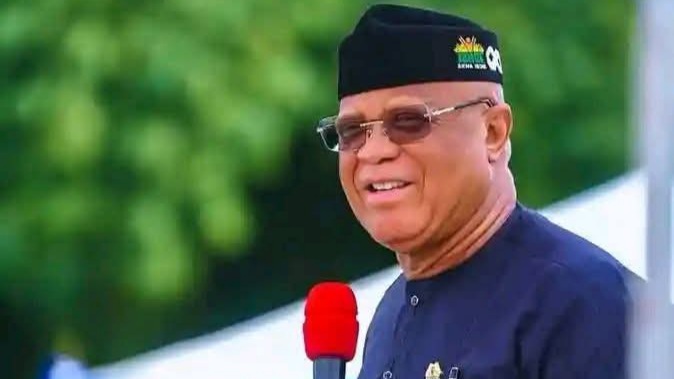
Akwa Ibom Governor Umo Eno Tasks Journalists On Ethical, Responsible Journalism
Akwa Ibom Governor Umo Eno tasks journalists on ethical, responsible journalism…Reaffirms Commitment to People-Centred Development
Akwa Ibom State Governor, Pastor Umo Eno, has called on journalists in the state to remain steadfast in the practice of factual, ethical and responsible journalism, describing the media as a critical partner in the promotion of good governance and societal development.
The Governor made the call on Sunday, January 18, 2026, at Qua Iboe Church, Abak Itenghe in Abak local government, during the New Year Thanksgiving Service of the Akwa Ibom State Council of the Nigeria Union of Journalists (NUJ).
Represented at the event by the Commissioner for Information, Rt. Hon. Aniekan Umanah, Governor Eno commended the NUJ for its invaluable contributions in promoting good governance, and urged the union to sustain its commitment to professionalism and nation-building.
While emphasizing the importance of press freedom in a democratic society, he cautioned that such freedom should not be misconstrued as a licence for defamation, slander or the spread of unverified information.
He charged the Chairman of the NUJ, Akwa Ibom State Council, Comrade Nsibiet John, to continue guiding members on the dos and don’ts of the journalism profession, particularly in the age of social media. The Governor cautioned those who misuse social media as a tool for defamation to always acquaint themselves with relevant cybercrime laws and strive to uphold the ethics of responsible journalism.
Further highlighting key development projects in Abak, he said the administration has over 20 projects including 43 KM of roads , Model Primary School, Ongoing Model Health Centre, Water Projects. Arise Compassionate Homes among others, noting that such projects underscore his administration’s commitment to initiatives that positively impact the lives and livelihoods of the people.
Earlier in his remarks, the NUJ Chairman, Comrade Nsibiet John, explained that the essence of the thanksgiving service was to appreciate God’s benevolence upon the lives of journalists in the state and to seek His presence, protection and direction in the year ahead.
Delivering the homily, the General Superintendent and Chairman of Conference, Rev. Ekpedeme Effanga, described the decision of the NUJ to hold its thanksgiving service in the church as a clear demonstration that the union recognizes God as its anchor.
Preaching from Proverbs 3:5 on the theme “Anchored in God, Advancing with Vision,” the cleric urged journalists to trust God completely in the year 2026, assuring them of His faithfulness even in the midst of life’s storms.
Umo Eno
Rev. Effanga further charged journalists to align their personal visions and professional conduct with the overall goals and objectives of the NUJ, warning against actions capable of undermining the unity and integrity of the union. He reminded members that the gathering was primarily to celebrate God’s mercies and faithfulness.
In attendance at the thanksgiving service included the Speaker of the Akwa Ibom State House of Assembly, Rt. Hon. Udeme Otong; Member representing Abak/Etim Ekpo/Ika Federal Constituency, Hon. Clement Jimbo; former Deputy Speaker of the State House of Assembly, Rt. Hon. Uwem Udoma; former National Legal Adviser of the Peoples Democratic Party (PDP), Barr. Emmanuel Enoidem, SAN; Chairman of Abak Local Government Area, Mrs. Ime Charles Effiong, members of the Akwa Ibom State House of Assembly, Clerk of the State House of Assembly, Mrs. Nsikakabasi Orok, Provost of Samuel Bill Theological Seminary, Rev. Ifiok Otu, Rector of the Federal Polytechnic, Ukana, Chairman of the Nigeria Labour Congress (NLC) past leaders and members of the NUJ.







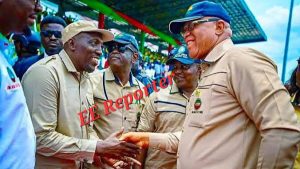
Workers’ Day: Akwa Ibom Gov Announces N160m Support Fund, Gifts Labour Leaders Cars
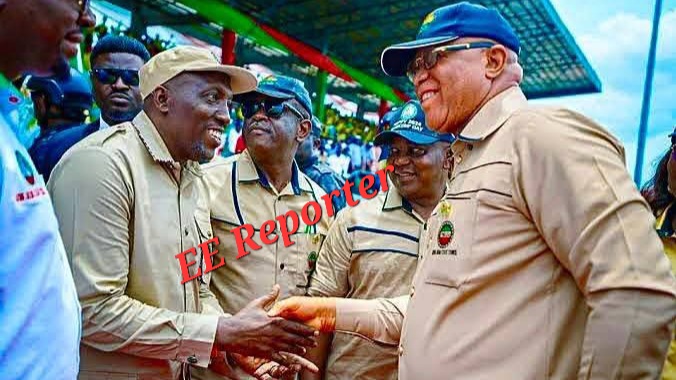
Akwa Ibom State Governor, Pst. Umo Eno has announced a support fund of N160 million for Akwa Ibom State Workers.
The Governor also gifted the Chairman of Trade Union Congress (TUC) Comrade Kingsley Akpan and the State Chairperson of the Joint Public Sector Negotiation Committee, Comrade Kingsley Ekong brand new Cars in commemoration of the day.
The Deputy Governor, Sen. Akon Eyakenyi who represented the Governor at the event, said it was a commitment by Gov Eno to supporting Akwa Ibom State Workers as their dedication, resilience and productivity have significantly boosted productivity in the state’s overall development.
She described Akwa Ibom as one of the most peaceful states in the country, attributing the steady influx of organisations and groups holding meetings in the state to its safety and stability, noting that recent commendations came in yesterday as the Inspector General of Police, Tinju Disu and the Chief of Air Staff, Air Marshall Sunday Kelvin further underscored the Government’s investments in security and peaceful coexistence.
“Just yesterday the IGP of Police and Chief Air Staff applauded the Gov for the peaceful and decent nature of the state.
“ And this speaks to the commitment and investment made by the Governor of the state.”
Eyakenyi, however, urged the Trade Union Congress to acknowledge the administration’s efforts in maintaining security and empowering youths, stressing that such initiatives had significantly contributed to the calm atmosphere in the state.
She disclosed that the leadership of the Nigeria Labour Congress and TUC had earlier paid a courtesy visit to the Governor to present key issues affecting workers, noting that the Governor promptly constituted a committee to address the concerns within one month.
She also paid tribute to the outgoing NLC Chairman, Comrade Sunny James, praising his patriotism and commitment to the growth of the state as she expressed optimism that he would continue to contribute to development even after his tenure.
Eyakenyi announced further that the state government was rewarding Comrade Akpan and Mr. Ekong, with official vehicles to support their work. She reiterated the government’s commitment to worker’s welfare, including the payment of gratuities, revealing that about N82 billion had been paid out of over N100 billion.
She added that the government had also provided housing for civil servants through a transparent raffle system and sustained training programmes to enhance manpower development, pledging that worker’s welfare would remain a top priority of the administration.
The Special Adviser to the Governor on Labour Matters, Sir Udo Kierian, in his tone setting, said May Day remained a significant occasion set aside globally to celebrate hardworking employees across both public and private sectors, noting that the state workforce had every reason to celebrate in view of the government’s favourable policies.
He stated that since assuming office in May 2023, the governor had carried workers along in governance, adding that the administration’s vision and mission had been effectively interpreted through various ministries and government offices.
Also, the NLC State Chairperson, Comrade Sunny James, commended the administration of Governor Eno for efforts in promoting workers, and sued for a more speedy process in implementation.
He also appreciated the Governor for paying gratuities till date.
“We have a leader who loves workers and is gradually clearing gratuities,” he said.
James described his tenure which began in April of 2019 as “not an easy one” noting that despite challenges, his leadership has recorded significant strides in representing workers’ interest.
He urged workers to remain committed and united as he bows out honourably in few months.
He further noted that even in moments of disagreement, Governor Eno had consistently demonstrated a willingness to find common ground, resolving issues amicably.
Akwa Ibom Governor
In their various solidarity messages, Head of Civil Service, Mrs. Elise Peter, Speaker, House of Assembly, Rt. Hon. Udeme Otong, Chief Judge represented by Justice Effiong Effiong, TUC Chairman Mr. Akpan, State Chairperson Joint Public Sector Negotiation Committee, Comrade Akpan, commended the Governor for his commitment to worker’s welfare, noting that despite occasional disagreements, the governor had always sought for ways of bettering the lots for workers.
They also acknowledged his administration’s efforts in promoting workers, mobilising contractors back to sites, and gradually clearing outstanding gratuities, while expressing optimism that the existing cooperation between labour and government would further enhance development and industrial harmony in the state.
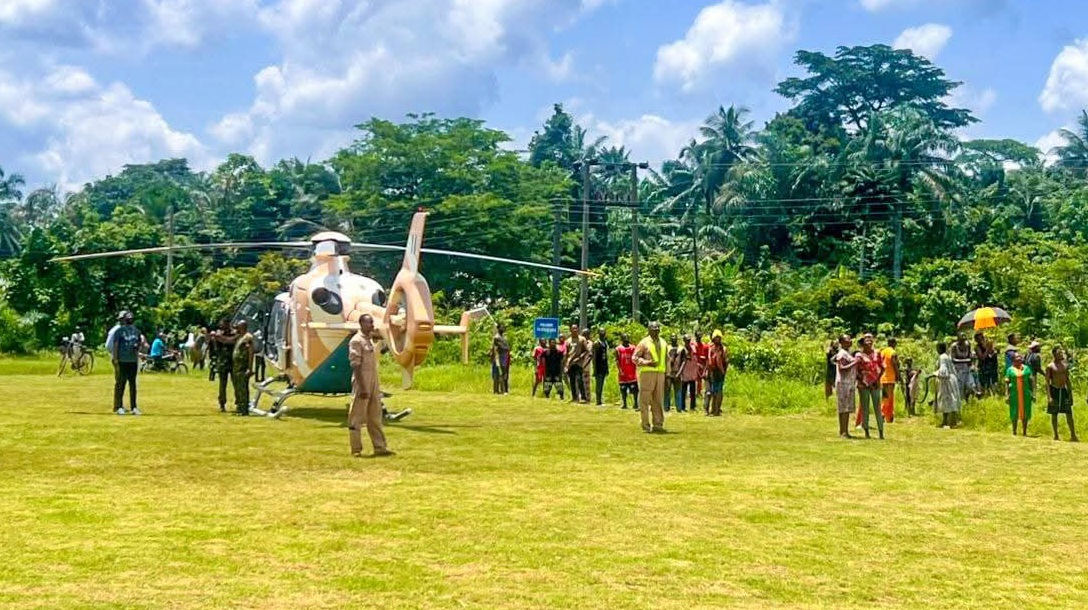
NAF Helicopter Landing Inspires Youths, Strengthens Bonds In Akwa Ibom Community
A routine flight turned into an unforgettable moment in Nsit Ibom as Nigeria marked Workers’ Day. The Nigerian Air Force (NAF) demonstrated its people-focused service during a routine liaison mission within the Niger Delta area.
While en route on the mission, the crew executed a precautionary landing at a primary school football field in Nsit Ibom LGA, in line with standard safety procedures.
The unexpected arrival of the helicopter transformed the quiet community space into a scene of excitement, drawing children and youths from Afaha Abia and Ikot Obio Asanga villages, many witnessing a military helicopter up close for the first time. What began as a routine mission quickly evolved into a meaningful moment of connection and inspiration.
Eereporter.com
Seizing the opportunity, NAF personnel engaged warmly with the young audience, sharing insights into career pathways and emphasizing the values of discipline, service, and patriotism. The interaction ignited hope and aspiration among the youths, with several expressing a desire to join the Service.
NAF
Seamless coordination between Nigerian Air Force and Nigerian Army personnel, alongside the warm reception by community leaders, further reinforced the strong bond between the military and the people.
Following necessary aviation procedures, the helicopter safely departed and has since returned to base, leaving behind more than just a story, it sparked hope, pride, and stands as a powerful testament to the Nigerian Air Force’s enduring commitment to national defence, community engagement, and inspiring the next generation.

Akwa Ibom Airport Commences International Operations With Maiden Flight To Ghana
Today, the people of Akwa Ibom State rolled out the drums, once again, in celebration of a milestone achievement with the completion of the international terminal and the commencement of international operations at the Victor Attah International Airport.
Eereporter.com
The Minister of Aviation and Aerospace Development, Festus Keyamo, SAN, was on ground, and officially declared the airport ready for international operations.

Ibom Air
The State Governor, Pastor Umo Eno, expressed satisfaction with the development, saying, “I am indeed proud to be an Akwa Ibomite.”
Details Loading >>>
-
 Crime12 months ago
Kogi Assembly Considers Law To Regulate Rent, Establish Control Board: Tenancy Law
-

 News1 year ago
Atiku Reveals Why He Failed To Pick Wike As Running Mate In 2023
-
 Akwa Ibom1 year ago
The Apostolic Church Gets New Territorial Chairman, Exco
-

 Crime1 year ago
Federal High Court Jails 2 For Vandalizing Transformer, Telecom Mast In Kogi
-
 News1 year ago
The Apostolic Church Gets New National President, Executive
-
 Akwa Ibom1 year ago
Umo Eno Commences Payment Of 80,000 Naira Minimum Wage With Arrears
-

 News1 year ago
Senator Natasha Returns To Senate With Husband Amid Seat Dispute
-

 Economy12 months ago
Kiyosaki: Is Tinubu’s Government Afraid Of Ibrahim Traore?