
News
Bello, Akpoti Sets For Epic Showdown, “Battle For The Heart Of Kogi Central”

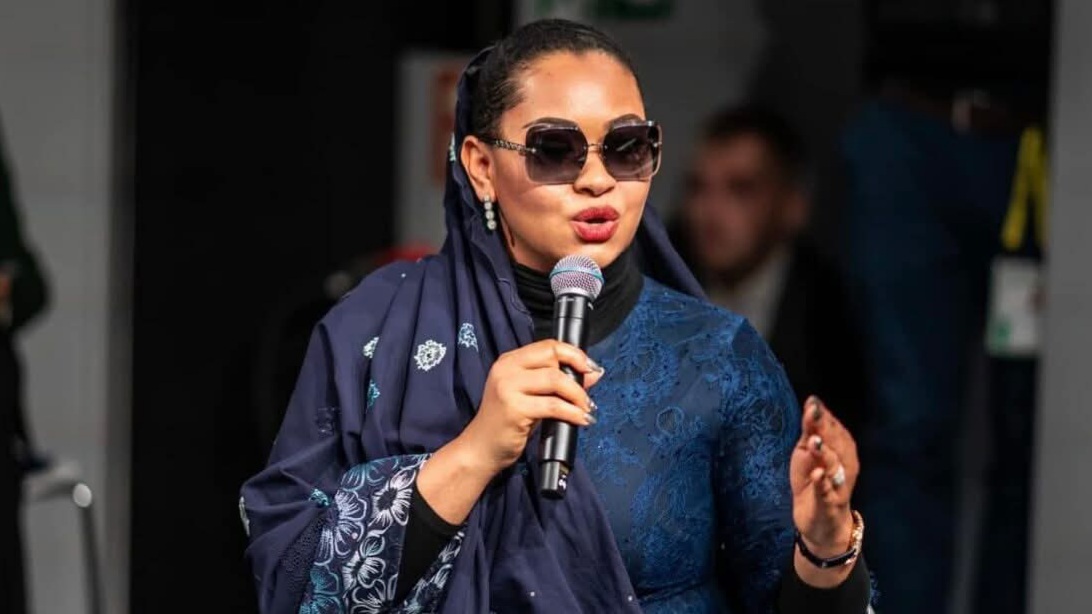
Bello, Akpoti Sets For Epic Showdown, “Battle For The Heart Of Kogi Central”
Bello, Akpoti sets for epic showdown, “battle for the heart of Kogi central”. In the nation’s political space, some contests transcend elections to become battles of power and legacy.
As ADEMU IDAKWO reports, such a struggle is already taking shape in Kogi Central ahead of the 2027 general election, with former governor Yahaya Bello and incumbent senator Natasha Akpoti-Uduaghan on a collision course.
Separated by style, political lineage, and governing philosophy, former governor Yahaya Bello and senator Natasha Akpoti-Uduaghan are not merely competitors; they are entrenched adversaries whose prolonged feud has shaped recent political narratives in Kogi State.
Their looming contest for the Kogi Central senatorial seat is widely regarded by observers as one of the most fiercely anticipated races in Nigeria’s North Central region, with implications that extend beyond the district into the national political landscape.
Yahaya Bello: Power, structure, and a bid for relevance
Yahaya Bello is no stranger to political combat. He emerged in 2016 as Nigeria’s youngest governor at the time, riding on the platform of the All Progressives Congress (APC) to govern Kogi state for eight turbulent years.
His tenure was characterised by firm control of party structures, aggressive political manoeuvring, and a leadership style that earned him both a devoted following and fierce criticism.
Now out of office, Bello’s decision to seek the Kogi Central Senate seat is widely interpreted as a strategic move to retain political relevance, consolidate influence in Ebira land, and reposition himself within national power calculations.
During a recent visit to the palace of the Ohinoyi of Ebiraland, Bello framed his ambition as a response to popular demand. “My people have spoken,” he told supporters, projecting confidence and continuity.
To his camp, the Senate represents a natural next step. On this platform, Bello can leverage his executive experience, protect entrenched political interests, and remain a visible force in national politics.
However, his return to frontline politics is not without controversy. Since leaving office, Bello has faced high-profile legal challenges, including allegations of large-scale financial impropriety. While he has consistently denied wrongdoing and described the cases as politically motivated, analysts agree that these issues will feature prominently in the 2027 campaign narrative.
Despite the controversies, Bello retains formidable political machinery. From ward leaders to former appointees and party stalwarts, his grip on APC structures across Kogi Central remains substantial, giving him a strong organisational base as the contest approaches.
Natasha Akpoti-Uduaghan: The incumbent who defied the establishment
If Bello symbolises entrenched political power, Natasha Akpoti-Uduaghan represents what observers describe as disruption. Her victory in the 2023 senatorial election was historic, not only because she became the first woman to represent Kogi Central in the Senate, but because she defeated political forces long considered untouchable.
A lawyer, development advocate, and former gubernatorial aspirant, Akpoti-Uduaghan built her political brand on grassroots mobilisation, gender inclusion, and resistance to political intimidation. Her emergence unsettled established power blocs, particularly those aligned with the former governor.
Since assuming office, she has projected herself as a vocal and fearless legislator, frequently challenging authority both within and outside the Senate. Her political and legal confrontations have kept her firmly in the national spotlight.
Her tenure, however, has not been without turbulence. She has faced defamation suits and sustained political pressure. While supporters insist these are calculated attempts to weaken her ahead of 2027, critics argue they reflect the risks inherent in her confrontational approach. But Akpoti-Uduaghan responded that she and her supporters are ”not threatened.”
Akpoti Sets For Epic Showdown
Addressing concerns over Bello’s declaration to contest her seat, Senator Akpoti-Uduaghan has played down suggestions that the former governor poses any threat to her political future.
Speaking through her Special Adviser on Media, Mike Idoko, the senator said she welcomed Bello’s entry into the race, insisting that competition strengthens democracy.
“We don’t see it as a threat. In fact, we are happy that he wants to contest. We are waiting for them,” the lawmaker said, projecting confidence ahead of the 2027 polls.
She has repeatedly described herself as unafraid, casting her political journey as a symbol of resilience against political dominance.
Akpoti-Uduaghan maintains that her mandate is rooted in the will of the people and that her record in office will ultimately speak louder than political intimidation.
Elected in 2023 following a prolonged legal contest, the senator has since positioned herself as a prominent and assertive voice in the National Assembly, insisting that no individual or political structure holds a monopoly over Kogi Central.
A rivalry years in the making
The Bello–Akpoti rivalry did not begin with the 2027 race. It is rooted in years of political tension, public exchanges, and courtroom battles that have hardened positions on both sides.
From petitions to security agencies to sharp rhetoric at rallies and media interviews, the conflict has often gone beyond policy disagreements, evolving into a personal and symbolic struggle over who truly represents the Ebira people.
Political observers note that the rivalry has polarised Kogi Central like never before, dividing communities, families, and long-standing political alliances.
The battleground: Kogi Central
Comprising Adavi, Ajaokuta, Okehi, Okene, and Ogori-Magongo local government areas, Kogi Central is both politically strategic and culturally cohesive. Control of the senatorial seat is widely seen as synonymous with control of Ebira political identity.
Bello’s strength lies in party structures, elite networks, and political experience, while Akpoti-Uduaghan’s appeal resonates strongly among youths, women, and voters disillusioned with traditional politics. The contest is therefore not just between two personalities, but between two political philosophies, structure versus spontaneity, dominance versus disruption.
What 2027 really means
Beyond the Senate seat, the 2027 election will shape the future political direction of Kogi State. A Bello victory could signal a reassertion of old power alignments and further consolidate APC dominance in the state.
Conversely, an Akpoti-Uduaghan re-election would deepen the Peoples Democratic Party’s (PDP) foothold and embolden reform-minded politicians across Kogi.
Nationally, the race will be closely watched as a test of whether grassroots-driven insurgencies can consistently overcome entrenched political machinery.
Divergent voices, competing narratives
Speaking with LEADERSHIP Sunday, the Kogi State chairman of the PDP, Muhammad Sani Gambo, dismissed Bello’s ambition, insisting the former governor poses no threat to Senator Akpoti-Uduaghan.
Gambo recalled that Akpoti-Uduaghan defeated Bello and his preferred candidate in the 2023 election when Bello was still in office. “Is it now that he is no longer in office that we should be afraid of him? That is not possible,” he said, adding that the senator has become a household name in Ebira land through what he described as tangible democratic dividends.
On the other hand, the chairman of Okehi Local Government Area, Hon. Amoka Eneji Monday, declared that Bello’s 2027 senatorial ambition is a collective project aimed at advancing the overall interest of Kogi Central.
Addressing party stakeholders and community leaders, Eneji described Bello’s bid as timely and strategic, citing his experience in governance and national politics.
“This ambition is not about Yahaya Bello as an individual. It is about the interest of our people,” he said, arguing that Bello’s eight-year tenure as governor equipped him with the exposure and federal connections needed to deliver meaningful dividends to the district.
A call for peace
Amid rising political tensions, a community leader in Okene-Eba, Alhaji Abdulrazaq Salihu, urged restraint, warning supporters of both camps against violence. Recalling lives lost during the 2023 elections, he cautioned against treating politics as a do-or-die affair.
“We must not take up arms against ourselves in the name of politics. If the aim is truly to serve the people, then bloodshed defeats that purpose,” he said.
Countdown to a political reckoning
With two years still to go, the political drums are already beating loudly across Kogi Central. Though formal campaigns are yet to commence, alignments are forming, narratives are crystallising, and loyalties are being tested.
One thing is sure: when Yahaya Bello and Natasha Akpoti-Uduaghan eventually meet on the ballot in 2027, Kogi Central will witness not just an election, but a political reckoning, one capable of redefining power, representation, and the district’s future.










News
Umahi Signs Tinubu’s Nomination Form, Describes It As Victory Form, Reaffirms Support For Continuity
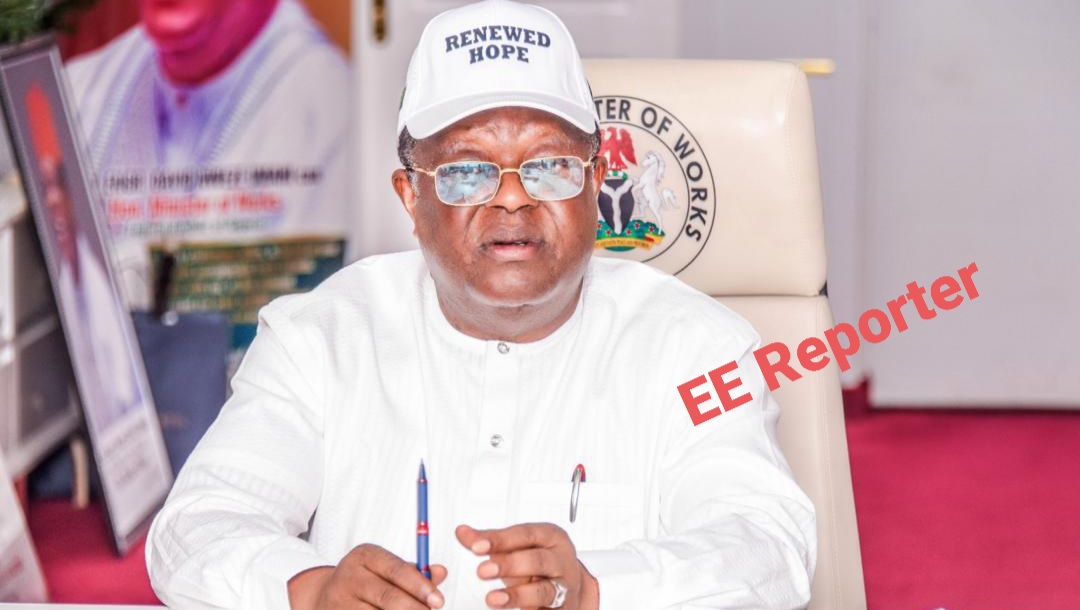
Umahi Signs Tinubu’s Nomination Form, Describes It As Victory Form, Reaffirms Support For Continuity
The Honourable Minister of Works, Senator Engr. David Umahi, CON, has signed the nomination form of President Bola Ahmed Tinubu, GCFR, for a second term, describing it as a “victory form” and a defining moment in Nigeria’s ongoing development journey.
Umahi said it is a collective commitment to continuity, stability, and the consolidation of gains recorded under the current administration. He noted that the President’s leadership has set in motion critical infrastructure reforms, particularly in road construction and rehabilitation, which remain vital to economic growth.
Eereporter.com
According to the Minister, ongoing projects across the country are part of the administration’s resolve to deliver tangible results, adding that the progress made so far provides a strong foundation for sustained national transformation.
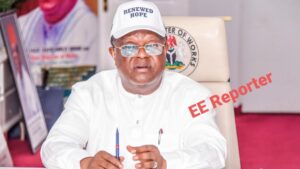
David Umahi
He expressed confidence that President Tinubu is well positioned to complete ongoing initiatives and further deepen development across all sectors.
Umahi also called for continued support for the administration, stressing that consistent leadership is essential to achieving long-term national goals.
Francis Nwaze, FIPMD
Senior Special Assistant to the Honourable Minister of Works (Media)
May 5, 2026

NPF Arrests Six Notorious Kidnapping Suspects, Rescues Victms In Kaduna
The Nigeria Police Force, through the Force Intelligence Department Special Tactical Squad (FID-STS), has recorded a major breakthrough with the arrest of six (6) notorious kidnapping suspects and the rescue of victims in Kaduna State.
The suspects, Yusuf Shuaibu (23), Abubakar Bature (19), Yau Murtala, Bello Suleiman (19), Abdul Kareem Nuhu (36), and Ahmed Musa (28), were arrested on 3rd April 2026.
Eereporter.com
Preliminary investigations revealed that the suspects are members of a kidnapping syndicate operating within Kaduna State and its environs, with links to criminal camps located in Rijana Forest.
Further findings indicate that the group was involved in multiple kidnapping incidents, including the abduction of a senior police officer and his son in October 2025. Despite collecting a ransom of Twenty-Four Million Naira (₦24,000,000) and other items, the victims were not released until police operatives intervened, leading to the successful rescue of the officer’s son unharmed. Efforts are ongoing to rescue the officer.
The suspects are also linked to the abduction of other victims, including a young child and members of the same family, where a ransom of Eighteen Million Naira (₦18,000,000) was collected before the victims were eventually rescued through police operations.

Police
Investigations are ongoing to apprehend other fleeing members of the syndicate, rescue remaining victims, and recover the syndicate’s weapons.
DCP ANTHONY OKON PLACID, psc(+), mnipr, mni Force Public Relations Officer Force Headquarters, Abuja, 5th May 2026

Alleged N10b Kogi Fraud: Ali Bello Used BDC in Transferring Money to Cronies- Witness
The trial of Ali Bello, nephew of the former governor of Kogi State, Yahaya Adoza Bello, before Justice James Omotosho of the Federal High Court Abuja, continued on Tuesday, May 5, 2026, with the 17th Prosecution Witness, PW17, Ahmed Audu Abubakar, telling the court how Bello utilised bureau-de-change, BDC to make monetary transfers to his cronies.
Led in evidence by prosecution counsel and Director, Public Prosecution, Rotimi Oyedepo, SAN, the witness, informed the court that Bello, the first defendant in his extra-judicial statement admitted the inflows and outflow of funds through BDC.
“The second column shows that the utilisation of the funds in the BDC were carried out by the instruction of the first defendant, most of them are the cronies of the first defendant. In the extrajudicial statement that was taken he has already made a statement as to the inflows and the outflows,” he said.
When asked by the prosecution counsel to tell the court about the funds, the witness stated that the money spent was on behalf of Ali Bello and the former governor of Kogi State, Yahaya Bello.
“The spending of the money is for the first defendant and for the former governor. Some of the beneficiaries were the cronies of the first defendant. Some of the money was for payment for the first defendant or the former governor. We have Mother Care Welfare, an NGO belonging to the wife of the governor. We have Mumuni Benghazi, a resident of Benghazi Street, Wuse, Abuja.
I remember the payment of N100 million for the first defendant to Dantata. We have payment for one of the properties for N80 million.
“We have CI Automobiles, paid to CI Automobiles. The second payment for Dantata is N20 million to complete the N100 million. We have Sunny Benghazhi, N19 million, Mother Care Welfare is also here. Exhibit R and S. These are the statements of the defendant before my lord,” he said.

Fraud
The PW17 was cross-examined by counsel to the first and second defendant Ahmed Raji, SAN and O. Jolaooyo, SAN, respectively
Justice Omotosho, thereafter, adjourned the matter till May 6, 2026 for continuation of cross-examination.
The Economic and Financial Crimes Commission, EFCC, is prosecuting Ali Bello, who is also the chief of staff to the governor of Kogi State governor, Usman Ododo, alongside Dauda Sulaiman on amended 16-count charge, bordering on misappropriation and money laundering to the tune of ₦10,270,556,800.00 (Ten Billion, Two Hundred and Seventy Million, Five Hundred and Fifty-six Thousand, Eight Hundred Naira).
-
 Crime12 months ago
Kogi Assembly Considers Law To Regulate Rent, Establish Control Board: Tenancy Law
-

 News1 year ago
Atiku Reveals Why He Failed To Pick Wike As Running Mate In 2023
-
 Akwa Ibom1 year ago
The Apostolic Church Gets New Territorial Chairman, Exco
-

 Crime1 year ago
Federal High Court Jails 2 For Vandalizing Transformer, Telecom Mast In Kogi
-
 News1 year ago
The Apostolic Church Gets New National President, Executive
-
 Akwa Ibom1 year ago
Umo Eno Commences Payment Of 80,000 Naira Minimum Wage With Arrears
-

 News1 year ago
Senator Natasha Returns To Senate With Husband Amid Seat Dispute
-
 Economy12 months ago
Kiyosaki: Is Tinubu’s Government Afraid Of Ibrahim Traore?